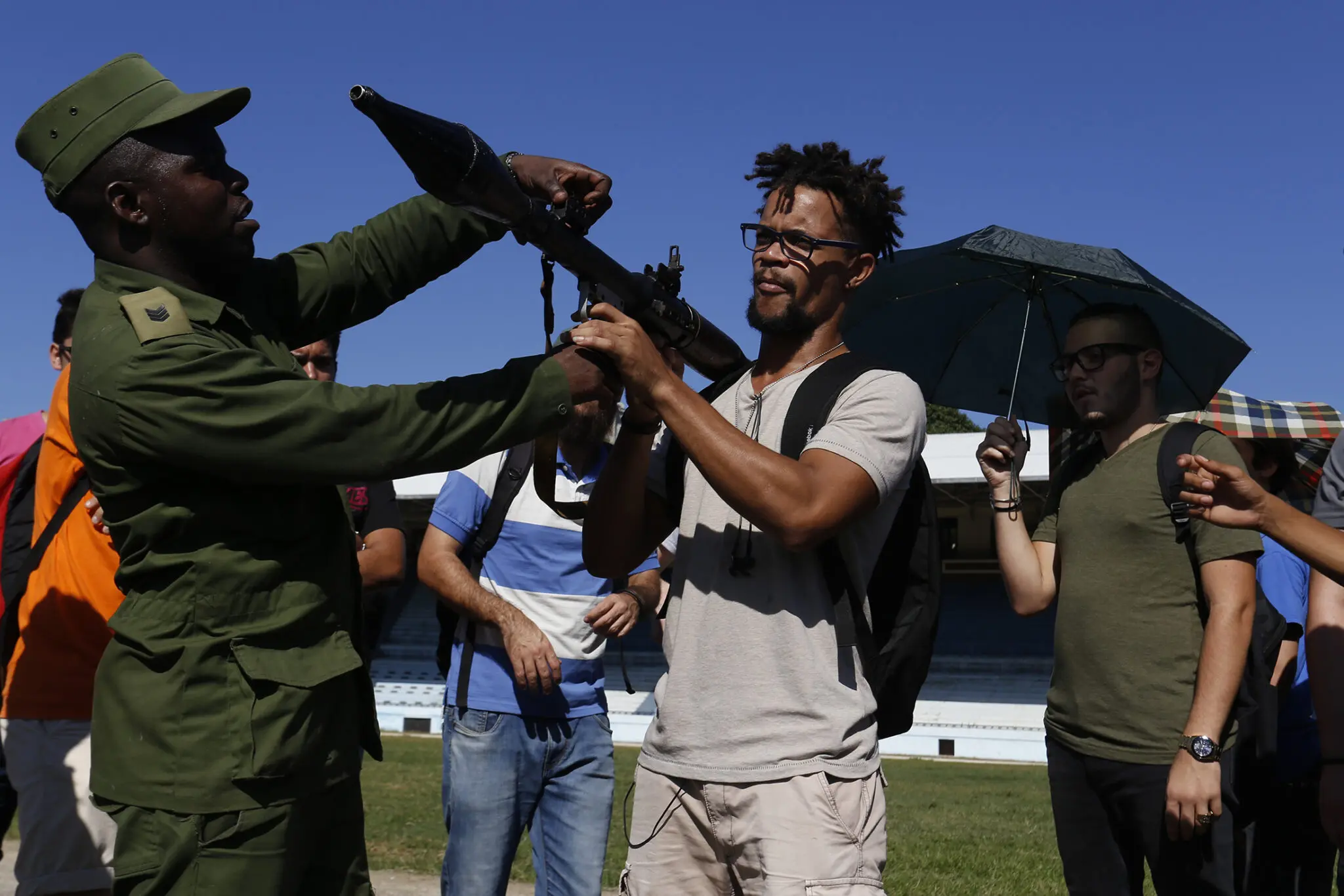
A university student receives instructions from a Cuban Army instructor on how a rocket launcher works during a university defense exercise in Havana. The military exercises called during the first week of November are intended to strengthen the organization and coordination of Cuba’s defensive capabilities. Photo: Jorge Luis Baños / IPS
By Dariel Pradas (IPS)
HAVANA TIMES – When Miriam Fuentes heard that the Cuban government had called military exercises the day after the midterm elections in the United States, her long-dormant fear of a military invasion by the neighboring superpower resurfaced.
“These military exercises wouldn’t surprise me if the Republicans had won the elections, but the Democrats swept them,” the 58-year-old Havana doctor told IPS, referring to the electoral debacle suffered by the ruling Republican Party in the November 3 elections.
On Wednesday, November 4, as media outlets around the world reported that the Democratic Party’s “blue wave” had swept even historic Republican strongholds and secured decisive majorities in the Senate, the House of Representatives, and state governorships, Cuba launched its “Moncada 2026” Strategic Exercise.
The nationwide operation lasted one day and was intended, according to the National Defense Council, to strengthen the preparedness and coordination of leadership and command bodies, troops, the territorial defense system, and the economy in the face of possible scenarios of aggression.
“We will defend every house, every neighborhood, every area until we defeat any Yankee who tries to take over Cuba,” declared Army Corps General Roberto Legra, first deputy minister and chief of the General Staff, in a video released on the social media accounts of the Ministry of the Revolutionary Armed Forces.
Cuban President Miguel Diaz-Canel, who participated in several meetings of provincial defense councils, also emphasized on his social media the importance of strengthening the country’s defensive capabilities “to confront any aggression against our homeland.”
Print media and local television reported how different Cuban provinces were preparing responses to possible scenarios of unconventional warfare and measures to neutralize aerial attacks by drones and manned aircraft, as well as the infiltration of commando units.
On Friday, November 6, the military exercises were followed by National Defense Day, during which many civilians were mobilized for military training with weapons, in accordance with Cuba’s Soviet-era defensive military doctrine known as the “War of All the People.”
These exercises have been repeated throughout 2026 as tensions between Havana and Washington have intensified.
Díaz-Canel had already indicated on March 20 that Defense Days were being held in 40,000 areas throughout the country.
“I’m really not too worried about a war breaking out. Although I begin my military service in December, and who knows what could happen,” said Dairon Rodriguez, an 18-year-old Havana student who graduated from a polytechnic institute.
Rodriguez will be drafted to complete two years of active military service, a requirement for men between the ages of 17 and 28, although shorter periods apply to those entering higher education, and exemptions exist for people deemed unfit for medical or other reasons.
“My mother, though, is worried all the time. She can’t stop thinking about it,” he added in his conversation with IPS.
*An army instructor shows a group of young people the features of an artillery piece during a university defense exercise in Havana. On Friday, November 6, a National Defense Day was held, during which civilians trained with weapons to respond to a potential military attack. Photo: Jorge Luis Baños / IPS*
Rising Tensions
The days leading up to the November 3 midterm elections in the United States were becoming increasingly tense, with the return of bellicose rhetoric not seen since early 2026.
Following the military operation that culminated in the abduction and detention of former Venezuelan President Nicolás Maduro on January 3, US President Donald Trump insisted that Cuba would be next on the list of military interventions.
Two executive orders signed by Trump on January 29 and May 1, aimed respectively at blocking fuel shipments and threatening foreign investors, ultimately became the real attacks on the island, plunging it into unprecedented levels of a multidimensional crisis.
In fact, since June, Washington has approved sanctions almost weekly against officials and state-owned companies in this Caribbean island nation, located just 90 nautical miles (145 kilometers) from the United States.
In October, the sanctions were expanded further, with new restrictions on financial operations involving Cuba’s private sector, which the Trump administration had claimed it wanted to strengthen.
Bellicose rhetoric, however, had been largely absent during those months, at least until October 23, when Trump stated at an election rally in Florida that US warships would “pass by” Cuba after the war in Iran.
He added that his secretary of state, Marco Rubio, who is of Cuban descent and a fierce critic of the island’s government, would be responsible for resolving the country’s situation.
“What we’re going to do with Cuba is we’re going to bring those beautiful ships back from Iran, we’ll pass by Cuba, we’ll have one of them stop about 50 yards (45 meters) off the coast. They’ll raise their hands, and then we’re going to send Marco Rubio in to close the deal,” the president commented.
Hours later, Cuban Foreign Minister Bruno Rodríguez rejected “any threat involving US ambitions toward Cuba” in a social media post.
“Our coasts have beautiful beaches, but also sharp, jagged coastal rock formations, inhospitable to those who arrive with hostile intentions and ambitions of domination,” he added.
That same day, Rubio urged Cubans seeking to bring about a change of government to engage in “discreet cooperation with the CIA.”
Shortly afterward, the US Central Intelligence Agency (CIA) published instructions in Spanish for those wishing to contact it “securely,” along with recommendations for online communications involving the use of VPNs, secure networks, private browsers, and email accounts not linked to personal identities.
Rubio’s statements were mocked by Cuban officials and dismissed by the Cuban foreign minister in an interview published by *The New York Times* on October 29.
“Frankly, they don’t seem serious at all. They seem a little childish,” he said.
On October 31, Trump said that the Cuban government “is not going to last much longer” and that results would be seen “within these two and a half years, even before that.”
However, the US president suffered an unprecedented defeat in the midterm elections, meaning that beginning January 3, 2027, he will face a highly adversarial Congress that will reduce his ability to operate without constraints.
Some Cubans, including Dr. Fuentes, thought US policy toward Cuba would change in some way.
But it did not.
*Members of the Ministry of the Interior wave Cuban flags during a parade marking International Workers’ Day in Havana. Rising tensions between Cuba and the United States during 2026 have led to an increase in military exercises on the island. Photo: Jorge Luis Baños / IPS*
After the US Elections
On November 5, the United States again imposed sanctions on Cuban oil, technology, and maritime companies, as well as two Chinese firms — China National Electronics Import & Export Corporation and Beijing H&C Technologies — accused of supplying defense and security equipment to the Cuban government.
According to Rubio, the new measures seek to “put an end to the harmful activities of the Cuban regime.”
On Monday, November 9, Trump once again described the island as a “failed nation,” while Rubio released a video arguing that Cuba “has no future” under its current political and economic model and that it poses “a threat to US national security and interests.”
These were clear indications that the offensive against Cuba would remain unchanged unless Democrats impose some restrictions when they take control of Congress in January.
However, several international analysts warn that his party’s defeat in the November 3 elections could prompt Trump to shift his focus toward foreign policy, where he enjoys broader presidential powers.
Nor does support among the Cuban-American community for the policy against the island appear to have changed in Florida, a state that remains under Republican control and is home to the largest Cuban-origin electoral base, which supposedly inspires many of the White House’s decisions regarding Cuba.
The 2026 FIU Cuba Poll, released on October 27 by Florida International University, indicates that 77% of respondents agree with prioritizing maximum-pressure policies against the Cuban government, while 65% support blocking oil imports to the island.
The survey, which has tracked the political attitudes of Cuban-origin adults in Florida’s Miami-Dade County since 1991, interviewed 1,004 people by telephone between September 4 and 29 for this edition.
Among respondents in the latest survey, 73% support US military action to overthrow the Cuban government.
Of those respondents, 43% prefer a clandestine CIA operation or other covert activity; 28% favor bombing selected military targets; 14% support a ground invasion; and less than 1% approve of bombing urban areas.
Tensions in Cuba-US Relations Enter an Uncertain Phase
Nevertheless, the survey reveals that many of those who support maximum pressure and military action against Cuba are also among those who send the most remittances to relatives on the island and would like measures affecting the population to be eased.
“Cuban Americans want two things at once: a tougher stance toward Havana and a more bearable life for the Cuban people… The same respondents who support maximum pressure also support medicines, food, and assistance to Cuba’s private sector,” said Guillermo J. Grenier, one of the survey’s principal researchers.
First published in Spanish by IPS and translated and posted in English by Havana Times.
Read more from Cuba here on Havana Times.