Synopsis: Geopolitical expert Gnel Rattha outlines strategies for small states to protect their sovereignty and expand economic flexibility without taking sides in major international disputes.
As geopolitical competition intensifies among major powers, Cambodia must strengthen its economic resilience, governance, diplomacy and human resources while avoiding overreliance on any single power, according to geopolitical expert Gnel Rattha.
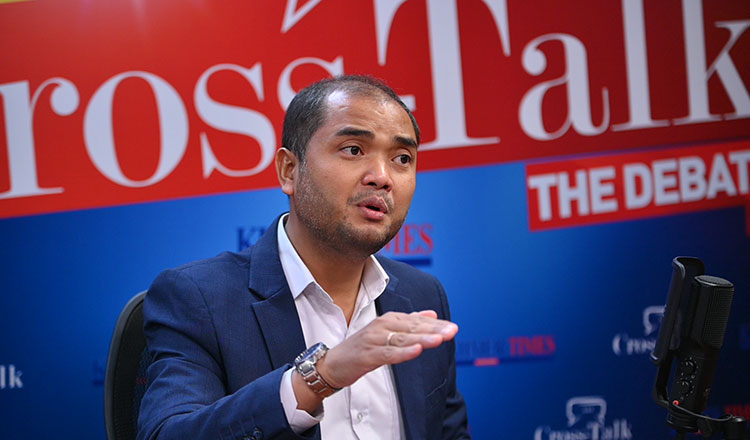
Speaking on the Khmer Times Cross-Talk programme, Rattha said countries with limited geopolitical influence face particular challenges when major powers compete for strategic, economic and technological influence. He highlighted international law, ASEAN cooperation, diversified partnerships, economic resilience and human-resource development as important tools for protecting national interests.
Small state challenge
Rattha said the term “small state” does not automatically mean a poor or underdeveloped country, noting that definitions vary across international organisations based on population size or geopolitical weight.
Some definitions classify countries with populations below 15 million as small states, which would include Cambodia. However, Rattha said the concept refers more broadly to countries with limited geopolitical influence and less capacity to act independently in international affairs.
For Cambodia, he said the issue rests on relative economic, military and diplomatic capabilities rather than population or geographic size.
Major-power competition extends beyond traditional military strength, Rattha added, with advanced technology, economic capacity, natural resources, human capital and control over strategic assets serving as critical components of national power.
He said this competition is expanding into new arenas, including outer space, as major powers seek to develop technologies and economic systems that strengthen their strategic positions.
For smaller states, Rattha said the challenge is not to compete militarily with larger countries, but to develop sufficient economic, diplomatic and institutional strength to protect national interests.
Rattha warned that smaller states become vulnerable when relying too heavily on a single major power.
Pointing to Israel as an example of the risks associated with close dependence on a major power, he said a smaller country that becomes closely identified with one powerful ally faces difficulties maintaining relationships with states holding different interests or positions.
He said this dynamic is particularly relevant amid competition between the United States and China, which he described as one of the most significant strategic rivalries shaping the international system.
Rattha said smaller states must carefully assess the interests of major powers and avoid allowing geopolitical competition to determine their own foreign-policy choices.
Rather than choosing one side exclusively, he said Cambodia should maintain a diversified network of partnerships and cooperate with different countries according to its national interests.
International law as a tool
Rattha said international law and multilateral institutions are particularly important for smaller countries because they provide mechanisms to present evidence, raise disputes and seek diplomatic solutions.
While acknowledging that international organisations have limitations and that major powers have at times disregarded international law or decisions by international institutions, Rattha said organisations such as the United Nations and the International Court of Justice remain valuable platforms for engagement.
For countries with limited bilateral influence, he said multilateral diplomacy creates opportunities to meet and negotiate with governments that might otherwise be difficult to engage directly.
Rattha said international organisations allow states to make their positions heard and establish diplomatic networks, with the United Nations enabling countries to discuss peace, security and cooperation within a common international framework.
He emphasised the importance of ASEAN as a regional mechanism that facilitates dialogue among member states through consensus and the principle of non-interference.
For Cambodia, he said regional and international mechanisms are important in addressing disputes before they escalate.
Using the analogy of firefighters responding to a blaze, Rattha said conflicts become increasingly difficult to control when no effective mechanism for mediation exists, pointing to the Russia-Ukraine conflict as an example of an ongoing war.
In the case of Cambodia’s disputes with Thailand, he said Cambodia should continue to pursue international mechanisms and negotiation while relying on established legal principles.
Rattha added that Cambodia should not approach such disputes solely through military considerations. Instead, he said security, economic strength and diplomacy must be developed together.
Strengthening from within
He said Cambodia’s ability to navigate geopolitical competition ultimately depends on its domestic strength.
While the country faces challenges in governance and economic development, Rattha said Cambodia can strengthen its position by improving transparency, respecting international law and maintaining constructive relationships with a wide range of international partners.
He also emphasised national unity and responsible conduct within the ASEAN framework.
Human resources are particularly important, Rattha said. He added that Cambodia needs to invest in skills training, create quality employment opportunities and expand research and professional development so that young people, particularly highly educated workers, can contribute to national development.
He said a lack of opportunities for skilled young people could weaken the country by preventing its human capital from being fully utilised.
Rattha added that people in positions of influence should use their skills constructively and avoid actions that contribute to social instability.
Learning from others
He said Cambodia can learn from countries that have successfully developed despite their small size, though he cautioned that models should be adapted rather than copied.
Singapore provides examples in governance, education, international relations and logistics, with its geographical position as an international port shaping its economic development and global connectivity, Rattha said.
He said Switzerland offers lessons in financial services while demonstrating how a country without major logistics advantages can develop specialised sectors, including tourism.
The Czech Republic and Slovakia provide examples of industrial development and integration into larger manufacturing economies through strategies such as “Germany+1” and “China+1”, he added.
Rattha said the Bahamas and Cyprus demonstrate how small states can build niche service sectors, including wealth management and maritime activities.
However, he said these models must be adapted rather than replicated. Cambodia has its own history, culture, language and geographical characteristics, which must be taken into account when developing national strategies. Rattha said strengthening Cambodia’s civilisation, language, writing system and literature remains important while the country selectively adopts useful elements from international models.
Rattha highlighted economic resilience as a central component of national strength.
He said average economic growth of 4.5-5.5% represents positive progress for Cambodia, but warned that relying on speculative investment, particularly in land and property, carries risks.
He noted that investment bubbles produce rapid increases in prices and activity before experiencing sharp corrections, potentially creating wider economic problems.
Instead, Rattha said Cambodia should focus on sustainable economic growth based on productive sectors and sound economic mechanisms.
Given the country’s tropical climate and agricultural potential, he said agro-processing represents an important area for future development, adding that Cambodia can study countries that have successfully transformed agricultural production into higher-value processed goods.
He said economic diversification helps reduce vulnerability and provides more opportunities for employment and investment.
Balanced approach
Rattha said Cambodia’s foreign policy should be based on pragmatism rather than exclusive alignment with any particular bloc.
He said Singapore’s approach demonstrates the importance of assessing geopolitical developments and determining how engagement with major powers can benefit the country and the wider region.
For Cambodia, Rattha said maintaining relationships with multiple partners provides greater flexibility as global power dynamics change.
He said the country should seek to balance security, economic development and diplomacy while strengthening domestic institutions and human resources.
The broader challenge for small states, Rattha said, is to ensure that competition among major powers does not undermine their own national interests.
For Cambodia, he said that means strengthening the foundations of national resilience: transparent governance, sustainable economic development, respect for international law, diversified diplomatic relations, regional cooperation and investment in people.
“Human resources are particularly vital,” Rattha said, stressing the importance of skills training, job creation and research.
Developing these areas is essential to transforming Cambodia’s economy, strengthening its national capacity and enabling it to navigate an increasingly competitive international environment, he added.
Related Posts
-
September 7, 2026
-
July 26, 2026
-
October 16, 2025
-
August 17, 2026