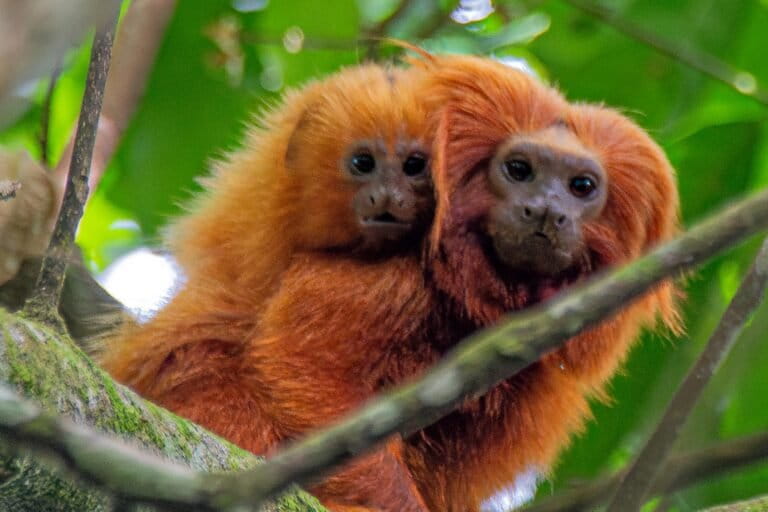
After a two-hour drive from the airport in Rio de Janeiro, you reach a special park dedicated to a special animal in Brazil’s Atlantic Forest. There, you can take a guided tour through the green and perhaps catch a glimpse of vibrant orange: The pelage or furry coat of one of this region’s most famous resident, the golden lion tamarin. Between 2017 and 2019, a yellow fever epidemic killed roughly 30% of the population, leaving only 2,500 alive. This small, endangered monkey, which nearly went extinct in the 1970s, is relegated to fragmented forests in the state of Rio de Janeiro, about 2% of their original territory, according to conservation nonprofit Save the Golden Lion Tamarin. But the tamarins (Leontopithecus rosalia) have made a significant recovery, rebounding to roughly 4,800 individuals according to a 2023 census. To better prepare for a possible outbreak in the future, a group of researchers wanted to find out how different environmental factors affected yellow fever transmission between tamarins. Their research identified high-risk areas, which could guide conservationists aiming to vaccinate the population against future epidemics. The golden lion tamarin, an endangered species, is found exclusively in Brazil’s Atlantic Forest, a seriously threatened biodiversity hotspot: only 7%-12% remains. Image by Themium via Wikimedia Commons (CC0 1.0). Mapping an outbreak Researchers compared mortality data from 2014-2016, before yellow fever struck, with more than 1,000 deaths that occurred during the outbreak in 2017-2019, information that was gathered by the nonprofit Golden Lion Tamarin Association (known in Brazil…This article was originally published on Mongabay