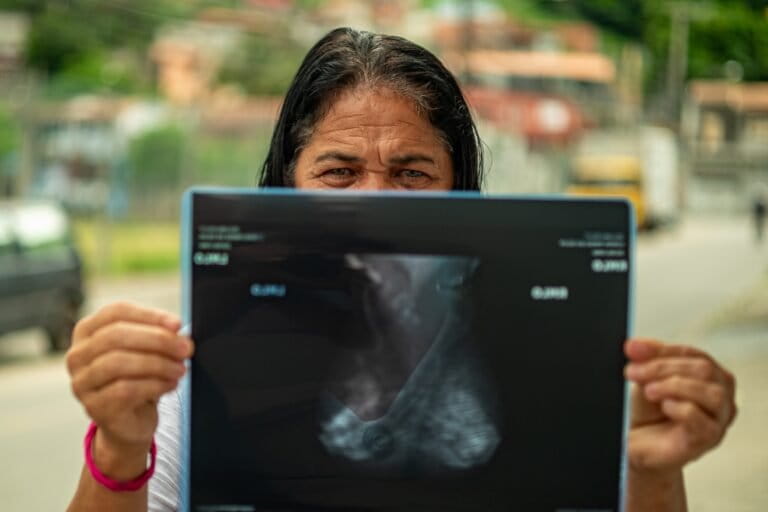
SÃO SEBASTIÃO, Brazil — In front of the house where she has lived for decades, Cosma da Silva points to nearby homes in her Itatinga neighborhood and lists a string of cancer cases. “There’s a woman with cancer over there. Another one lives in that building. And yet another one there [points at the place]. People in this area only die of cancer.” She sees illness as an integral part of the neighborhood’s landscape and includes her own family in the tally. Her husband Paulo José da Silva died at age 51 from a brain tumor. Cosma herself recently underwent surgery to remove a nodule. As she deals with the consequences of the treatment — a wound that burns and itches on the side of her chest — she continues to observe several sick relatives, neighbors and acquaintances. The connection between these cases and the environmental contamination that has marked Itatinga’s history has never been proven or investigated the way residents expected it to be. From the 1970s to the 1980s, part of the neighborhood was used for the disposal of oily sludge associated with oil exploration. Years later, homes were built on the land. Environmental investigations by public agencies found contaminants in the soil and groundwater. For almost 20 years, documents from the São Paulo State Environmental Company (CETESB), the State Prosecution Service (MPE), the Federal Prosecution Service (MPF) and Petrobras itself — the Brazilian state-controlled oil company, which the investigations accused of being responsible for the disposal — pointed to toxic substances…This article was originally published on Mongabay