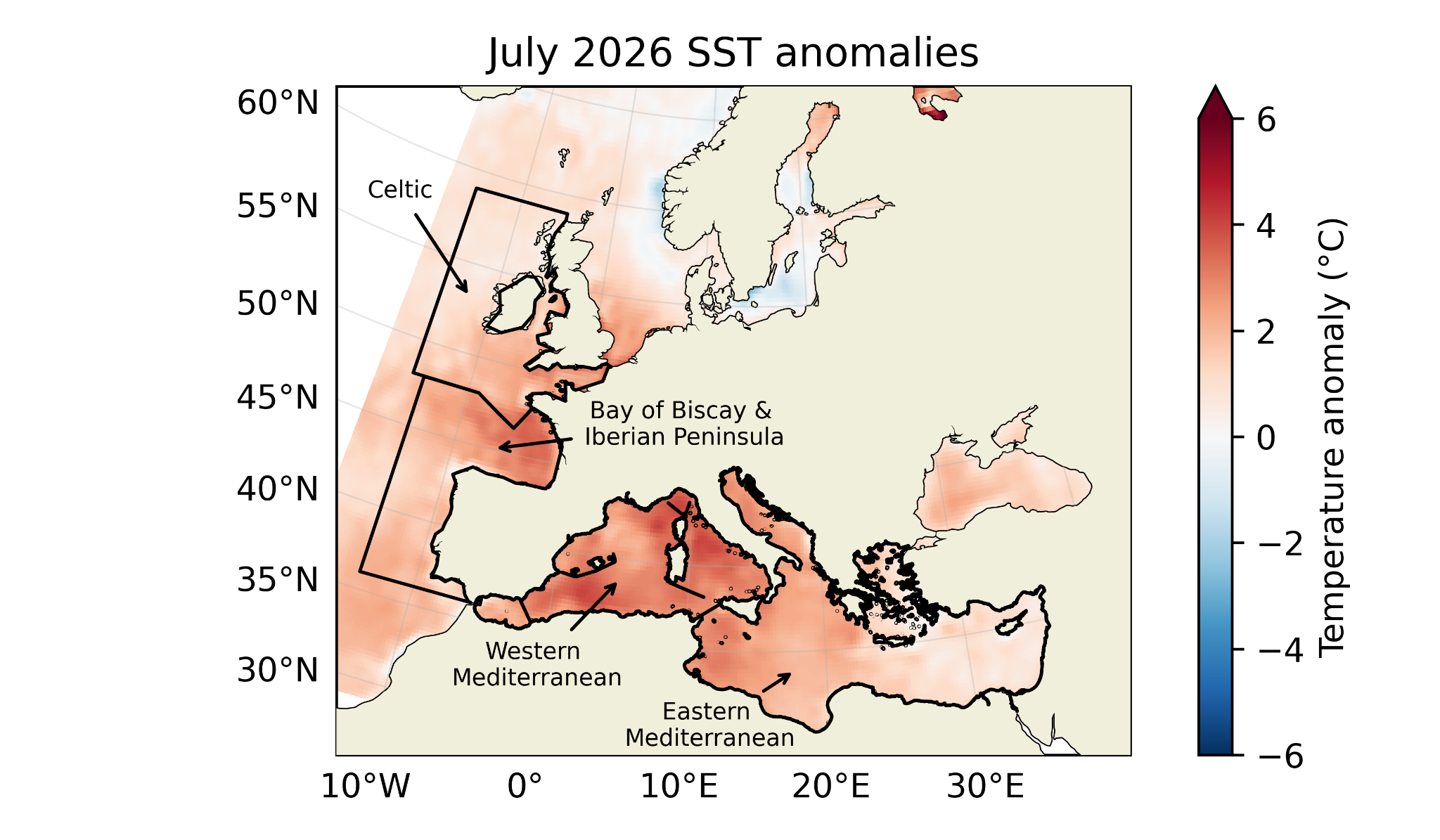
European coastal waters recorded unprecedented sea surface temperatures in July 2026. A new study has found that human-induced climate change primarily drove the temperature surge, pushing marine ecosystems past their limits.
The rapid analysis was conducted by World Weather Attribution (WWA), a global network of researchers who analyze the influence of climate change in extreme weather events.
WWA scientists focused their analysis on the warmest 14-day periods within July. They chose this specific time frame because sea surface temperatures normally peak in late summer (August-September). The authors analyzed July to isolate how early-season ocean heat is changing as the planet warms.
Across all four regions studied — the Celtic Sea, the Bay of Biscay and Iberian Peninsula (BIP), and the western and eastern Mediterranean — these sea surface temperatures averaged 2.4° Celsius (4.3° Fahrenheit) warmer than historical July baselines. In individual basins, the Celtic Sea was 1.9°C (3.4°F) above normal, while the Eastern Mediterranean was 2°C (3.6°F) hotter than typical July conditions.
The WWA report notes these extreme July temperatures would have been “virtually impossible” in a preindustrial climate, which was 1.4°C (2.5°F) cooler, but are “relatively common” in today’s climate.
The study’s rapid attribution analysis reveals that burning fossil fuels directly drove this extreme warmth. In both Mediterranean regions, climate change added about 2°C of direct heat. In the Eastern Mediterranean, climate change accounted for the entirety of the 2°C anomaly. In the Celtic Sea and BIP, climate change directly added 1.1-1.4°C (2-2.5°F).
“We find that without human-caused global warming, we would expect only 30% of the area for the Celtic region would have experienced a marine heat wave, in comparison to 80% in today’s climate,” Claire Bergin, lead author from Maynooth University, Ireland, said at a press briefing. “In the Western Mediterranean, the change is from 40-80%, and in the Eastern Mediterranean, the change has gone from a startling 9-70% in today’s climate.”
According to the study, the ecological consequences of increasing frequency and intensity of marine heat waves are devastating: they trigger mass mortalities of habitat-forming species like corals and macroalgae, causing cascading failures up the food web.
“Generally speaking, the primary impact is simply when organisms … exceed the physiological thresholds they can tolerate,” co-author John Bruno, a marine ecologist at the University of North Carolina at Chapel Hill, U.S., said at the briefing. “The temperature increases … are way beyond the thresholds that are required for mass mortality.”
Most marine animals are cold-blooded, meaning their body temperature generally tracks that of the surrounding seawater, so heat accelerates their metabolism, leading to starvation and collapse of biodiversity, Bruno said.
Bergin said these observed temperatures are expected to be another 1.3-1.9°C (2.3-3.4°F) hotter by the end of this century “without a rapid transition away from fossil fuels.”
Banner image: Anomalies in July 2026 sea surface temperatures around Europe with respect to the 1990-2020 climatological average for July. Data: OISST NOAA.