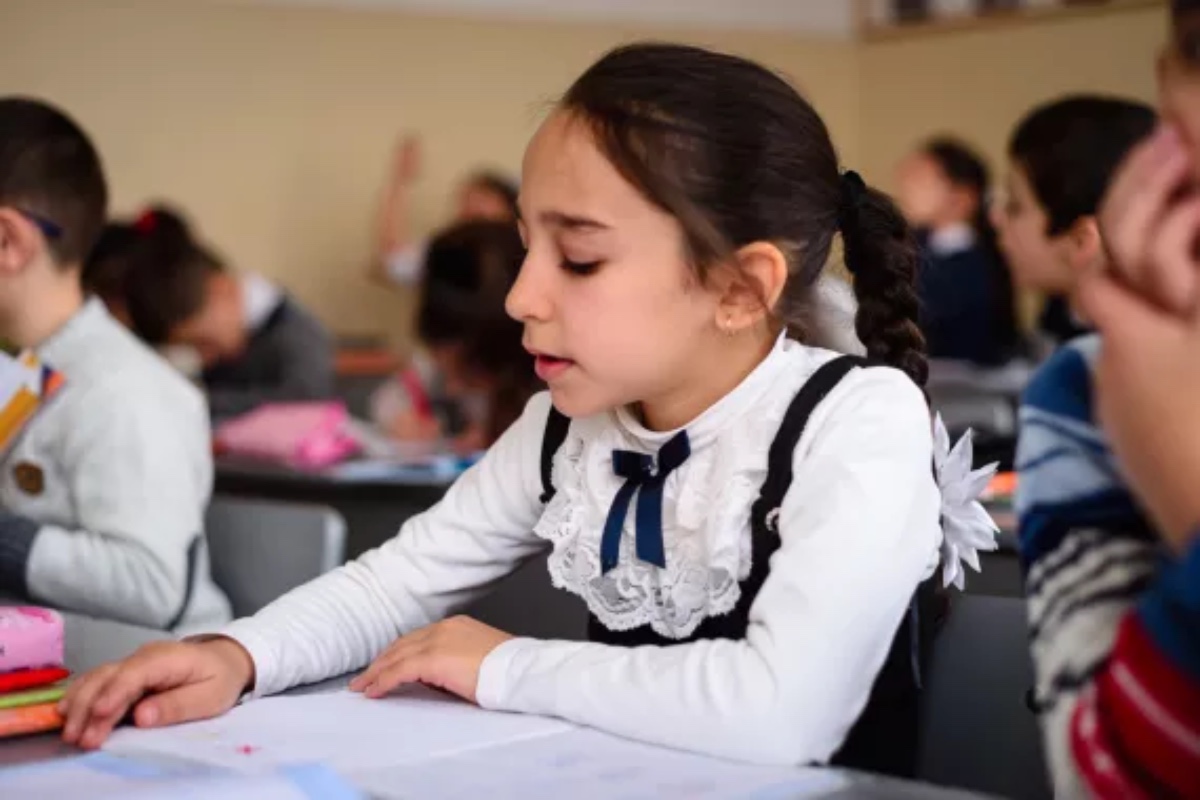
In recent years, Armenia has introduced a series of reforms in education and science, including new academic standards, improved infrastructure for schools and kindergartens, and increased government budget allocations. Yet experts argue that the system has not undergone meaningful qualitative or structural transformation.
According to specialists analyzing developments in the sector, political authorities continue to avoid deep and comprehensive reforms, particularly those likely to provoke public dissatisfaction. Instead, they often prioritize visible and politically safer changes that are easier to present to the public.
As a result, broader conceptual debate about the future of education remains largely absent, while many systemic problems remain outside the country’s core political agenda.
Education expert David Amiryan argues that although Armenia’s strategic programs formally identify the key problems facing the education system, the proposed road maps largely avoid addressing the most fundamental issues. World Bank data show that a significant share of Armenian schoolchildren face functional illiteracy — meaning they can formally read texts but struggle to understand meaning, draw logical conclusions, or perform basic analytical and mathematical tasks.
Amiryan identifies three major problems that remain outside active political discussion. The first is educational poverty — unequal access to quality education for socially vulnerable groups, low-income families and residents of remote communities. In his view, no education system can be considered effective if parents’ social and financial status predetermines children’s educational opportunities and future quality of life.
The second issue is the absence of an independent and comprehensive system for evaluating education quality. Armenia lacks institutionalized mechanisms for continuous monitoring and internal quality control, relying instead on periodic international assessments that often fail to reflect local realities.
The third problem concerns the growing staffing crisis in schools. The voluntary teacher certification process has failed to substantially improve education quality, partly because participation remains low. In many cases, teachers who do not meet minimum qualification thresholds continue working because of the shortage of replacement personnel. Meanwhile, the number of applicants to pedagogical universities continues to decline, while shortages of physics, chemistry, biology and mathematics teachers in the regions are becoming increasingly severe.
Amiryan also highlights the problem of “invisible children” — students who are formally enrolled and physically present in classrooms but remain disconnected from the education process and fail to acquire practical knowledge or skills over the years.
According to Amiryan, Armenia’s understanding of inclusive education also remains limited. Inclusion, he argues, should not be reduced to the physical presence of children with disabilities in classrooms, but should ensure the meaningful participation of every child, regardless of social, economic or geographical background.
Experts say similar structural problems exist in science and high technology.
According to Tigran Shahverdyan, a member of the Gituzh Initiative and co-founder of the RoboMart startup, Armenia still lacks a unified scientific and technology policy connected to the country’s strategic needs and challenges. Although funding for science, researchers’ salaries, laboratories and grant programs has increased in recent years, these investments have not translated into a coherent long-term policy.
Shahverdyan argues that Armenia has failed to build a functioning research and development system capable of linking theoretical science with practical application. As a result, scientific research often remains disconnected from the country’s economic realities and development priorities.
In his view, science should not only generate academic publications but also contribute directly to solving practical state challenges, including environmental protection, water management, food security, health care risks, cybersecurity and seismic resilience.
He also argues that many priorities outlined in current government strategies are mechanically borrowed from international frameworks and fail to reflect Armenia’s actual needs. Without a clearly formulated state demand, experts say, it is impossible to build a sustainable scientific ecosystem.
The concerns raised by Amiryan and Shahverdyan are also reflected in a report by education expert Serob Khachatryan. According to the report, Armenia ranks 100th out of 134 countries in government funding for higher education. Between 80% and 95% of university revenue comes from tuition fees, while 83.8% of students at public universities study in tuition-based programs.
Science should not only generate academic publications but also contribute directly to solving practical state challenges
The report further reinforces concerns about educational inequality. Only 17.2% of Armenia’s poor population holds a higher education degree, making access to higher education increasingly dependent on social and financial background.
At the same time, despite official emphasis on STEM development, Armenia ranks 129th globally in graduates’ practical skills. Experts argue that this reflects the weak connection between education, science and the country’s economic needs.
The report also notes a decline in Armenia’s academic freedom index from 0.84 to 0.64 in recent years. Experts link this trend to the politicization of university governance structures and the increasing involvement of government officials in boards of trustees.
Both Amiryan and Shahverdyan say the roots of these problems lie in Armenia’s political culture and decision-making system. According to Amiryan, the education system has long been used for political purposes through administrative influence over school principals and teachers. Although opportunities for depoliticization emerged after 2018, many reforms remained incomplete.
He argues that authorities continue to avoid difficult reforms that could provoke public dissatisfaction, including school consolidation or large-scale personnel restructuring, while prioritizing more visible projects such as school construction and renovation.
Shahverdyan adds that in the modern world, science and technology are among the main drivers of international competitiveness and national security. If the state does not treat research and innovation as strategic priorities, discussions about sustainable development lose credibility.
According to experts, education and science can no longer remain secondary issues on Armenia’s political agenda. Independent professional groups have repeatedly offered to participate in strategic policymaking, but experts say political authorities continue to show limited systemic interest in such cooperation.
Experts warn that if education quality and access continue to depend on citizens’ social and financial status, while science remains disconnected from clear state priorities, Armenia’s structural problems will continue to deepen. In their view, these challenges cannot be solved solely through renovated school buildings, larger budgets or formally adopted reforms.
The core issue, experts argue, is the absence of reform and of a consistent long-term vision. Without deeper systemic change and stronger political commitment, education and science will remain vulnerable sectors rather than strategic foundations for Armenia’s future development, competitiveness and security.