Mom and Dad were children of the Great Depression. Hearing me parrot their stories, one could think I lived then. Fortunately, my grandparents weren’t as bad off as others during that era. At least they didn’t scavenge railroad tracks for coal for fuel, as others did. More about tracks…
As a kid in Lynn, Mom had always wanted to play piano. There was one accessible for community use. With much coaxing, she convinced Mezpapa (Grandpa) to pay 25 cents per hour for lessons. When the price doubled, he called it quits. So ended Mom’s short-lived musical career.
Key to happiness
Dad grew up in the Armenian enclave in densely populated, industrial East Cambridge. His dad eked a living for a while as a peddler — according to the census — of meat from the trunk of his old jalopy. Sanitary? Questionable? That enterprise ended when thieves stole the junk box’s four tires, leaving the hulk sitting on the ground.
Dad learned early and well about making best use of everything, a trait he honed while in the Navy. Being the cook on a small ship in World War II, he began calling himself The Tinkerer, making galley appliances work however possible, even if it meant jerry-rigging parts. As a factory machinist after the war, he’d surveil the concrete floor for stray nuts, bolts, washers, clips and other metal fastening paraphernalia. He sorted and bottled his found treasures and suspended the glass jars from the ceiling in our basement in leafier West Cambridge (see ‘Key to happiness’).
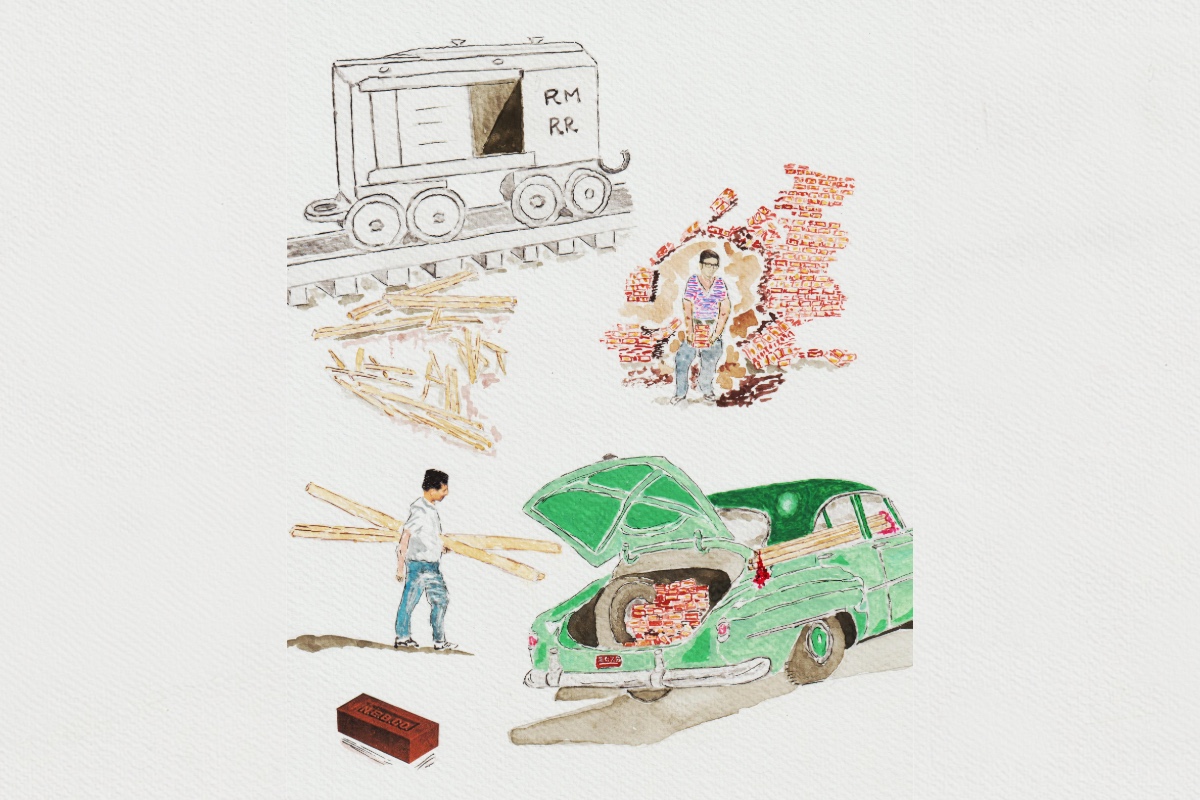
I return mentally and physically to the railroad tracks where Dad took me picking as a boy. Remotely situated between a lumberyard and my current doctor’s office, boxcars would be orphaned there after being emptied. Miscellaneous boards had been nailed onto the metal walls to protect cargo, but once the car was unloaded, those boards would get yanked off and left for dead on the ground. Dad and I would cherry-pick the best and gingerly position them through the open windows of Dad’s 1952 two-tone green Chevy. Then, we’d target a nearby defunct hospital annex with piles of demolished, locally made N.E.B.CO. bricks. We’d salvage the unbroken ones to stack neatly into the car’s cavernous trunk, the weight straining rear shocks.
At home, I’d alchemize the bricks into usable condition for projects around the house. I crowbarred nails out of boards and gently hammer-tapped bricks to loosen stuck mortar. With the planks, we lengthened the garage and built a trash shed and fence along one property line. We laid the bricks as a walkway between our freestanding garage and hedges separating us from neighbors along another property line.
Buffing machine
The city dump, what we’d call a landfill today, was a short ride from our house. Dad would take me — his Picker Junior — there to go “a-sort-in.” Our activity was legal then, or at least overlooked by police. Once we found an old Remington typewriter, used it for a while and ultimately trashed it.
Another time, we found a washing machine, the motor of which we liberated. Tinkerer Dad made his own buffing/grinding machine (see ‘Buffing machine’) by using the salvaged motor and studs. Naturally, our accumulated material got so that we had to build shelving in the basement and garage to store it, using found planks, of course, in a vicious cycle. Eventually, Mom insisted we get rid of some of the junk, her word. (I’ve included Dad’s Buffer/Grinder in exhibits of his metal art, but not before fumigating the device because insects had bored into the legs.)
I doubt people today do what Dad and I did routinely, at least not without a permit or business interest. Open, public dumps essentially don’t exist anymore, nor do I think freight trains intentionally leave behind trash by tracks. Entering such sites today would be considered trespassing. Nonetheless, it’s pleasurable reminiscing about Mom and Dad. Besides, I need a subject to write and paint about.
The post Abe and son, creative reusers appeared first on The Armenian Weekly.