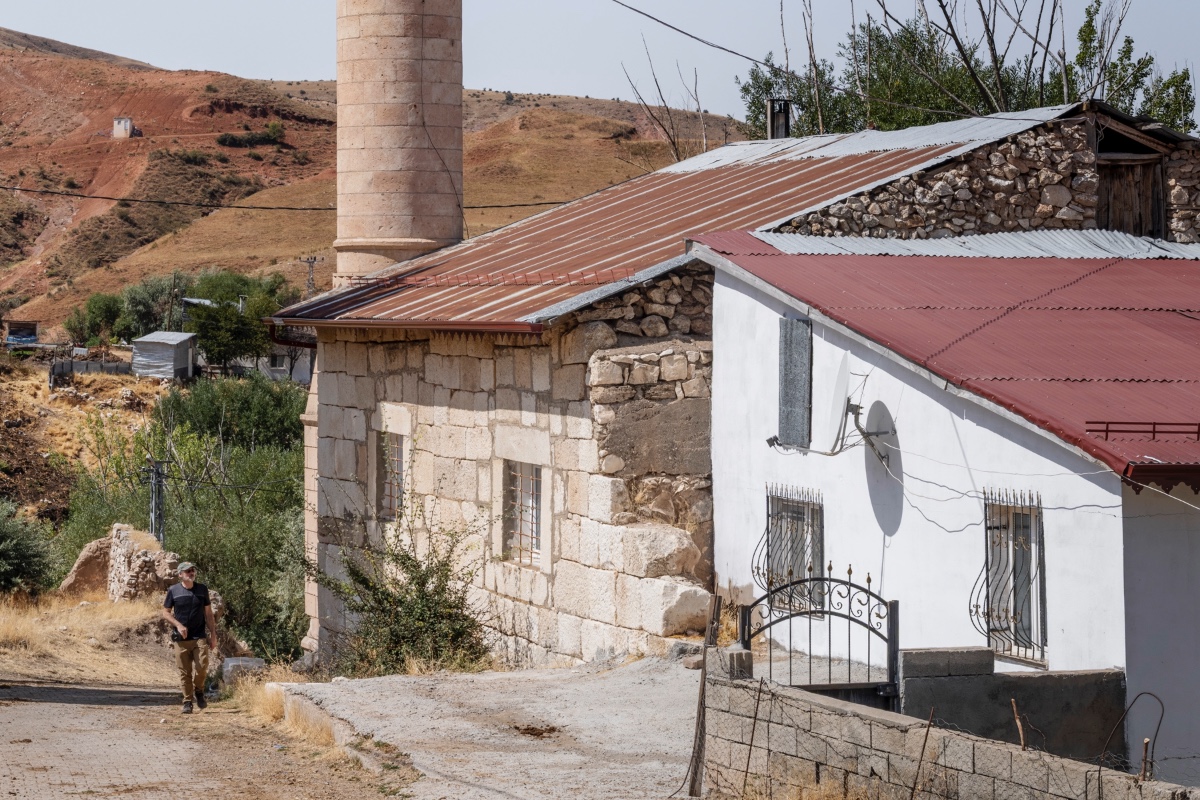
The building carried the heavy feel of alternate reality. The roof and windows were wrong. The minaret, too. We had felt this before. Many villages had the quality and sense of standing inside a palimpsest, scraped and written over, where even the landscape, after 100 years, had been altered. And yet, as before, smaller, muted traces refused erasure. First to speak was the traditional nave-shaped water fountain, long dried and filled with rubble. Then the stones spoke — large, pale and honed with the meticulous edge of a craftsman’s tools. They belonged to another era. We were in Ghavraz. Until the start of the 20th century, it was an Armenian village and the home of Ted’s great-grandfather, Zadig Matigian.
The khachkar hidden behind a minaret and The inscription
A khachkar hid behind a minaret. It was carved into the wall of what was once the church of Surb Prkich, or Holy Savior. Unlike countless other khachkars erased from countless other churches, someone allowed this one to remain.
The year, possibly of restoration of the church
Maybe it was a mercy for descendants of history and neighbors long gone. Maybe they were just too tired to scrape off the remaining Armenian fragments and thought no one would notice. We cannot know. We surveyed the rest of the building. Among faint, unidentifiable carvings, the year 1871 could be read above a window. Further along a wall, a hidden Armenian inscription eluded our collective efforts to decipher it. But its worn letters shouted louder than the call to prayer, or azan.
The original shone through.
As usual, our presence was noticed, and a man named Mahmut approached. He told us there had been many Armenian villages in the area and that the people “left.” He showed us the old cemetery and explained that the graves were robbed “by outsiders.” Similar stories of mysterious self-deportation and pillage by others, now familiar to us, did not make this one any easier to ingest.
Advertisement
Ted separated from the group and went up the hill to photograph the village from above. Thoughts and emotions run strong in places like this.
Mahmut showed us the old millstones and told us that a landslide had changed the course of the river. We remembered stories of deportations that were delayed until the end of the harvest season. The scythe neither rested nor resisted. It cut the last stalk of wheat, changed hands and cut down humanity. No wheat, no flour, no people. The millstones stand idle on the riverless hilltop as a memorial.
Ted by a millstone. This one appears to have almost rolled into a dug-out grave
We spoke quietly about the people who lived here and reflected on Zadig’s path from Ghavraz to the ARF and to Operation Nemesis.
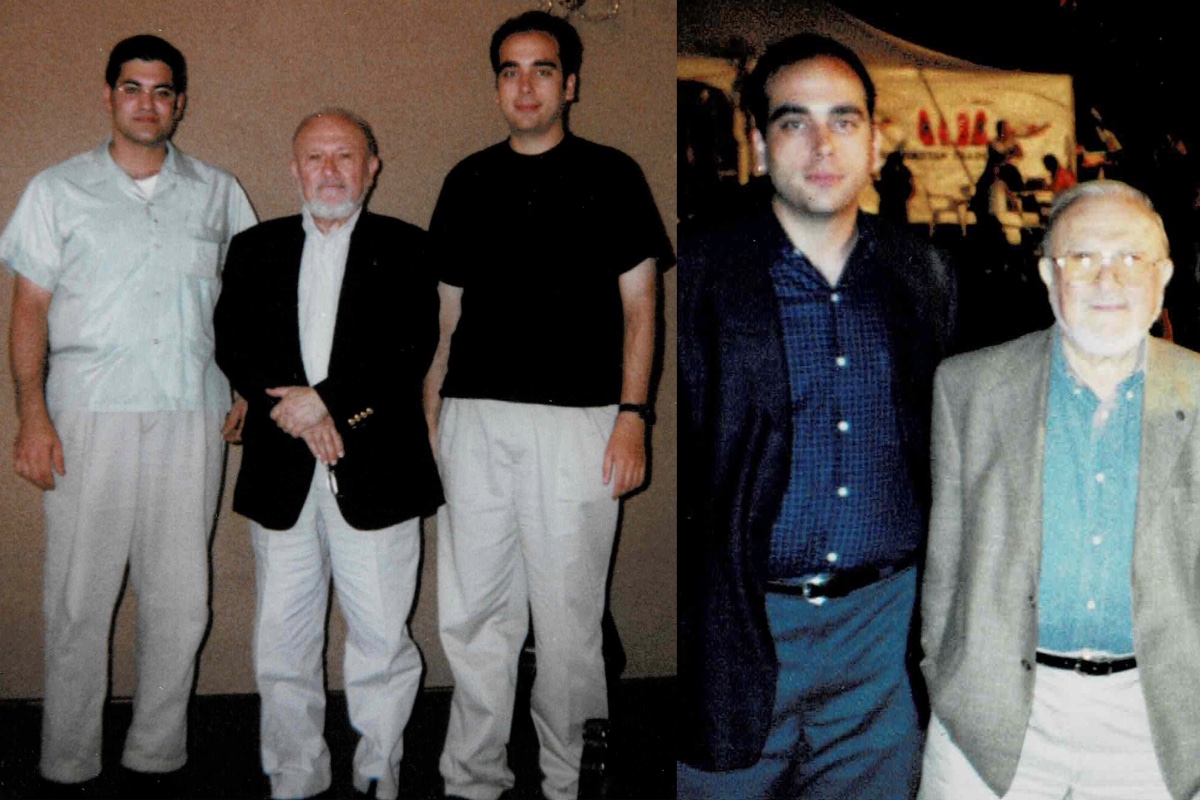
Zadig Matigian was born in Ghavraz in 1878 as Der-Matigian, the prefix marking the family of a priest. In those years and in those regions, priests rarely died of old age. Zadig left the village when he was young and studied in Constantinople and Paris. He joined the ARF at 18 and married Victoria Yazedjian in 1898. His mother, Aghavni, was already a widow.
ARF work took him to the Balkans, where he was arrested in Greece under Turkish pressure and released through party intervention. In November 1906, he sailed from Cherbourg with Victoria, their daughter, Eugenie, and his mother to New York.
By 1919, he was one of a small group of delegates at the Yerevan congress that authorized what became known as Operation Nemesis, that brought to justice the men responsible for the destruction of his people. He died in 1937. Active to the end and loved by the people who knew him, his funeral drew 2,000 mourners. It was a long way from his village church.
Ted and I entered the building. We had seen these churches-turned-mosques before, but this was different. We stood where Ted’s great-grandfather prayed as a boy and where earlier members of the Der-Matigian family administered sacraments. The lyrical sounds of baptisms, wedding vows and funeral services lingered from the walls.
Inside the church-mosque
Four sides of Ted’s family are genocide survivors. Until recently, he knew only the general locations of Constantinople, Smyrna, Ordu and Sebastia. Now, on our fourth journey through historic Armenia, these were actual stones — stones to touch and say, “I found you.”
A familiar detail
We photographed the remaining details of the church: the inscription, the hidden khachkar, the millstone, the nave of the fountain, the overturned gravestones, the landscape, the ancient bridge and the thick plaster of the mosque beneath which the original outline is visible.
What were once full lives are only imagined. We tell ourselves this was a mission. That we somehow keep the lost afloat. That our digital echoes are evidence of a previous life where our ancestors lived, loved, worked, studied, traveled, prayed and received a proper burial.
Of the original parchment.
Epilogue
At home in New York, we studied materials provided by George Aghjayan and verified names and dates. We started editing our photographs from the trip, and Ted sharpened the photograph of the inscription. I made another attempt to read it, and suddenly, a few things came together.
Landscape of Ghavraz. View from above. In the lower left is what remains of the cemetery
The 1838 Ottoman population register for Ghavraz, which Aghjayan had located, names at the head of one household the priest Matos, Der Matos, who is almost certainly an ancestor of Ted’s. The household carries the priestly Der prefix that Zadig’s family name preserves, and Matos becomes Matigian.
The sharpened image of inscription revealed the letters Տ. Մաթէոս, Der Matos. We sent the inscription to Jesse Arlen, who deciphered the rest. It read: Սա է տապան…, “This is the gravestone of…” Then came a scraped passage, illegible. And then, at the end, the name: Տ. Մաթէոս. Der Matos.
Ted at the grave of his great-grandfather, Zadig Matigian
What we had stood in front of in the hot September of Ghavraz, in 2025, was a grave marker for an ancestor of both Ted and Zadig.
On a quiet, drizzly Saturday morning, we found Zadig’s grave in Cedar Grove Cemetery in New York and brought him hello from his village and his ancestors.
From birthplace to resting place.
We are grateful to George Aghjayan, Armenian historian and demographer, for the research that made this journey possible, and to Jesse Arlen, director of the Krikor and Clara Zohrab Information Center in New York, for reading what the wall had kept.
This article was written by Nune Karamyan and edited by Ted Andreasian. All photographs were taken by Ted and Nune in September 2025.