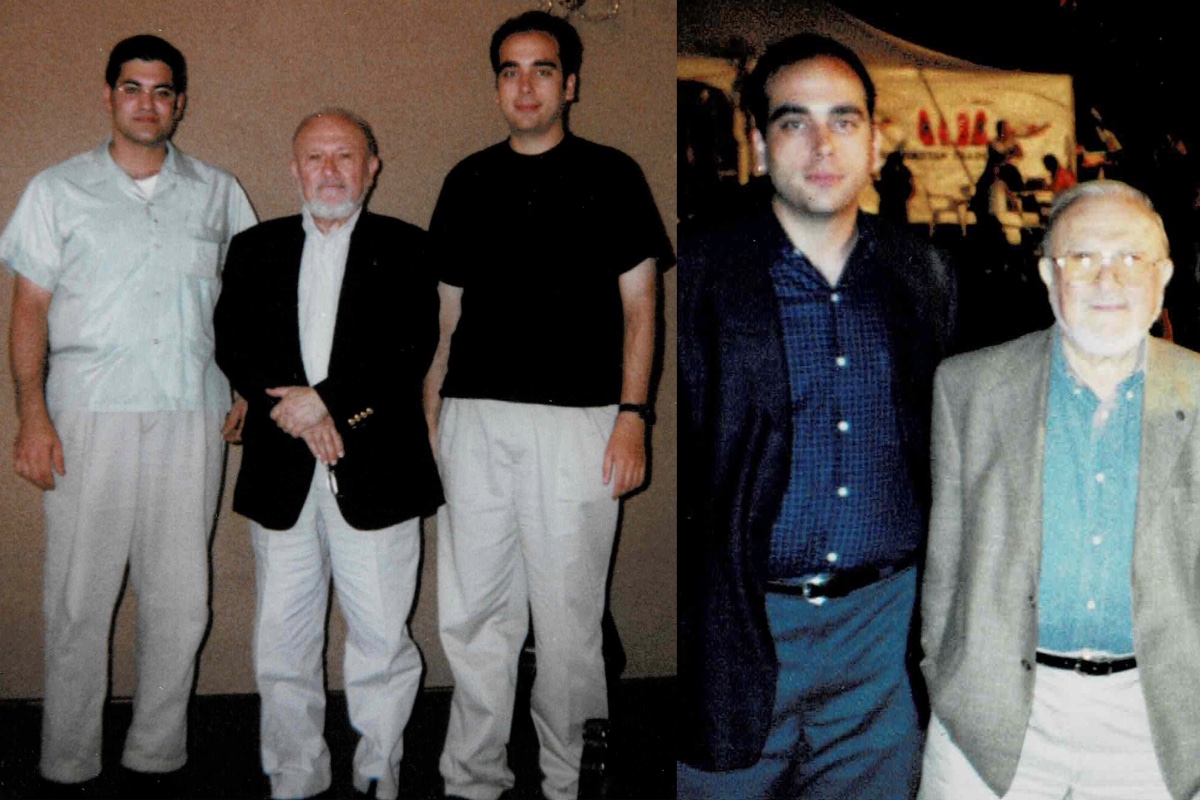
It was the late 1990s. We were at a May 28 commemorative event in Lowell, Massachusetts. We decided to take a stroll to help digest the chicken and pilaf dinner. I always had a tin of Schimmelpenninck or Dannemann mini cigars in my pocket whenever we went somewhere together, just in case. We were both decked out in suits for no particular reason other than to look sharp. It was a quiet neighborhood, the streets lined with two-family houses and kids playing in small yards. We smoked while walking down the middle of the street, as if we owned the place. A preteen boy holding a basketball was checking us out.
“Hey, are you guys the mafia?”
“No, kid, we’re not the mafia,” I replied curtly with a sly smile. Deep down, I wanted it to be true somehow.
“Yeah, you are. You’re the mafia. Hey, you see these guys? They’re the mafia!”
Our cover was blown. Unger Tatul started chuckling. “Can you believe this kid? What a character!” We would laugh about that episode for years.
Advertisement
From then on, he called me Consigliere.
“Consigliere, come stai? Che cosa fai, ragazzo?” was how he would greet me.
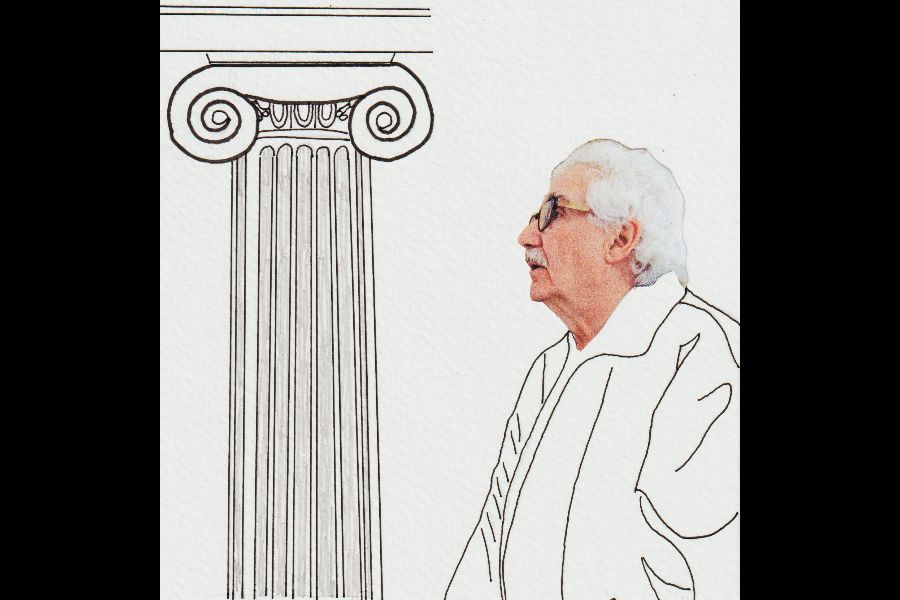
Tatul Sonentz, who added Papazian in adulthood and recently passed away at the age of 97, was the nucleus of the Hairenik building in Watertown, Massachusetts. He gave the place an air of sophistication and sustained a constantly churning creative power. He influenced so many people of all ages and specialties. Everyone adored him.
I joined the Armenian Weekly staff as an intern in the summer of 1994. I had just graduated from the University of Massachusetts Amherst with a bachelor’s degree in English, and I wanted to dive into a writing career as quickly as possible. Vahe, the editor of the Weekly, offered me 20 hours a week, and I grabbed the opportunity without hesitation.
He introduced me to Unger Tatul on the very first day. At the time, he was both executive director of the Armenian Relief Society and editor of Armenian Review. He also contributed regularly to the Weekly. Tatul took an immediate interest in me when he learned I was a budding writer. A short story of mine had recently been published in the annual literary magazine Spectrum at UMass. He was impressed by that and was eager to see what else I could produce.
In reality, I didn’t know what I was doing. I was a young and naive dreamer who lacked direction. I needed a mentor to set me straight, and I knew immediately after we met that I would learn tremendously from him.
Every time Unger Tatul strolled into the newsroom, my heart leapt. I always stopped whatever I was doing to observe him and listen. Usually, he would leaf through a recently published issue or one of the newspapers and magazines lying on the layout table. He’d start chatting with the Hairenik secretary, Shake; Grace, the assistant editor; and Nora, who was the layout designer for Hairenik. Garbis would take a break from proofreading the mock-ups to joke with him. Then he’d wander into Vahe’s office before checking in with the Hairenik’s manager, John, who held the entire place together and kept it ticking like a priceless Swiss watch. If I was lucky, he’d mosey on over to me to see what I was working on. He always encouraged me to keep writing.
Unger Tatul had a magnetism, a gentle charisma that I had never encountered before. He had a fine, sandpapery baritone voice and spoke with a Scottish accent because as a child growing up in Alexandria, Egypt, his family lived in a neighborhood where expatriate families resided, including one from Scotland. He projected deep wisdom with every step, every gesture, every comment. Everyone in the place made time for him, no matter how busy they were in the moment. Sometimes he’d meet with John in his office with the door closed to discuss internal party politics. Otherwise, he was hanging with everyone. We were enthusiastic to listen carefully to what he would say — a soft-spoken, lighthearted comment about gossip going around or a joke about something we were trying to get done. He flirted, laughed and charmed. And whenever he left the newsroom, as he always had something important to do, I’d feel slightly disappointed. I couldn’t get enough of him.
Unger Tatul was Hairenik’s intellectual spirit and its ambassador to the world. He was the wise sage that visitors to the building — contributors, subscribers, artists, photographers and academics — always sought out. There was no point in entering if he was unavailable.
Gradually, we became much closer while I spent more and more time in the Weekly newsroom with additional responsibilities. Eventually, we began working side by side on various reports and publications for the ARS, including its official periodical, Hai Sird. I would help him with layout, proofreading and word processing. We would work from 7 to 11 every night until the project was completed. We’d take a couple of breaks to goof off, have a drink or smoke a small cigar. I’d drive him home when he finally exhausted himself for the day. It was our normal routine.
His regular workday was often 10 to 14 hours long, depending on how much needed to get done before a deadline. Occasionally, he would quietly cope with pain and disappointment by delving deeply into his work.
Unger Tatul was a true Renaissance man. By profession he was a graphic artist and designer, and he ran his own firm for several years. He was a political cartoonist, sketch artist and painter. He was a prolific writer of poetry, short fiction, creative non-fiction, and political and social commentary and analysis in both English and Armenian. Unger Tatul was an editor and a literary translator, having translated countless Armenian poems, stories, academic papers and other works into English. He was a lecturer and presenter. He was a political activist and a devout servant of the Armenian Cause. He was an unobtrusive pillar of the Armenian American community. He was an avid enthusiast of music, art, literature and film. He knew several languages fluently, not only Armenian and English but also French, Italian and Arabic. And he always had remarkable stories to tell about his life, from his fascinating childhood in Alexandria to his various endeavors in Boston.
Unger Tatul was a genius. But he always carried himself as an ordinary, jovial guy who could relate to and communicate with anyone, regardless of their age and background. He was an extraordinary human being.
A comprehensive, cataloged volume of his works does not yet exist. Some of the thousands of poems he wrote or translated during his lifetime are lost or unindexed. Often, while working with his randomly named Word files, I would find poems or short story fragments hidden in between pages of draft text for the project we happened to be working on. Many of those files have hopefully been backed up or still reside on stowed-away hard drives and his old laptops. He didn’t properly organize and maintain his prolific literary portfolio. And no matter how many times I and others urged him, he tragically never penned his memoirs.
Fortunately, the bulk of his works published in English or Armenian can be found in issues of Armenian Weekly, Hairenik daily, weekly and monthly, Armenian Review, and even his Facebook posts. It will take years for a dedicated archivist to compile all of his known published and unpublished literary and artistic works from the last eight decades. This vital, monumental task must finally be realized. Tatul Sonentz was incontrovertibly a giant of Armenian American literature.
I owe so much to Unger Tatul. I would not be where I am today without his love, guidance and boundless support. He gave me confidence in my writing. I launched my career in journalism and later in proofreading and editing technical, educational and academic texts, including for Armenian Review. I went on to pursue an MFA in Creative Writing. Then I employed my writing skills in higher education and influenced hundreds of students, just as he had influenced me. I was honored to become a full-time professor in the English and communications department at the American University of Armenia, where I worked for nearly 10 years and taught numerous courses. I gave a TED talk, and I wrote a novel, a screenplay, as well as countless short stories and articles about my experiences in Armenia. Now I teach in Boston.
Quite simply, I could not have carried out these accomplishments without his mentorship. And I always knew I had achieved something major whenever he said, “I’m proud of you, kid.”
The last time I saw him was in January 2024. Zaven Torikian, the editor of Hairenik, called to tell me that Unger Tatul had dropped in for a short visit, and I darted over there. Whenever I was in town, I would stop by Unger Tatul’s spacious office, lined with shelves of books and archived ARS materials, with a bottle of Armenian brandy and catch up with him. But by then, he had retired. Seta, his dynamic wife who was a librarian at Harvard’s Widener Library, had recently passed away. And Artsakh, where his lineage had roots, had been completely lost, with its entire population displaced. That passion, that joie de vivre, wasn’t there. I couldn’t revive the spark, if only for a few moments. He was clearly devastated and heartbroken. Later, his visits ceased, and it was no longer possible for me or others to see him.
There was a yearslong period when we were practically inseparable. I was his consigliere. We worked closely together, we ate countless meals and drank together, we went to concerts and the movies, and we even traveled together. Unger Tatul was one of the few people who really understood me and saw my potential, even when I couldn’t see it. Every moment I spent with him was sacred. He utterly captivated me. And during a period when I had completely lost myself after an unusual, incapacitating illness that brutally affected me and essentially destroyed my life, he helped me get back on track. He never scorned me for the mistakes I made in my personal life. Rather, he was compassionate. He inspired me to be a better human being and a better Armenian. He was my confidant. He was my idol and my best friend. And I will always love him.