The dream and the sacrifice
Sameer*, an engineering student in Syria, dreamed of a better life in Europe, but reaching the continent was difficult. Without knowing what lay ahead, he decided to contact a UK-based Syrian fixer who could help him cross the Mediterranean. The fixer promised safe passage, but that passage turned into a nightmare.
“My family and I sold so many of our deceased father’s possessions, including my own car, to secure the money,” Sameer told Syria Direct. “[The fixer] said that the crossing was more than guaranteed and that he was dependable.”
Sameer raised $13,000 for the journey, leaving him with little else. His journey began in autumn 2025 and exposed him to detention and abuse, as well as witnessing the deaths of fellow migrants—experiences that still haunt him. Unlike some of his fellow migrants, who remain missing, stranded, or detained, Sameer survived.
“My family and I sold so many of our deceased father’s possessions, including my own car, to secure the money.”
Syria Direct has identified the man accused of arranging Sameer’s voyage out of Syria. It has interviewed three Syrian migrants who accuse Haider Adnan Asad, a Syrian man believed to be living in the UK, of receiving payment for arranging voyages to Europe through Libya. The Syrian migrants allege that Asad is part of a multimillion-dollar human smuggling network operating in Libya that flourished after Gaddafi’s downfall in 2011.
Their accounts describe detention, abuse and a failed Mediterranean crossing in which five people reportedly died. Messages reviewed by Syria Direct document Asad’s involvement in arranging payments for the journeys.
Haider Adnan Asad is part of a multimillion-dollar human smuggling network operating in Libya (Art: Syria Direct)
Asad’s hometown and its wartime history
Asad comes from the village of al-Mazra’a in Homs province. It has a controversial wartime history. Due to its predominantly Shia population, the Assad regime stationed Iranian troops and advisers there and had an army base and a military college near the village. It played a significant role during the Syrian uprising, which became increasingly sectarian as anti-regime protests turned into an armed conflict. Locals told Syria Direct that it was known for housing gangsters and criminals who later became pro-Assad Shabiha thugs and were deeply implicated in abuses during the 2012 siege of Homs. The role of the Shabiha intensified further after Hezbollah joined the fight in 2013. Al-Mazra’a was regarded as a village with strong Hezbollah ties and homes there were reportedly demolished by government forces in 2026, following the fall of Assad. Government forces accused the village of harboring men involved in crimes and captagon smuggling.
The demolished village of al-Mazra’a, 18/11/2026 (Photo: Syria Direct)
Gregory Waters, a nonresident senior fellow with the Syria Project who has conducted extensive fieldwork in Syria, said that residents of the local area claimed “everyone in the village was with Hezbollah.” It was also known for drug manufacturing. He added that the claim that “everyone” was affiliated with Hezbollah was “an exaggeration to some extent. But what we can say for sure is that this specific village, the Shia militia fighters, whatever number they were, are widely accused of horrific crimes against the Sunnis of al-Waer [a neighboring suburb of Homs], things like executions, killings and rapes against women.” Syria Direct has also discovered that a number of Syrians from the village are involved in human smuggling operations all over Europe.
Asad is a Shia Muslim in his late twenties. Communications reviewed by Syria Direct indicate that he has relatives in the Lebanese city of Baalbek, another Hezbollah stronghold. Two individuals familiar with Asad’s background alleged that he was previously associated with Hezbollah. Syria Direct could not independently verify the nature or extent of his alleged involvement during the civil war.
Read more: In Syria’s divided Talkalakh, an uneasy peace takes hold
Syria Direct also obtained a photograph showing Asad dressed in tactical gear and holding what appears to be a PK machine gun. While the photograph shows him holding military equipment, it does not independently establish that he was a Hezbollah member or participated in combat on the group’s behalf or that he belonged to the Shabiha.
The sources allege that Asad fought during the Syrian conflict, and later worked as a smuggler running cigarettes from Lebanon into Syria. When the Assad regime fell in December 2024, he left for Lebanon and remained there. He later traveled to Libya, before making his way to the UK by way of Europe. Syria Direct has found evidence suggesting that Asad relies on friends from his village whose relatives in Tripoli are involved in smuggling.
Read more: Why did Germany keep a report used to justify deportations to Syria a secret?
Haider Asad wearing tactical gear and holding a PK machine gun (Photo: Syria Direct)
Syria Direct has established that Asad was in Libya in July 2025 through video footage appearing to show him alongside two men alleged to be his associates in the back of a truck. Asad’s alleged smuggling activities took place amid Libya’s conflict and instability, which created a lucrative migrant-smuggling industry worth millions of dollars.
The migrants Syria Direct interviewed say that Asad had connections to smugglers who operated in Libya’s gray zone. Syria Direct has reviewed photographs and voice messages involving individuals believed to be Asad’s Libyan associates. Some of these smugglers were allegedly affiliated with local militias or tribal networks that operated with the knowledge of Abdulhamid Dbeibah’s internationally recognized Government of National Unity in Tripoli as well as Field Marshal Khalifa Haftar, a strongman who rules most of eastern Libya through a rival administration based in Benghazi. Tim Eaton, a senior research fellow at Chatham House’s Middle East and North Africa program, previously noted that Libyan authorities backed by the EU had ties to migrant smuggling. “The penetration of Libyan state institutions by armed groups and the development of a conflict economy meant that the EU’s partners were themselves deeply involved in smuggling,” he wrote in a 2025 paper. These conditions allowed for the migration routes to operate and flourish.
Asad’s associates across eastern and western Libya are tasked with bringing migrants to departure points. Sameer and Kareem* are two of several Syrians interviewed by Syria Direct who say that Asad operates this network from the UK.
Asad himself left Libya and arrived in the UK in August 2025. Interviews and open-source evidence suggest that he currently resides in the northern English city of Huddersfield. Several migrants say that he is currently an asylum seeker but Syria Direct has not been able to independently verify this. According to text messages seen by Syria Direct, Asad charges $13,000 for an entire crossing that starts from Syria or Lebanon.
Haider Asad in Libya in 2025 (Photo: Syria Direct)
Leave the body behind
One of Asad’s customers, Sameer, left Syria for Libya and then attempted to cross the Mediterranean. He was joined by other Syrian migrants, including Kareem, on this well-known migration route. They all shared the dream of reaching Europe, but the journey was fraught with danger. If the crossing failed, they risked drowning and joining the countless migrants who died attempting the same voyage. They could also be intercepted by the EU-funded Libyan coast guard infamous for exploiting and torturing thousands of migrants in detention centers.
“On the 17th of September we arrived at Benina Airport in Benghazi,” Sameer said. “We stayed in a hotel for a couple of days before moving to Tripoli.” From there, he and his fellow migrants hoped to cross by boat.
Sameer and Kareem say that Asad assured them that he had the right boat for their journey, describing it as safe and equipped with a 250-horsepower engine. Yet, when the migrants arrived at the departure point, the boat was nothing like what he had described. Asad had broken his promise.
“We were dismayed by the appearance of the boat,” Kareem told Syria Direct. “There were eighteen of us from Syria, including women and children. The boat was about four meters long. It was not seaworthy from the beginning.”
Kareem and Sameer knew that the journey would be risky, but desperation drove them on. They had paid thousands of dollars to Asad, and their only hope of reaching Europe lay in that crammed vessel.
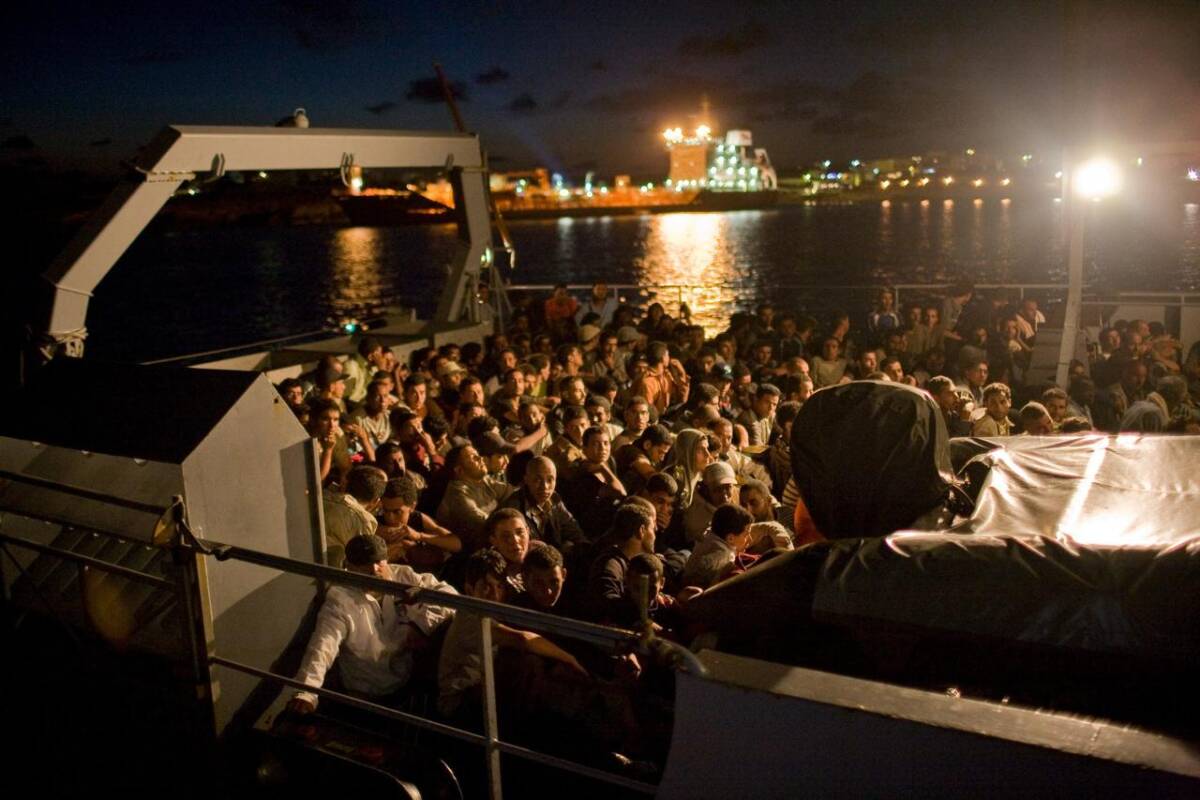
At sea, the boat was struck by a large wave and capsized, Kareem said. “It was pitch black, and all I could think of was the children and their families.” Kareem and Sameer remained in the water with the group of migrants after the boat overturned. They tried to stay afloat for several hours. At around 8 a.m., a two-year-old boy died. “It was unbearable,” Kareem added, “to see the two-year-old boy drown before my eyes.” Had it not been for a fishing boat that rescued the surviving passengers, they would have all drowned.
“At the time, I lost all hope, and I truly thought that I was going to die,” Kareem said. “With no other options available, I had to swim toward [the boat]. Luckily, they took us on board and brought us back to Tripoli.”
Migrants being rescued by a Libyan fishing boat in September 2025 (Photo: Syria Direct)
“It was unbearable to see the two-year-old boy drown before my eyes.”
A video shared with Syria Direct showed the survivors after their rescue. In the footage, the father of the dead boy can be seen burying his head between his hands. Sameer and Kareem say that the failed crossing resulted in the death of five migrants, including the two-year-old child.
Throughout the journey back to Tripoli, Kareem and Sameer had no time to make sense of the situation. They were too busy consoling the father who lost his child and could not bring the body on board. According to Kareem, the father was faced with a tough decision: either to cling to the body and risk drowning with it, or to leave it behind. He reluctantly chose the latter. When they arrived at the port of Tripoli, they were detained.
“We were interrogated by the [Tripoli] immigration authority,” Sameer said. “Afterward, they took us to a detention center in Tajourah, where we stayed for 28 days before being released through the intervention of the Syrian consul.”
Tajourah is located roughly 16 kilometers east of Tripoli. It is a coastal area with aging buildings, farms, sheep herders and a notorious detention center. In 2019, the Tajourah migrant detention center was the subject of extensive media coverage. The center is known for its systematic human rights violations. This is not unique to Tajourah; as of 2026, Libya hosts 17 official migrant detention centers. According to the International Organization for Migration (IOM), at least 5,000 migrants are being held inside official detention centers. In addition to the ones recognized by Libya’s two rival governments, there is also a cluster of clandestine ones.
When Kareem and Sameer were detained, Asad was allegedly in contact with their families asking them for money to secure their loved ones’ release.
“What bothered me the most was when I learned that Asad was contacting our families to ask them for ransom money,” Kareem said. “He was capitalizing on any opportunity to scam us further.”
Kareem told Syria Direct that when they contacted Asad after their release, he lied to them by saying that he paid $25,000 to have them released. Later, Asad refused to refund this. Instead, he acknowledged receiving the amount and promised them another crossing.
A child rescued from the sea in September 2025 (Photo: Syria Direct)
The Zawiyah ordeal
A few months went by before Asad reached out to Kareem and Sameer to relay plans for another crossing. Since Asad kept their money, they reported having no other choice but to accept his offer of another journey.
This time, the departure point was in the city of Zawiyah, which is located approximately 50 kilometers west of Tripoli. The city is known as a smuggling hub, where migrant smuggling, drug trafficking and illicit fuel trading take place. It is controlled by a number of militias that regularly operate outside of the state apparatus. When Kareem and Sameer arrived in Zawiyah, they were detained with other migrants in a detention center.
“I remember looking out the barricaded window from the place we were staying,” Kareem said. “I caught a glimpse of what was inside the adjacent building. It was horrific what I saw. People were alive, but they looked dead. They looked emaciated and seemed like they were detained without food or water. They were skin and bones. That is when it dawned on me that Zawiyah was the Wild West.”
“People were alive, but they looked dead. They looked emaciated and seemed like they were detained without food or water. They were skin and bones.”
A few days went by before Kareem and Sameer were released from the detention center and made their way back to Tripoli. According to both of them, the reason for their journey to Zawiyah had not been to make a crossing. Instead, they had been duped, held hostage for ransom. Syria Direct could not independently verify the extent of Asad’s involvement.
When they returned to Tripoli, Sameer, desperate, reached out to Asad and demanded their money back.
“I swear on my sister’s life that I will kill your families,” Asad wrote to Sameer in a text seen by Syria Direct. “If either of you is a real man, reach out to me again and see what happens. This conversation is over.”
Since then, they have not contacted him about this matter. Instead, they resorted to filing a report to Interpol. In addition, Sameer submitted evidence and his testimony to London’s Metropolitan Police. The Met contacted Sameer to arrange a call to review the evidence, explaining that officers could not understand the Arabic-language material. They have not yet interviewed Sameer but have given him a crime reference number, meaning only that a report has been logged.
“I swear on my sister’s life that I will kill your families.”
Haider Adnan Asad in 2024 (Photo: Syria Direct)
Detention and torture
While Kareem and Sameer struggled to make ends meet, another Syrian migrant was preparing to make a crossing to Europe that Asad had allegedly promised to facilitate.
Mounir* lived in Lebanon before deciding on a plan to leave for Europe. Like many Syrians, Mounir left Syria after the outbreak of the civil war in 2011. While in Lebanon, he worked in the food sector and hoped for a better future. He knew of Haider Asad, yet he was unaware of the allegations concerning Asad’s activities.
“One of my cousins told me that Haider Asad was in the UK,” Mounir told Syria Direct. “We learned that he was engaged in the smuggling business into Europe, so I reached out to him to agree on terms and logistics.”
Mounir arrived in Benghazi in September 2025 and moved to Tripoli in anticipation of the planned crossing. When he arrived in Benghazi, Mounir believed he was only days away from crossing the Mediterranean. However, when he reached Tripoli, Asad had nothing planned for him.
“Asad’s Libyan accomplices detained us in a house in Tripoli,” Mounir said. “They took all of our possessions, including our phones, and locked the doors. We stayed there for 10 long days, which consisted of psychological torture and physical assault. It is hard for me to describe the horror we endured. Words can never capture the reality of it.”
Mounir said that he and other migrants had little to no access to food, water, or electricity, adding that they barely slept at night. Eventually, Mounir and the other migrants broke out of the house on their tenth night, without knowing where they were. They later realized that they were in Gergarish, a coastal area in Tripoli. Gergarish contains numerous villas, making it well-suited for smugglers who wish to detain migrants before a crossing.
“From the outside, you might think it was a house that we stayed in,” Mounir said. “But what we endured on the inside was worse than prison. It was all a scam from the start. There was no planned crossing.”
Mounir later contacted Asad to ask for his money back. Asad responded in a similar manner to the refund request by Kareem and Sameer, threatening to kill his family if he ever contacted him again. Eventually, none of the three migrants who spoke to Syria Direct managed to make a successful crossing through Asad.
According to Emadeddin Badi, an associate fellow at Chatham House, the ordeal that the Syrian migrants went through in Libya is not unique. Badi believes that smugglers tend to change the services they initially promised.
“Their story is unfortunately commonplace when it comes to migrants,” Badi told Syria Direct. “[There are] a lot of false promises and also variables that change as [migrants] transit in Libya, which makes them prone to abuse.”
“On the justice angle, frankly impunity is the name of the game.”
Badi also believes that there are more people like Asad who operate from afar, leveraging their distance and local connections to harm migrants. Syria Direct has seen evidence suggesting that Asad may be part of a wider network that stretches from Syria and Lebanon to Libya, Germany and the UK, and much of it appears to involve family connections originating in the villages in the Homs countryside.
“It is relatively common to have smugglers targeting a particular clientele—in this case Syrians—while being abroad,” Badi said. “On the justice angle, frankly impunity is the name of the game.”
Syria Direct contacted Asad and gave him an opportunity to respond to the allegations made against him. He had not responded by the time of publication.
If you have any further information relevant to this investigation, contact us confidentially at info@syriadirect.org. Use the subject line: Haider Asad.
*Names have been changed to protect the individuals’ safety.