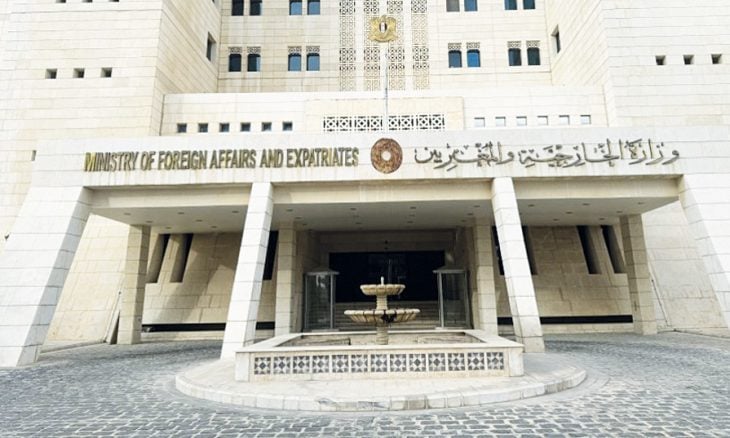
The Syrian Foreign Ministry’s announcement that it had recovered a Syrian aircraft from the Libyan city of Benghazi on 12 November has renewed scrutiny of Damascus’s diplomatic outreach to eastern Libya. The move comes as Syria’s new leadership seeks to rebuild its Arab and regional relationships on a different footing from that pursued under the former regime.
The development carries particular significance given the long-standing ties between forces loyal to retired Field Marshal Khalifa Haftar in eastern Libya and the former Syrian government, as well as years of political and military interaction between the two sides.
Syrian Foreign Minister Asaad al-Shibani met Saddam Haftar in Benghazi on 11 October to discuss security cooperation and the opening of a Syrian consulate in the city. Whether the recovery of the aircraft signals a deeper stage of official engagement or merely constitutes a limited technical and diplomatic step that could pave the way for closer relations remains an open question.
Although Damascus already enjoys positive relations with Libya’s Government of National Unity in Tripoli, questions persist regarding its ability to maintain balanced ties with the country’s rival centres of power without becoming entangled in Libya’s internal divisions. The rapprochement with eastern Libya has also prompted speculation over whether it reflects broader shifts in regional alignments, particularly in light of growing Turkish and Saudi engagement with Benghazi.
By balancing political, economic, and security considerations, Damascus appears to have an opportunity to pursue a foreign policy based on engagement with Libya’s competing actors while capitalising on evolving regional dynamics. Such an approach could also help address unresolved issues dating back to the former regime, notably reports that figures linked to the Assad era have found refuge in eastern Libya. Against this backdrop, Syrian analysts differ in their assessments of the motives, limitations, and possible outcomes of the growing contacts.
Shifts in Benghazi Create an Opening
Syrian researcher and writer Dr Bassel Maarawi argues that the recovery of the Syrian aircraft from Benghazi reflects the positive results of recent political and diplomatic contacts between Damascus and eastern Libyan authorities, signalling a mutual desire to strengthen relations.
Speaking to Ultra Syria, Maarawi noted that while Libya’s internationally recognised government is based in Tripoli and administers the western part of the country, eastern authorities cannot be regarded as an extra-state force or a separatist entity. He stressed that they remain integrated within Libya’s political and institutional framework, sharing in the management of state resources and maintaining links with official financial, administrative, and military bodies, alongside the House of Representatives headquartered in Benghazi.
According to Maarawi, the Syrian government has consistently sought to conduct relations through recognised state institutions rather than non-state actors. From this perspective, engagement with Benghazi is compatible with Damascus’s broader diplomatic approach, since eastern authorities form part of Libya’s official state structure.
He added that Syria has a strategic interest in maintaining relations with both eastern and western Libya, enabling it to work with different institutions without undermining ties with the government in Tripoli. In his view, relations between Damascus and Benghazi are likely to witness tangible progress in the near future.
Maarawi links these prospects to recent political shifts in eastern Libya. He argues that Benghazi has gradually distanced itself from Russia and the United Arab Emirates while ending support for Sudan’s Rapid Support Forces. At the same time, he points to the growing influence of Saddam Haftar, whom he describes as the most likely successor to his father, and to eastern Libya’s increasing engagement with Saudi Arabia and Turkey, two countries central to Syria’s current foreign policy orientation.
He noted that Turkey has invested significant effort in drawing Saddam Haftar closer and reducing his dependence on previous alliances. Among the indicators he cited were Haftar’s repeated visits to Ankara, Turkish Foreign Minister Hakan Fidan’s visit to Benghazi, and a series of cooperation agreements concluded between the two sides.
According to Maarawi, these agreements included the supply of Turkish weaponry to forces affiliated with eastern Libyan authorities and the provision of Turkish military expertise. He further argued that relations reached a new level when Libya’s House of Representatives ratified on 20 October 2026 the maritime boundary agreement originally concluded between Turkey and the Tripoli-based government of Fayez al-Sarraj in 2019.
In his assessment, Ankara’s rapprochement with eastern Libya has helped create favourable conditions for closer relations between Damascus and Benghazi, opening space for broader diplomatic and political cooperation amid shifting regional dynamics.
Security Interests and Emerging Regional Alignments
At the regional level, Maarawi expects relations between Damascus and Benghazi to deepen further, with both eastern and western Libya potentially becoming part of a wider regional framework centred on stability and security cooperation.
He argues that the nucleus of this framework lies in what he describes as the Mecca Defence Alliance, bringing together Saudi Arabia, Turkey, and Pakistan, with Syria, Qatar, Kuwait, and Libya among the countries that could potentially join in the future.
According to Maarawi, the objective of such a framework would be to limit the expansion of competing regional projects, whether Iranian or Israeli. He cited reports of Saudi financing for a Pakistani arms deal benefiting Haftar’s forces, as well as the arrival of Pakistani military advisers alongside weapons shipments to eastern Libya.
However, he emphasised that Damascus’s interest in rapprochement with Benghazi extends beyond regional diplomacy. It also encompasses security concerns stemming from the legacy of the former Syrian regime.
In this context, Maarawi pointed to the possibility that stronger ties with eastern Libya could assist Syrian authorities in pursuing former regime figures who reportedly fled there following the fall of Bashar al-Assad’s government. Enhanced cooperation, he suggested, could eventually facilitate the extradition of some of those individuals.
He stressed the importance of preventing eastern Libya from becoming a safe haven for former regime officials or a base for activities directed against Syria. In his view, closer cooperation with Benghazi offers an opportunity to address these concerns and strengthen security coordination between the two sides.
Balancing Rival Relationships
The recovery of the Syrian aircraft may ultimately prove more significant than a routine administrative procedure. It could represent another indication of expanding diplomatic engagement between Damascus and eastern Libyan authorities at a time of shifting regional alliances and converging security and economic interests.
Yet such outreach does not necessarily signal a Syrian realignment within Libya’s internal conflict. Maintaining constructive relations with the government in Tripoli remains a key strategic priority for Damascus.
While analyst Saado emphasises the importance of a balanced approach that enables Syria to engage with all Libyan actors, Maarawi places greater emphasis on evolving regional dynamics, particularly the roles played by Turkey and Saudi Arabia in facilitating rapprochement with eastern Libya, as well as the security implications associated with former regime figures.
Between these two approaches lies the central challenge facing Syrian diplomacy: translating existing contacts into durable institutional relationships without provoking tensions with Tripoli or becoming drawn into Libya’s rival power centres. The success of Syria’s emerging foreign policy will depend not only on its ability to establish channels with actors once aligned with the former regime, but also on its capacity to manage multiple relationships simultaneously while placing Syrian national interests above regional axis politics.
Against that backdrop, the recovery of the aircraft may represent one step in a broader diplomatic process. Its true significance, however, will become clear only through future developments and the willingness of Libya’s competing actors to engage with Damascus on the basis of shared interests rather than the legacy of past alliances and internal rivalries.
This article was translated and edited by The Syrian Observer. The Syrian Observer has not verified the content of this story. Responsibility for the information and views set out in this article lies entirely with the author.