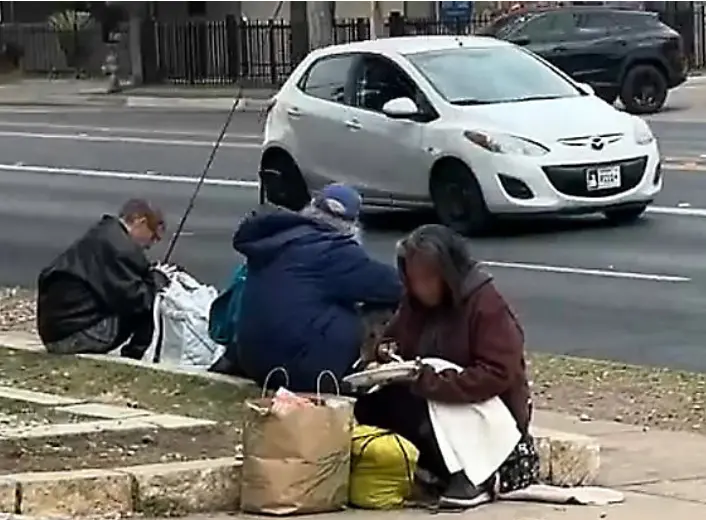
Homeless people in Tampa, Florida. Screenshot
By Pedro Pablo Morejon
HAVANA TIMES – It was a rainy day, and I was stressed. I left home hoping the downpour wouldn’t start. I had to get to work. I don’t have a car, and for now, I don’t want to buy one either. My immigration situation is difficult and unstable, and you never know what might happen. I don’t want to invest my limited resources in something I could lose overnight. All it takes is one bad day for ICE to detain you, take you to a detention center—which is nothing more than a kind of concentration camp where you can spend months—and then deport you to Cuba. And if your own country doesn’t want you, who knows, maybe you’ll end up in Africa.
That’s why I ride an electric moped. I use it to get all around the city. The drawback, of course, is the rain. There had been other times when I’d gone out fearing a downpour, but that day I wasn’t lucky. I hadn’t gone four miles when the heavens opened up.
I barely managed to make it under a bridge on the Veterans Expressway, where I stopped to wait.
This isn’t Cuba, where you can arrive late to work and somehow work things out. Here, if you’re late, they won’t let you in. You lose the day’s pay, and who knows what else. And you end up stressing over a job that pays minimum wage and where they exploit you in every possible way; where you have practically no labor rights because you’re cheap labor, an immigrant, almost undocumented.
There I was, angry, worried about the time, and glancing sideways at a homeless woman a few yards away, surrounded by her belongings. When I noticed her, I felt a mixture of compassion and sadness. I didn’t judge her. Someone had told me that most homeless people end up that way because of addictions. But you never know. We can’t judge others without knowing their circumstances.
At one point, the woman approached me and spoke in English. She must have been around forty, although she looked twenty years older. She was dirty, dressed in rags, and looked like someone life had treated very harshly. I could barely understand her, between her pronunciation and the slang she used. At first, I thought she was going to ask me for something. But she was actually asking whether I had a rain poncho or some plastic sheeting to protect myself from the rain.
I told her I didn’t. So she went back to where she’d left her belongings, picked up two pieces of plastic sheeting, and, without asking my permission, began covering me with one of them. She covered my backpack and took care to protect me from the rain with a mother’s devotion.
I stood motionless, submitting to everything that woman was doing for me. A childlike feeling washed over me. I felt like a little boy, and she was like my mother. She did everything with a tenderness that deeply moved me. She made sure I was well covered, so thoroughly that I was unlikely to get wet again.
But she didn’t stop there. She used the other piece of plastic to wrap the entire battery of my electric moped, aware that a heavy downpour could damage the wiring and leave me without transportation. That woman overlooked nothing.
I remained silent, enjoying her attention with a mixture of sadness and relief. The downpour had eased, although a persistent drizzle was still falling.
When she finished, I wanted to say goodbye. I had two bottles of Malta, along with some other things to snack on and eat, because it was around five in the afternoon and I’d be working until the early hours of the morning. I wanted to give her something, but she absolutely refused to accept anything.
All I could do was tell her:
“You are very kind.”
And then I blurted out:
“I love you.”
I found myself saying those words that had come straight from my heart, in the purest and most sincere way. Of course, it wasn’t romantic or physical love, nor did it have any other connotation. It was love in its purest form, the kind you can feel for another human being when they show you an unexpected gesture of empathy and solidarity.
I left that place completely protected. The rain no longer mattered to me.
A few miles later, I passed some warehouses whose roofs I had helped install when I did my first job in the United States, working in roofing with a crew of Hondurans. I remember those days. I even have a diary about that experience, which I think I titled Blood, Sweat, and Pain, or something like that…
Back then, I felt completely lost. I remember that the first time, someone had to come pick me up because I didn’t know how to get around the city. Now things are different. Whenever I pass those warehouses, I remember those days with a mixture of compassion and a smile. I also smile because today I know my way around the entire city.
I arrived at work, but I couldn’t stop thinking about that woman. I told a friend what had happened, and he jokingly said:
“Sounds like she fell in love with you.”
I don’t know. Nor do I care what her motives were. I’ll never know who that woman was or what circumstances had led her to live that way. I only remember her empathy, her gesture of kindness. I remember that, for a few minutes, we were simply two human beings.
Sometimes I feel bad and think: Damn, I came to this country, and here I’m nobody. Here I’m not a professional, I’m not a lawyer, I’m not a writer. I have no recognition whatsoever. I do the jobs US Americans won’t do. Many times, I cry on the inside.
In Cuba, people think you’ve hit the jackpot. They tell you that you’re in the United States and that you’ve got it made. And yes, here you have food, electricity, and a roof over your head. Of course, Cuba is much worse off materially, but that doesn’t mean life as an immigrant is easy. Here, too, you have to fight a very hard battle, especially when your situation is so precarious and unstable.
And yet, there are people who are much worse off than you. Much, much worse.
From that day on, every time I passed under that bridge, I thought of the woman and tried to find her. But I never saw her again.
There is one thing that did change after that encounter. Now, every day when I go to work, I take something to eat and give it to the first homeless person I come across. I don’t do it out of any religious conviction or to feel superior to anyone. It’s simply that the encounter left something with me that I still carry. And doing it makes me feel good about my own humanity.
I’m not a believer, but I remember those words of Jesus in the Gospels: “The poor you will always have with you.”
And it’s true. There will always be someone who’s more screwed than you are.
Read more from the diary of Pedro Pablo Morejon here on Havana Times.