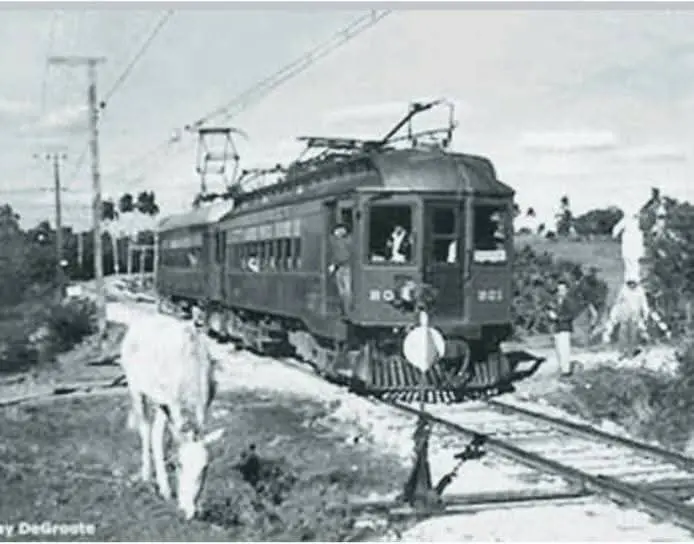
The Hershey train stopped in Cojimar until 1957.
Photo Feature by Nike
HAVANA TIMES – I was reading a story written by a childhood friend in which he expresses his nostalgia for the first day he visited Cojimar and my family’s home.
The story inspired me to write this article for you.
In the 1930s, a train service was inaugurated in the town of Cojimar, allowing residents to travel to the city of Havana. The train ran along the entire length of G Street—which still exists today—where, until not too long ago, sections of the railway tracks could still be seen protruding from the pavement between 30th and 31st Streets.
Cojimar became part of the Hershey railway project in this area of Havana. The US businessman had built an entire town, complete with a sugar mill, housing, and hospitals for his workers. He did so around the time of the Great Depression in the United States because he needed sugar for his chocolates.
The train departed from the town of Casablanca, where the station was located. With the Hershey railway lines intersecting in the area, it was decided to establish a train service to Cojímar, connecting the town with Havana, where electric streetcars were already operating at the time. In the photographs, you will see a map of Havana’s streetcar network in 1930, marked in blue, with the Hershey electric railway connecting Casablanca and Cojimar marked in red.
The train entered Cojímar along G Street and crossed the entire town until it reached a block from the sea. There, it made a loop and headed back, passing very close to private farms.
There were several stops along the route, including one with a café called “La Línea” (The Line). Upon leaving town, the train followed the road known as “Los Curas” (The Priests), so named because there was a Franciscan monastery there. All that remains of the monastery today are two walls, but the road is still known by that name.
The last train departed at 11 p.m. The electric train, which was quiet and produced no pollution, was taken out of service in 1957 and replaced by gasoline-powered buses.
The train ended its journey at the Casablanca station. To reach Havana, passengers crossed the bay aboard a ferry that still operates today, known as “La Lanchita de Casablanca.” There is also another ferry in Regla, better known as “La Lanchita de Regla,” which still exists. Nowadays, however, there is almost always just one ferry serving both routes between Havana, Regla, and Casablanca.
In the 1930s, Cojimar was a very rural town, surrounded by farms with cows, horses, and chickens. People were accustomed to letting their animals roam freely. Cojimar was like one enormous farm, and many residents saw the streetcar as an intruder in their lives.
I mention this because accidents involving cows and horses began to occur. The residents who owned these animals went to complain to the mayor of Cojimar, asking him to demand that the railway company install a fence along the entire train route to prevent further accidents.
The mayor met with the company, and a dispute over the fence began. After several meetings, the company refused to build it, claiming it lacked the necessary funds. In the end, the townspeople had to fence in their animals, and there were no more accidents.
Civilization brings many good things for some people, while others find it very difficult to accept progress, even when it benefits everyone. For the animals that had to spend their lives confined, however, it was no benefit at all.
See more photo features here on Havana Times.