An investigation into a series of killings across the governorates of Homs and Hama has uncovered a disturbing pattern of lethal street violence, limited judicial accountability, and sparse official reporting.
Between January 2025 and August 2026, the rights organization Syrians for Truth and Justice (STJ) documented 55 fatal incidents in Homs, Hama, and their surrounding countryside, resulting in 89 confirmed civilian deaths. Homs accounted for the vast majority of casualties, with 74 victims, or 83 per cent of the total, while Hama recorded 15 deaths.
According to STJ, at least 50 victims were members of the Alawite community, while six incidents targeted individuals from the Ismaili and Murshidi communities. Separately, the Syria Justice and Accountability Centre (SJAC) documented at least 83 violent incidents and 102 killings in Homs alone since May 2025.
Stories of Loss Amid Limited Accountability
Eyewitness testimony and medical records reviewed as part of the investigation reveal the sudden and often indiscriminate nature of the attacks.
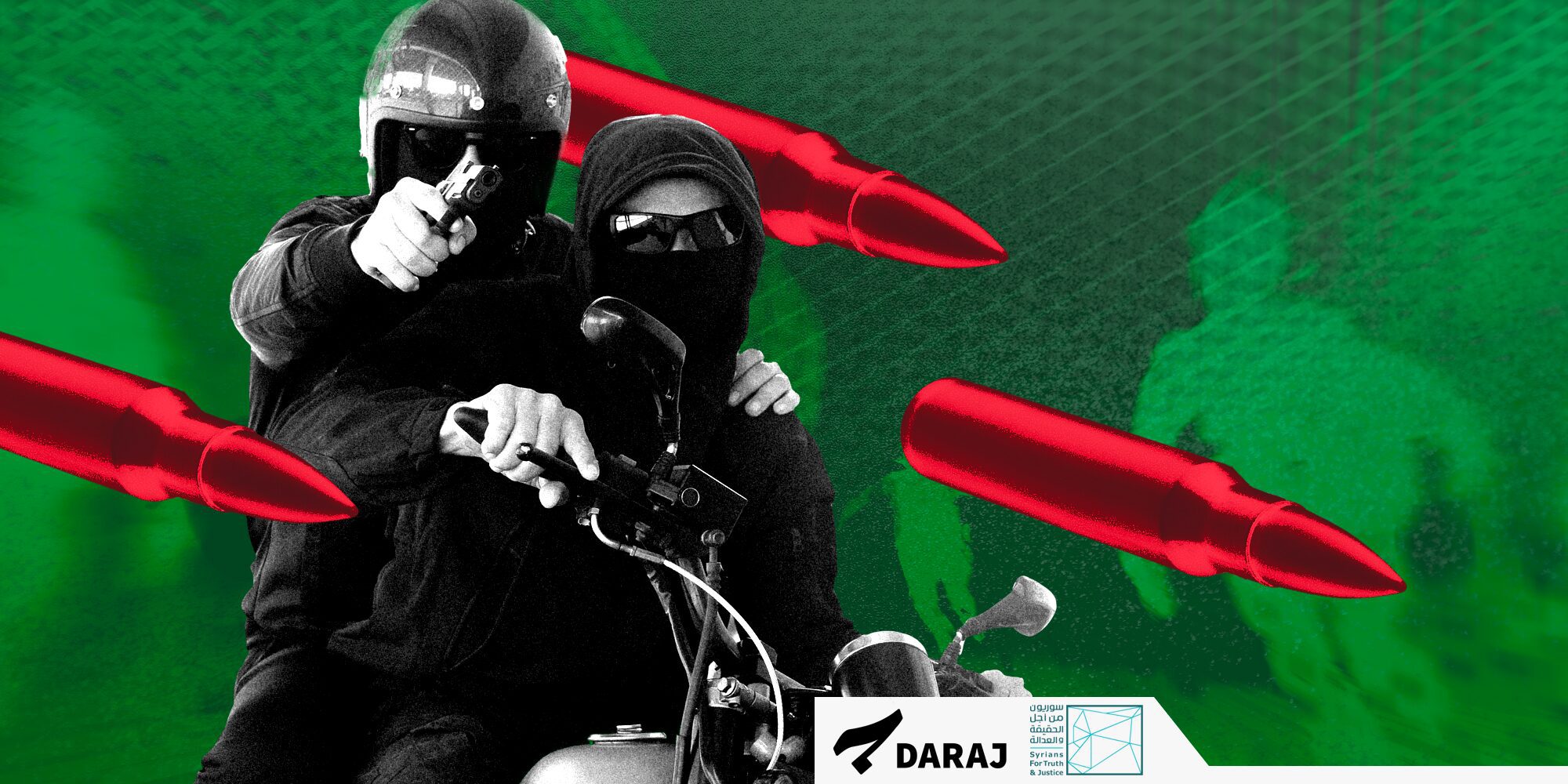
In May 2025, Sumaya, a pseudonym used to protect the survivor’s identity, was crossing a street in Homs with her mother and sister when two armed men on a motorcycle opened fire. Her mother was killed by a gunshot wound to the neck, while both daughters were seriously injured.
Sumaya survived a bullet wound to the head and later identified one of the suspects after he was brought to the hospital under the custody of General Security forces. Yet the family received no information regarding subsequent legal proceedings. After learning that the suspects had been released, they eventually fled Homs.
Similar stories have emerged across the region.
In February 2026, a healthcare worker was shot dead by unidentified gunmen near his hospital in Homs, leaving behind a widow and children with few answers. Around the same period in rural Hama, an elderly farmer was killed outside his home by assailants travelling in a vehicle whose licence plate had been obscured by mud.
His son Ahmed blamed the unchecked spread of weapons and the absence of accountability.
“I no longer care to know who did it,” he said. “I just want to know why.”
The violence continued throughout 2026. In June, security camera footage from the village of al-Jiyed in the al-Ghab Plain showed armed men on motorcycles opening fire during a local dispute, killing an elderly woman and injuring three others. Internal Security later announced the arrest of two suspects.
Three months later, in September 2026, a masked gunman entered a shop in the village of Tell Sikkin al-Qaada in western Hama countryside and fatally shot two men.
Limited Coverage and Few Public Answers
A review of official media coverage and government Telegram channels between September 2025 and August 2026 revealed a significant gap between documented incidents and public reporting.
Of the 55 incidents recorded by STJ, only a limited number were covered by the state news agency SANA and state-run broadcaster Al-Ikhbariya. In most cases, perpetrators were described simply as “unknown assailants,” with little or no follow-up reporting on investigations, arrests, prosecutions or court rulings.
The official Telegram channels of the Ministries of Interior and Justice did not publish statements on any of the 55 incidents on the days they occurred, although major attacks, including a mosque bombing in Homs and the killing of an entire family in Hama, did receive official attention.
Throughout the period reviewed, state media addressed possible sectarian motives only once, when officials publicly rejected suggestions that the February 2026 killing of Iman Jarjis in Homs’s Ikrima neighbourhood was linked to religious or sectarian considerations.
For many victims’ families, the absence of answers has become part of the trauma itself.
Sumaya has since undergone multiple operations and regained the ability to walk. Yet the hand she raised to shield her younger sister from gunfire remains paralysed.
Reflecting on her survival and the lack of closure experienced by many families, she said: “I do not know the meaning of staying alive. Perhaps it is divine providence that wanted people to hear my story.”