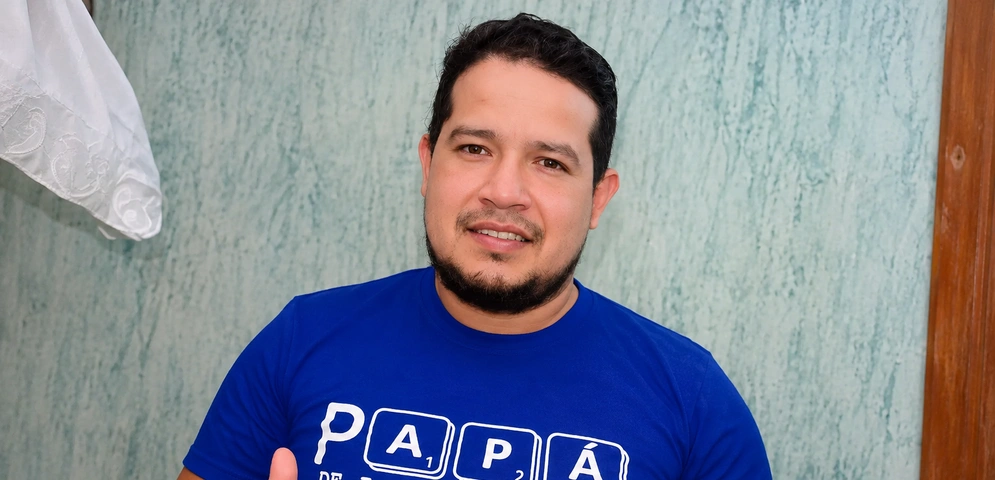
Former political prisoner Jairo Lenin Centeno Ríos. Photo: Carmen Aguirres / Nicas Libres Ya
Javier Centeno, one of 222 Nicaraguan political prisoners banished to the US in 2023, was denied asylum on the basis of Ortega-Murillo’s bogus drug charges.
By 100% Noticias
HAVANA TIMES – On November 10, 2026, a US immigration judge denied Jairo Lenín Centeno Ríos the right to political asylum. Centeno was one of 222 political prisoners the Ortega regime exiled to the United States in February 2023 and subsequently stripped of their citizenship. Stateless, he now faces the threat of deportation back to Nicaragua or to a third, unknown, country.
The court’s decision was announced on Tuesday, November 10, 2026, during a hearing held via video call from the Folkston D. Ray Detention Center in Georgia, where Centeno remains in immigration custody. Javier now fears being sent back to the country where he was imprisoned and from which he was expelled.
Meanwhile, he remains in an ICE detention center, leaving his four minor children in Nicaragua without the financial support he provided them.
Decision the result of baseless drug charges filed in Nicaragua
The Nicaraguan, originally from León, claims that the decision was based on a drug trafficking conviction handed down in Nicaragua, even though a United Nations report declared his detention arbitrary.
In statements to the Nicaraguan newspaper LA PRENSA, on Wednesday, November 11, the former political prisoner explained that the judge rejected his request for protection, given the criminal record resulting from his imprisonment in Nicaragua. The judge termed him a danger to the United States due to the crimes for which he was convicted by Nicaraguan authorities, despite the attempts of his defense team to explain the circumstances of his imprisonment in Nicaragua and subsequent exile.
Centeno maintains that the Nicaraguan regime’s drug charges were bogus, used by the regime to politically persecute him. He is now in a state of uncertainty, as he has already received a deportation order that he has refused to sign, and is waiting for his attorney to file an appeal.
From Exiled Political Prisoner to ICE Detainee
Centeno was arrested by the Ortega regime on September 14, 2018, during the period of repression that followed the outbreak of massive anti-government protests. He was released on December 30, 2019, under the regime’s unilateral Amnesty Law, but was recaptured on February 26, 2020 in a manner the Nicas Libres Ya website termed: “arbitrarily and illegally, and without a warrant in a raid at his grandmother’s house.”
Centeno remained in a Nicaraguan prison until February 2023, when he was among the 222 political prisoners the Nicaraguan authorities released and transferred to the United States under an agreement with the Biden administration. Almost immediately afterwards the Ortega-Murillo regime ordered all members of that group to be stripped of their citizenship. Centeno, like many of the others, remains stateless.
Arrested and detained by ICE despite the conclusions of the UN Working Group
After arriving in the United States, Centeno tried to rebuild his life. He began working in the construction industry as a welder.
However, on July 27, 2026, he was once again arrested – this time by agents of US Immigration and Customs Enforcement (ICE) while he was at a beach in Maryland, spending a day off with his partner, Conny Martinez. He was subsequently transferred to Georgia, where he remains in detention.
One of the most significant aspects of the case is that Centeno’s detention in Nicaragua was examined by the United Nations Working Group on Arbitrary Detention. In its Opinion 69/2023, adopted during the session held from November 13 to 17, 2023, the international body analyzed the situation of 23 individuals imprisoned in Nicaragua, including Jairo Lenín Centeno Ríos.
The document concluded that his detention was arbitrary and contrary to the guarantees recognized in the Universal Declaration of Human Rights and the International Covenant on Civil and Political Rights. In its analysis, the Working Group also identified serious violations of the guarantees to a fair trial in the case of Centeno and other individuals included in the opinion.
This conclusion constitutes a documented international precedent regarding the irregularities of his imprisonment in Nicaragua. Unfortunately, the United Nations’ ruling does not automatically lead to the granting of asylum in the United States. The immigration decision depends on a separate procedure, subject to US law, within a US political administration that has moved to deport as many immigrants as it can.
According to Centeno, his attorney presented to the judge both the political nature of his imprisonment and the fact that he was stripped of his nationality, but neither of these arguments were given the weight he had hoped for.
Detention leaves his Nicaraguan children without economic support
Beyond his immigration status, Centeno faces the anguish of being unable to financially support his four minor children, who remain in Nicaragua. Before his arrest, he worked as a welder in construction and, as he explained to LA PRENSA, was the children’s primary financial provider.
Since his arrest by ICE in July, he has stopped sending them money.
In the interview, he expressed concern about his children’s needs and the possibility of remaining in detention for a longer period. He is particularly concerned for how his Nicaraguan family can sustain the costs associated with their studies if he continues in detention. This is the dilemma of many in ICE detention: while he fights to obtain legal protection in the United States, he leaves his children without economic support.
Fears Being Sent to Nicaragua or to a Third African Country
According to a report published by LA PRENSA, on Tuesday, November 10, Centeno received a deportation order that calls for his return to Nicaragua or the possibility of sending him to a third country in Africa.
The former political prisoner stated that he has not signed the document because he fears the consequences of returning to Nicaragua, where he was imprisoned for reasons he considers political.
He also expressed his opposition to the possibility of being transferred to an African country, given the difficulties he already faced in adapting to a new life after several years of imprisonment.
His concern is compounded by the revocation of his Nicaraguan citizenship, a measure that has affected numerous opponents and critics of the Ortega-Murillo regime.
The existence of a deportation order does not necessarily mean that his expulsion has already been carried out or that the transfer will be immediate. The situation will depend on pending legal proceedings and the appeal decisions of immigration authorities.
In this case, Javier’s defense team will seek to overturn the court’s decision while he remains in custody in Georgia. He is currently seeking support from human rights organizations and bodies that could help resolve his situation.
Centeno’s situation raises questions about the legal options available to people who were expelled from their country, lost their nationality, and now face deportation proceedings in the United States. It also raises questions about whether convictions handed down by governments accused of political persecution should be considered valid evidence in immigration proceedings.
In Javier Centeno’s case, there is a United Nations ruling documenting the arbitrary nature of his imprisonment, but it is not yet publicly known whether that information was fully considered in the U.S. immigration decision.
The Nicaraguan reiterates that he did not arrive in the United States on his own initiative, but rather as part of a group of political prisoners transferred from Nicaragua in February 2023.
The fear of returning to Nicaragua, the uncertainty surrounding his immigration status, and concern for his four children are all part of a situation that, as he told LA PRENSA, has deeply affected him.
The outcome of his appeal will determine whether he can continue to seek protection in the United States or whether he will face new deportation proceedings.
Seven of the 222 Nicaraguan ex-prisoners revictimized by ICE
According to a September 18th article in the Nicaraguan news site Confidencial, seven of the group of 222 have been newly detained by ICE. One was released, one has been ordered deported to Ecuador, and – at the time of the article – the others, including Centeno, were awaiting resolution of their cases.
First published in Spanish by 100% Noticias and translated and posted in English by Havana Times.
Read more from Nicaragua here on Havana Times.