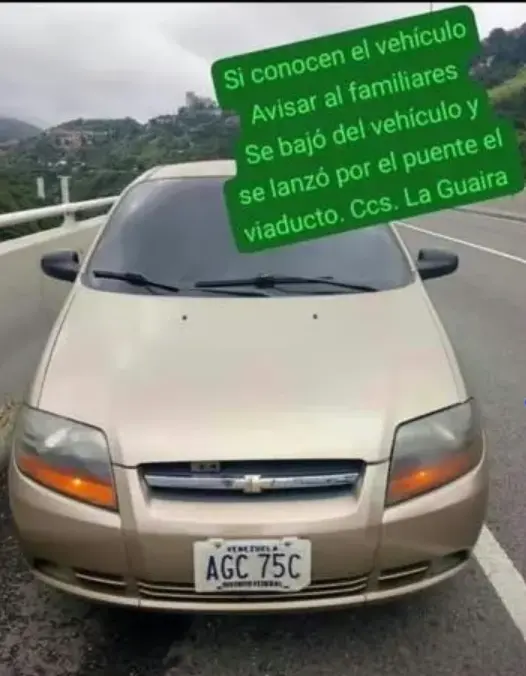
If you recognize the vehicle, notify the family. The driver got out of the vehicle and threw themself off the La Guaira Viaduct bridge.
By Antígona Urbana
HAVANA TIMES – It all began when I saw an image on social media: a car parked and abandoned on the Caracas-La Guaira highway viaduct. The license plate was highlighted, along with a message asking whether anyone recognized the vehicle so they could contact the family of a very young man who had left it there and jumped to his death. That photograph, so stark and silent, left me thinking about the absences that, in Venezuela, the State prefers not to record.
Ever since the National Statistics Institute stopped publishing its reports and official statistics were replaced by word of mouth, it seems that whatever doesn’t appear in an official document simply doesn’t happen. But when you walk through your community, you know that reality weighs far more heavily than that silence.
Recently, I was talking with a journalist about the mental health of our young people, and she told me something that stayed with me: although no official figures are publicly available, suicide attempts among adolescents are extremely high. She called them “verbal statistics.” These are the figures that never appear in official publications but circulate by word of mouth in hospitals, high schools, and notices like the one about that car abandoned on a public highway.
Adding to that silence is another equally painful one: there are also no reliable records of how many young people have left the country as “land rafters,” making their way on foot. And it is no exaggeration to say that at least 80 or 90 percent of these migrants are young people searching for a future. Many left behind empty homes and broken families; others never even made it to their destinations. We will never know how many were lost along the way or in the depths of the Darien jungle.
While government institutions look the other way, organizations such as the Community Learning Centers and the Venezuelan Violence Observatory are doing the work of documenting what is happening. Their recent reports raise serious alarm bells: nearly one in four minors assisted by the Community Learning Centers reported suicidal thoughts, a record figure that increased by more than 30 percent.
Nearly 300 cases of self-harm were also recorded, along with an increase of more than 50 percent in young people suffering from severe depression. Across the Americas, the Pan American Health Organization (PAHO) warns that suicide is now the third leading cause of death among people between the ages of 10 and 24.
Here, in this country of enormous wealth, our young people face this storm alone. Between the emotional toll of migration, bullying at school, and the lack of opportunities, there are no mental health specialists available in public institutions to help them, while private consultations are extremely expensive compared with average incomes.
And the State? It remains silent when it comes to the mental health of our youth. Likewise, it ignores the figures concerning those who risk their lives crossing a jungle. As long as we continue without official information, it falls to us to pay attention to those verbal statistics, to listen before it is too late, and to stand by the young people around us so that no one else is left alone at the edge of the abyss.
Read more from Antígona Urbana’s diary here in Havana Times.