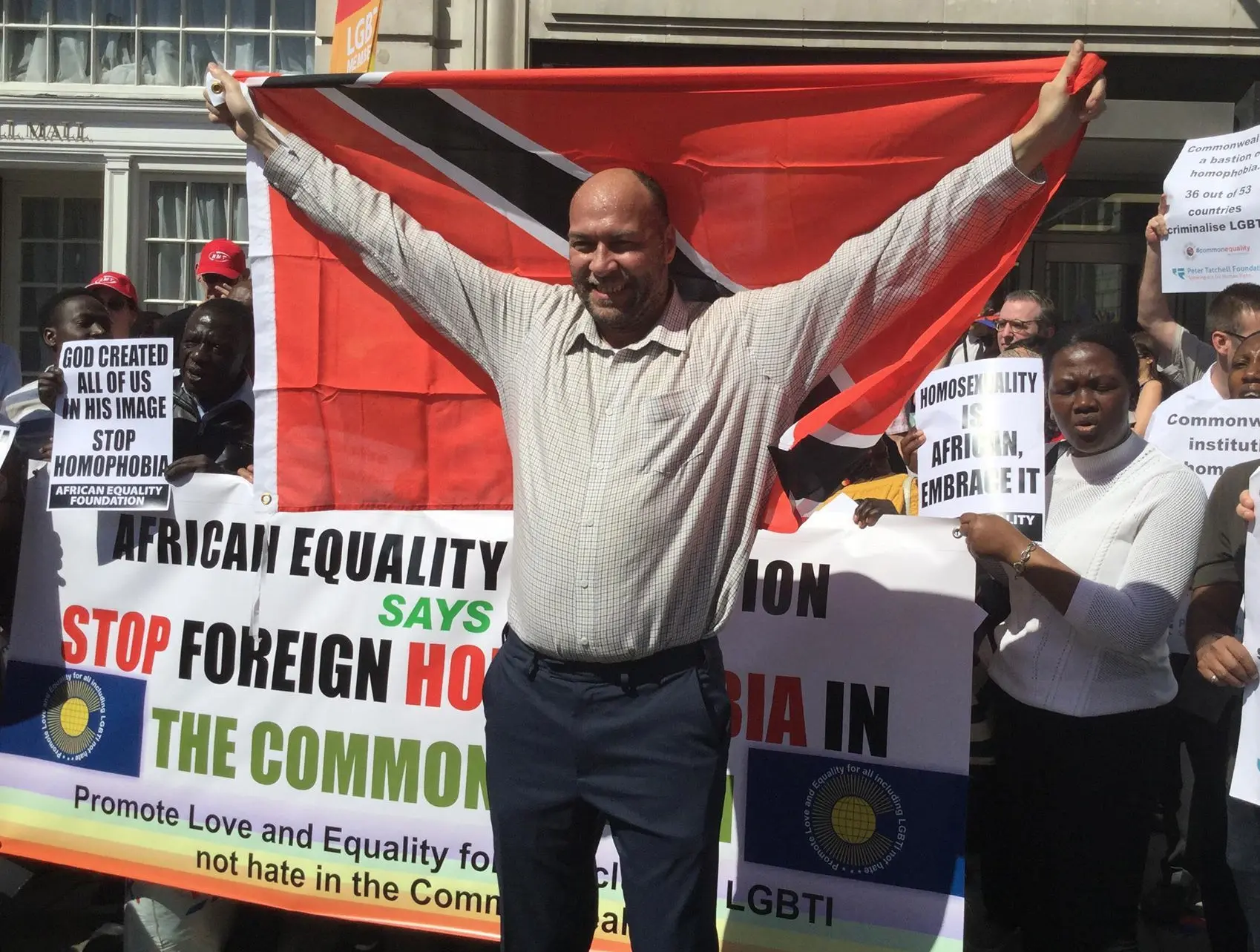
For years, activist Jason Jones led the fight against the criminalization of homosexuality in Trinidad and Tobago. The country’s highest court ruled in his favor, ordering the decriminalization of same-sex relationships in the Caribbean nation. Image: Edwin Sesange / Erasing 76 Crimes
By IPS Correspondent
HAVANA TIMES – United Nations High Commissioner for Human Rights Volker Türk welcomed on Wednesday, November 11, the historic ruling by Trinidad and Tobago’s highest court, which declared the criminalization of private, consensual same-sex relations in the country unconstitutional.
“I hope the ruling will help eliminate a longstanding source of stigma, exclusion, barriers and violence experienced by people in Trinidad and Tobago because of their sexual orientation and gender identity,” Türk said in a statement issued in the Swiss city of Geneva.
On November 10, 2026, the Judicial Committee of the Privy Council (based in London), the highest court of appeal for Trinidad and Tobago, unanimously ruled to decriminalize same-sex relations in the Caribbean country.
For Türk, the Privy Council’s unanimous decision “represents an important milestone for human rights and equality,” adding that it “reinforces the principles of dignity, privacy, non-discrimination and equal protection under the law.”
The ruling upheld the findings of lower courts in Trinidad and Tobago that criminal prohibitions on private, consensual sexual relations between people of the same sex are not reasonably justified in a society that properly respects individual rights and freedoms.
“This is a powerful reminder that meaningful advances in human rights are often achieved through the sustained efforts of individuals and communities to ensure that their rights and those of others are respected. We applaud and congratulate them and commend their courage,” Türk said.
Under the Sexual Offences Act of 1986 and other laws inherited from the colonial era (Trinidad and Tobago gained independence from the United Kingdom in 1962), “buggery” was punishable by up to five years in prison, while “gross indecency” carried a maximum sentence of two years in the country of 1.4 million inhabitants.
LGBTIQ+ activist Jason Jones waged a legal battle against those laws for nearly a decade. He initially won his case in the High Court in 2018, suffered a setback when the local Court of Appeal overturned that ruling in March 2025, and ultimately secured a definitive victory before the London-based court.
Trinidad and Tobago does not recognize same-sex marriage, civil unions or joint adoption by same-sex couples, nor does it have comprehensive laws prohibiting discrimination based on sexual orientation.
Throughout Latin America, same-sex relations have been decriminalized, and four countries—Bolivia, Cuba, Ecuador and Mexico—along with some jurisdictions in Argentina and Brazil, provide constitutional protection against discrimination based on sexual orientation.
Five other countries—Chile, Colombia, Honduras, Peru and Uruguay—as well as Suriname and French Guiana, offer “broad protection” against discrimination based on sexual orientation, including protections concerning access to goods and services, healthcare, education and employment.
Nicaragua and Venezuela provide protection against employment discrimination, but not in other areas, as is also the case in Puerto Rico.
The situation is different in the English-speaking Caribbean, where same-sex relations remain criminalized in Dominica, Grenada, Jamaica, Saint Kitts and Nevis, Saint Lucia, and Saint Vincent and the Grenadines. In Guyana, homosexual relations between men are punishable by imprisonment, but those between women are not.
In his statement, Türk said, “I urge other Caribbean States to decriminalize consensual sexual relations between adults of the same sex.”
“This would be consistent with the strong regional trend toward repealing outdated and harmful colonial-era laws, and with the principle of equal treatment for everyone, regardless of who they are or whom they love,” he added.
Worldwide, more than 60 countries and territories criminalize homosexuality. In five of them—Afghanistan, Saudi Arabia, Somalia, Uganda and Yemen—it is punishable by death. In Bangladesh, Pakistan, Sudan, Tanzania and Zambia, penalties can extend to life imprisonment.
In predominantly Muslim countries across North, East and West Africa and the Middle East, same-sex relations are punishable by imprisonment, as they are in Brunei, Malaysia, Myanmar and Sri Lanka, in Southeast and South Asia.
First published in Spanish by IPS and translated and posted in English by Havana Times.
Read more news here on Havana Times.