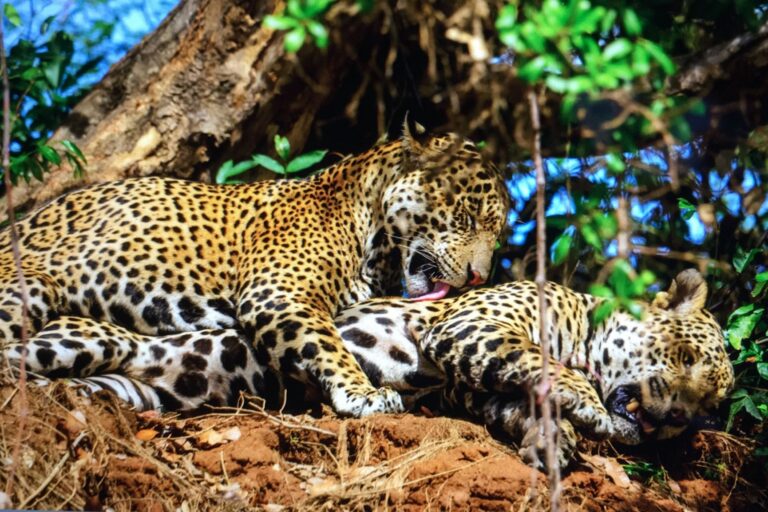
Jaguars are widely believed to be solitary cats, only tolerating others when mating or raising cubs. However, a new study in the Brazilian Pantanal has found the jaguars there often pair up and are far more social than expected. The Pantanal, the world’s largest wetland, has the world’s highest population density of jaguars (Panthera onca), where tourists are nearly guaranteed to spot them from a tour boat. This jaguar abundance has also attracted researchers. Since 2013, scientists with the Jaguar ID project have conducted daily surveys during the Pantanal’s dry season, June to October. They collect photos and videos, and have identified 459 individual cats from their distinctive rosette patterns. Combined with citizen scientist data, the images provide a “treasure” of information about jaguars and their social interactions, according to Valeria Boron, lead author of the study and senior program adviser for Latin America with WWF UK. Boron told Mongabay in a video call that most of what scientists previously knew about jaguars came from camera traps and genetic testing, which can’t accurately capture the full range of their interactions. Analyzing 13 years of data, the team found that the Pantanal jaguars were much more social than expected, with significant differences between males and females. The researchers recorded 167 instances of jaguar pairs interacting: nearly half involved two males, 31% involved a male and a female, and just 17% involved two females. Roughly a quarter of the interactions were aggressive, 36.5% were neutral — individuals resting or hunting independently in…This article was originally published on Mongabay