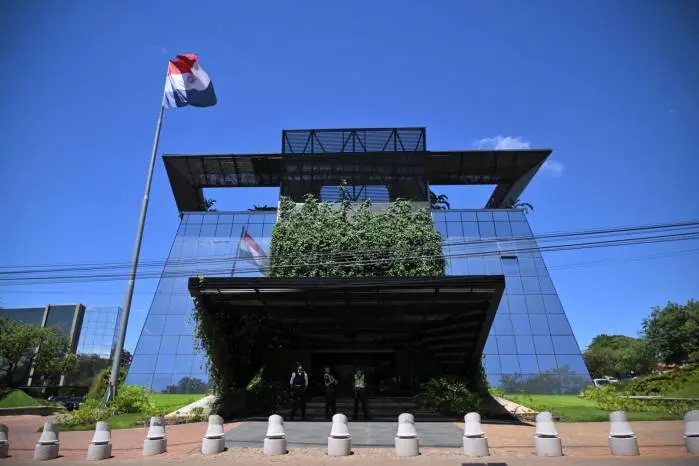
The official explained that the business structure is complex, consisting of nearly 40 companies that provided various services to Ueno Bank. Photo: RODRIGO BUENDIA | AFP
By Manuel Vega Loo (La Estrella de Panama)
HAVANA TIMES – Paraguay’s Minister of Labor, Monica Recalde, said she had received communications from workers in Panama, Nicaragua, Argentina, and Mexico who provided services to the company Itti and received their salaries from Paraguay.
Workers in Panama are among those affected by the crisis involving companies linked to Ueno Bank in Paraguay, which has impacted approximately 7,000 direct employees, both in Paraguay and abroad, Monica Recalde told radio station Universo 970 AM.
In an interview, Recalde explained that the impact of the situation extends to several countries because companies associated with the business group provided technology and IT support services from Paraguay while employing workers in other markets.
The minister said she had received communications from workers in Panama, Nicaragua, Argentina, and Mexico who provided services to the company Itti and received their salaries from Paraguay.
Itti is a Paraguayan technology company founded in 2004 and owned by Grupo Vazquez. It specializes in software development and digital solutions for the financial and corporate sectors.
Recalde clarified that these employees are subject to the labor laws of their respective countries, although their employment relationships were connected to the Paraguayan business structure.
The minister told Universo 970 AM that the Paraguayan government’s updated estimate is approximately 7,000 workers affected by the crisis, including employees of the bank, affiliated companies, and nonbank correspondent operations.
Of that total, around 6,000 are workers associated with the bank and companies operating in Paraguay, while the remainder are linked to international operations.
The minister explained that the business structure is complex, consisting of nearly 40 companies that provided various services to Ueno Bank.
According to Recalde, some employees had contracts with one company but, in practice, performed duties for another company within the same corporate network or directly for the bank. She noted that some workers even used the bank’s uniforms, email accounts, and equipment, although they were formally employed by third parties.
Among the first measures adopted by Paraguay’s Ministry of Labor was the elimination of contractual restrictions that prevented employees from providing services to other companies.
Recalde explained that several companies maintained exclusivity clauses prohibiting their employees from working for another company, in some cases for up to six months after their employment ended.
The Ministry issued a ruling releasing workers from that obligation and allowing them to seek other employment opportunities or work independently, even if they remain on the companies’ payrolls.
The minister justified the decision on the grounds of the right to work and the lack of actual work assignments, since many of these companies had ceased operations and their employees were no longer being assigned duties.
The ruling was delivered to representatives of 37 companies linked to the group.
Recalde also reported that the Ministry of Labor had asked the Board of Directors of the Social Security Institute to evaluate exceptional measures to protect access to medical care for affected workers.
Concerns include pregnant women and people requiring medical treatment, given the uncertainty surrounding the continuation of their social security contributions.
The minister said the last employer contributions recorded by the companies corresponded to September and that the government is seeking to coordinate mechanisms to prevent employees from losing access to medical services.
She also noted that working groups continue to review the legal situation of each employee and determine the conditions for paying their severance and other employment benefits.
Regarding the possibility of the state helping keep some of the affiliated companies operating, Recalde said the government is examining the issue but cautioned that it must first understand how the business model functioned and the legal circumstances of each company.
First published in Spanish by La Estrella de Panama and translated and posted in English by Havana Times.
Read more news here on Havana Times.