By Amado Viera
HAVANA TIMES – During its final years under state management, the Punta de Ganado campground was notorious for the neglected condition of its beaches. By the summer of 2025, mounds of sargassum seaweed covered most of the swimming area, and vacationers had to resort to ingenious maneuvers just to get into the water.
Santa Lucía Beach, where Punta de Ganado is located, is particularly hard hit by the arrival of this seaweed, carried by ocean currents from the vast expanses of the Atlantic. For decades, it was common to see tractors in the mornings “plowing” the dunes to collect the sargassum that had washed ashore the night before. Crews of workers would then haul it to designated dumping sites far from the coast. It was laborious work, but essential to keeping this Camaguey beach resort clean.
However, as the economic crisis worsened in 2022–2023, sargassum removal was among the first activities to suffer budget cuts. Before long, only the stretches of beach occupied by hotels and other tourist facilities were being cleaned. Later, not even those areas received attention. With foreign tourism disappearing and domestic tourism falling to a minimum, there was no one to pay for the cleanup. Mounds of rotting sargassum on the sand became the new normal that greeted the few Cuban vacationers who ventured there.
For Now, More Expensive
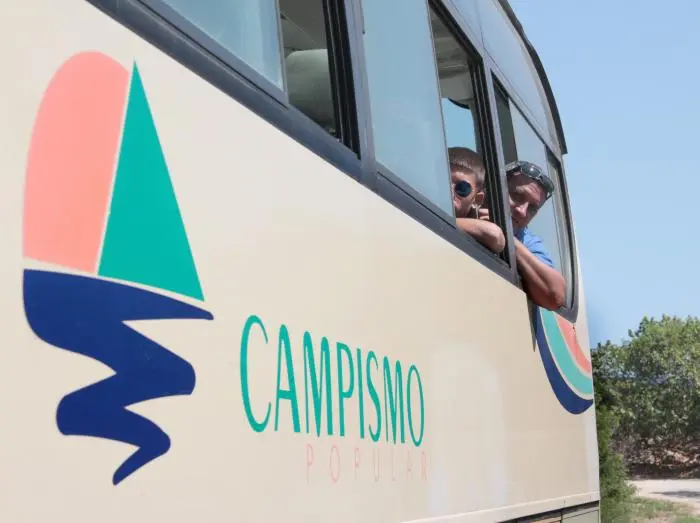
In mid-October, Punta de Ganado became one of the first campgrounds to be managed by a private business. These facilities are intended primarily for Cubans. Although the Popular Camping Business Group has issued no public statement about the transfer, it is most likely part of a broader process that will affect a substantial portion of the roughly 100 such facilities across the country. An employee of the group’s Camagüey branch said that, at least in the province, the goal is to transfer all seven of its campgrounds to private management before the end of 2027.
Punta de Ganado was leased to a private company that committed to restore its beach, open-air pavilion, and restaurant first; then, in a second phase, repair the cabins, “so that accommodations will be available during next year’s vacation season.” That was the explanation given by one of the sales promoters who advertise day trips there on Facebook and other social media platforms.
The offers are far from cheap. Round-trip transportation from the city of Camagüey costs between 5,000 and 6,500 pesos per person, depending on the private transportation provider hired. Admission to the campground costs an additional 500 pesos per adult and 300 pesos per child or teenager. (With average state salaries under 9,000 pesos a month ($10 USD) these private offers are extremely expensive, while more accessible to those who have private businesses or family remittances from abroad).
That’s how a typical day begins at the new Punta de Ganado, where visitors are prohibited from bringing in food or beverages and can choose from activities as varied as ATV rentals and an inflatable children’s playground. A bubbles party was organized for the facility’s reopening, and “they even hope popular performers will be offering concerts,” the sales promoter highlighted.
The plans are ambitious, but the economic situation presents a formidable obstacle. “The food is as expensive as in the most exclusive private restaurants in Camagüey,” complained Nayara Ramírez, a resident of the provincial capital who attended the facility’s mid-October reopening party.
“It wasn’t bad, but everything has to be put into perspective,” she said. “On the one hand, there were the high prices, and on the other, the beach, which is the main reason you travel all the way there, wasn’t nearly as clean as they advertised. Only the ‘VIP area’ looked as though it had been thoroughly spruced up, but not all customers had access to it. I don’t even want to imagine how much it will cost to stay overnight once they start offering accommodations again.”
This reporter tried several times to contact Punta de Ganado’s new managers, but without success. In general, the businesses beginning to emerge in former Ministry of Tourism facilities follow the principle of attracting as little attention as possible. It is not unusual for changes in management to be made public only after the lease agreements have been signed, and sometimes even after the facilities in question have reopened.
Even the defense of these new businesses is often left not to their owners but to public figures, in what appears to be an attempt to lend the privatization legitimacy.
For example, even Carlos Rene Soriano, director of the Popular Camping company’s Camagüey branch, has come to Punta de Ganado’s defense. Responding to recent criticism of the so-called “VIP area,” he justified the additional 5,000-peso charge for this service by explaining that customers who pay for the service receive “personalized attention, with a waiter who brings them whatever they order; exclusive use of a lounge chair, a table and four chairs; and access to one of the cleanest beaches in the resort area.”
As for the menus costing 5,000 pesos or more per person, he ended the discussion with a blunt remark: “These days, an onion costs 300 pesos.”
Changing the Rules
At first glance, the decision to lease campgrounds and lower-end hotels to private entrepreneurs would seem to be a consequence of the crisis facing Cuba’s tourism sector. As of the end of September, the island had recorded a decline of nearly 40% in foreign visitors compared with 2025, a year that was already considered poor. And the outlook is even worse, mainly because of fuel shortages, which have reduced foreign airline operations to a minimum and, consequently, tourist traffic.
But that circumstance explains only part of the problem. The other fundamental variable in the equation is the peso’s exchange rate against the dollar, which has made virtually all state-owned enterprises unprofitable.
Balancing the books has become practically impossible, explained Yasmani Rabelo, an accountant who worked for years at the Popular Camping Company’s Camagüey branch.
“When Punta de Ganado reopened after the pandemic, there was a certain correspondence between the official exchange rate and the informal market rate, and state-owned companies still sold supplies and provided services at prices that aligned with both. But as the peso continued to lose value, an increasingly wide gap developed between the government’s exchange rate and the real one, which is what private businesses operate with. This happened while virtually all commerce was shifting into private hands, which sell at much higher prices. Popular Camping and other similar companies did not raise their rates to the same extent and began accumulating losses, to the point where they couldn’t even cover their workers’ low salaries,” he explained.
By the end of 2025, the situation had become unsustainable. That year, during the last summer the facility operated under state management, “there were barely enough supplies to serve the campers. The facilities weren’t repaired, the furniture wasn’t replaced, and when it came to food, we reached the point where the restaurant had only one meat option and the cafeteria couldn’t open because there was nothing to offer,” Rabelo recalled. To generate enough income to operate normally, they would have had to double or even triple most of their prices, something government guidelines didn’t allow state enterprises to do.
Private companies, whose only obligation is to their owners, don’t have to abide by that restriction. The clearest reflection of this change in approach can be seen in the prices, which at Punta de Ganado increased between fourfold and tenfold, simply because of the change in management.
Far too much for most Cuban families to afford. It matters little that the beach is cleaner than it was a year ago. Ultimately, many Cubans will no longer be able to enjoy it.
Read more from Cuba here on Havana Times.