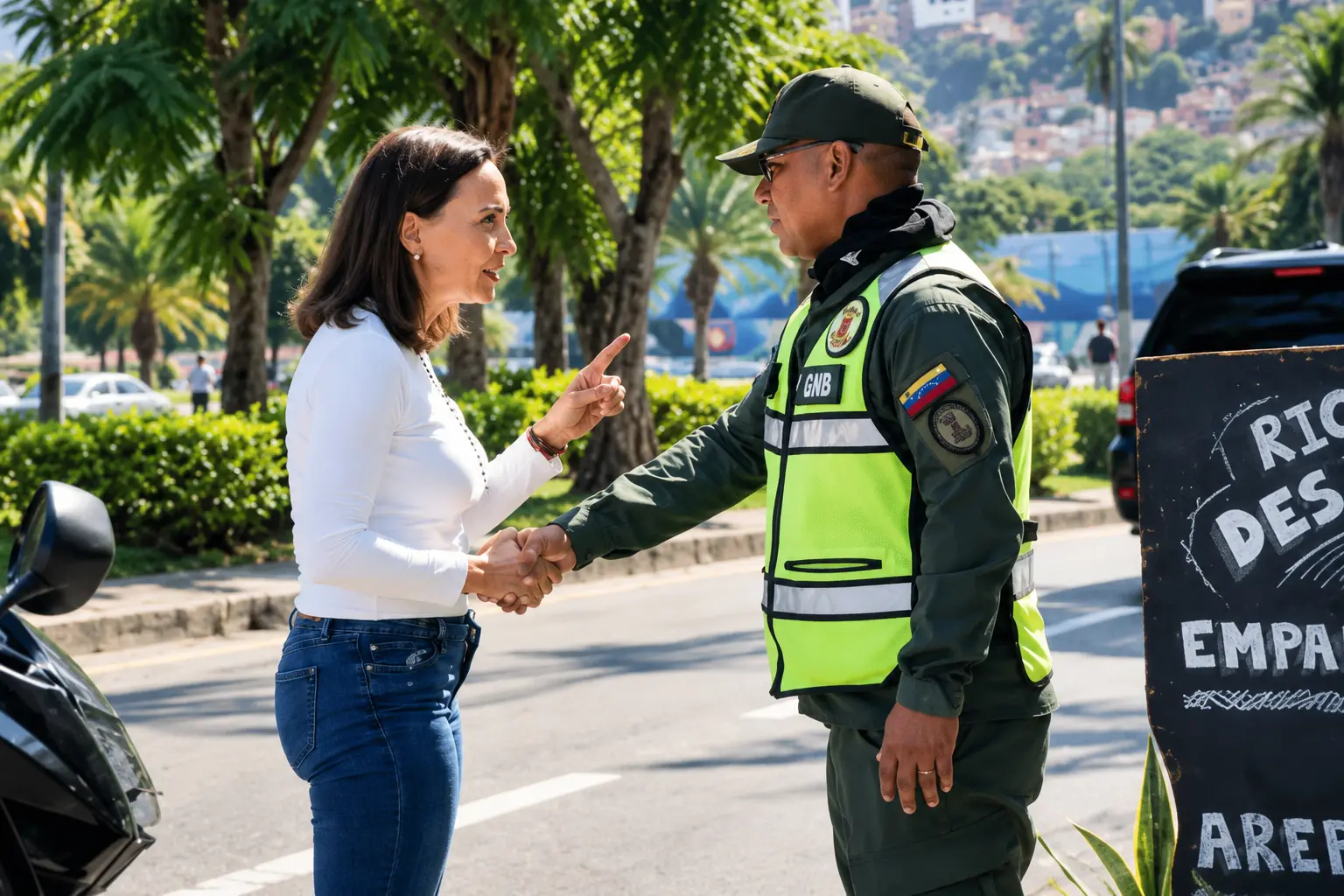
Within a few hours, the image was circulating across social media, as if the uniform itself had bowed before the opposition figure.
By Antonio de la Cruz (El Nacional)
HAVANA TIMES – A National Guard officer’s greeting to Maria Corina Machado changed nothing, and that is precisely why it deserves attention: transitions are lost when an image is mistaken for an institution.
On October 28, in La Guaira, María Corina Machado was making her way along roads damaged by the June 24 earthquakes. She had been back in Venezuela for three days. A National Guard officer approached her, greeted her, and spoke with her for about ten seconds. Someone recorded the encounter. Within hours, the footage was circulating on social media as though the uniformed officer had bowed before the opposition leader.
That scene changes nothing. No command changed hands, no order was disobeyed, no military barracks declared its allegiance. It was a gesture of courtesy between two people on a street where residents are still waiting for their homes to be rebuilt. Even so, dismissing it as meaningless would be another mistake. Transitions rarely begin with decrees. They begin with images that show a society that another way of behaving is possible.
In Venezuela, two forms of power coexist but do not coincide. One controls the guns, the budgets, the appointments, and the offices. The other enjoys the recognition of millions of people who turned out to welcome Machado on October 25 and who accompany her on every visit. The first commands because it can compel obedience. The second carries weight because people accept its legitimacy. The story of recent years is the distance between these two forms of power. The greeting in La Guaira matters because, for ten seconds, that distance seemed to disappear.
Consider the guard. If he offers a greeting, he risks disciplinary action, a mark on his record, or his career. If he does not, he risks nothing. The calculation made by a public official in a polarized country is not heroic: it is the calculation of someone who feels he could lose what he already has. That is why such a gesture should not be interpreted as an expression of allegiance or an act of disobedience. It raises a question: what would happen if offering a greeting carried no consequences? The answer does not come from the guard. It comes from the rules that protect or punish those who offer such greetings. And in a country where everyone watches everyone else with suspicion, every public gesture is calculated twice: what does the superior see, what does the public see, and what price might be paid tomorrow?
Machado did not go to La Guaira looking for a military barracks. She went to visit earthquake victims. That is the second meaning of her visit: a movement born in the streets wants to become a set of rules that apply to everyone, including those who did not vote for it. That requires something more difficult than mobilizing supporters: treating officials of a state that until yesterday shut its doors to you with respect, without asking them to betray their uniforms, but rather to uphold the law. No one takes the first step if they distrust what the other side will do tomorrow. That is why gestures are not enough, written, public, and verifiable agreements are needed.
Each media outlet framed the visit in its own way. Some focused on the greeting. Others highlighted residents’ questions about reconstruction. Both portrayals are accurate, and both are incomplete. The image of the greeting says one thing: a guard greets a political leader. It suggests another: respect and peaceful coexistence. And it tempts people to tell a third story: that reconciliation between civilians and the military has already taken place. That third story is a myth, and the myth is dangerous because it allows people to celebrate a transition that does not yet exist. Images of peaceful coexistence, on the other hand, undermine the narrative that everything must be confrontation. That is their real value, and also their limitation.
We must distinguish between different levels, just as we distinguish between having the key and owning the house. Machado has the support of the people in the streets, but she does not control the treasury, the appointments, or the signature that moves an administrative file forward. A greeting hands over none of those keys. Nor does it take them away. What it does is show that, for a moment, the door was not closed.
From here on, there are three possible paths, and none is predetermined. The first is that everything remains the same: the greeting becomes an anecdote, and the rules do not change. The second is that a small opening emerges: greater guarantees for civil interactions and public signs of neutrality. The third is that the laws, oversight mechanisms, and training change. Only the third constitutes a transition. The other two are simply waiting under better lighting.
Meanwhile, each actor operates according to a different timetable. Washington is watching the November 3 electoral calendar and calling for a new Supreme Court before the end of the year and an Electoral Council afterward, without yet setting a date for voting. Delcy Rodríguez’s interim government administers and negotiates, needing the process to move forward without losing control. Machado mobilizes supporters and demands guarantees, but she does not sign appointments. The Armed Forces protect their discipline and institutional continuity. None of these timetables matches that of La Guaira’s earthquake victims, who measure time in homes that have yet to be rebuilt.
The United States is currently calling the shots in the process. That brings both an advantage and a risk. The advantage is that no one else can impose a timetable on a government that has spent years pushing deadlines further into the future. The risk is that outside supervision becomes the norm: Washington manages the deadlines, Caracas manages the waiting, and democracy is always postponed until the next phase. First, prevent everything from collapsing; then rebuild; and finally, hold elections. The sequence sounds reasonable until one notices that the third phase never arrives.
That is why the right question is not whether the guard sympathizes with Machado. Nobody knows, and it does not matter. There are five questions that matter, and all must be answered with facts, not photographs. Are the same protocols applied to political leaders of every persuasion? Is an officer punished for greeting an opposition figure? Have the doctrine, training, and oversight of the security forces changed? Are abuses investigated independently, and is professionalism rewarded as firmly as misconduct is punished? Can Parliament genuinely exercise oversight over the uniformed services? As long as the answers to those questions remain no, La Guaira will be an anecdote, not a turning point.
There is another level that almost nobody examines: the middle ranks, the officers who connect orders from above with the streets below. Their training, salaries, and legal protections determine whether a reform is implemented or shelved. A guard offering a greeting is the first rung of a four-rung ladder: the gesture, the permission, the rule, and the Constitution. The greeting barely reaches the first. A transition is not brought about by a single leader. It is achieved by a network: judges, parliament, military commanders, and citizens who exercise oversight.
Ultimately, the measure of change will not be how many military personnel greet a political leader. It will be whether any Venezuelan, Chavista or opposition supporter, can approach a uniformed official with the same guarantees. On October 28, in La Guaira, an image suggested that this is possible. Images do not bring about transitions. Institutions are built after the cameras are turned off do. Venezuela will know it has crossed that threshold on the day a greeting like this is no longer news.
Read more opinion articles here on Havana Times.