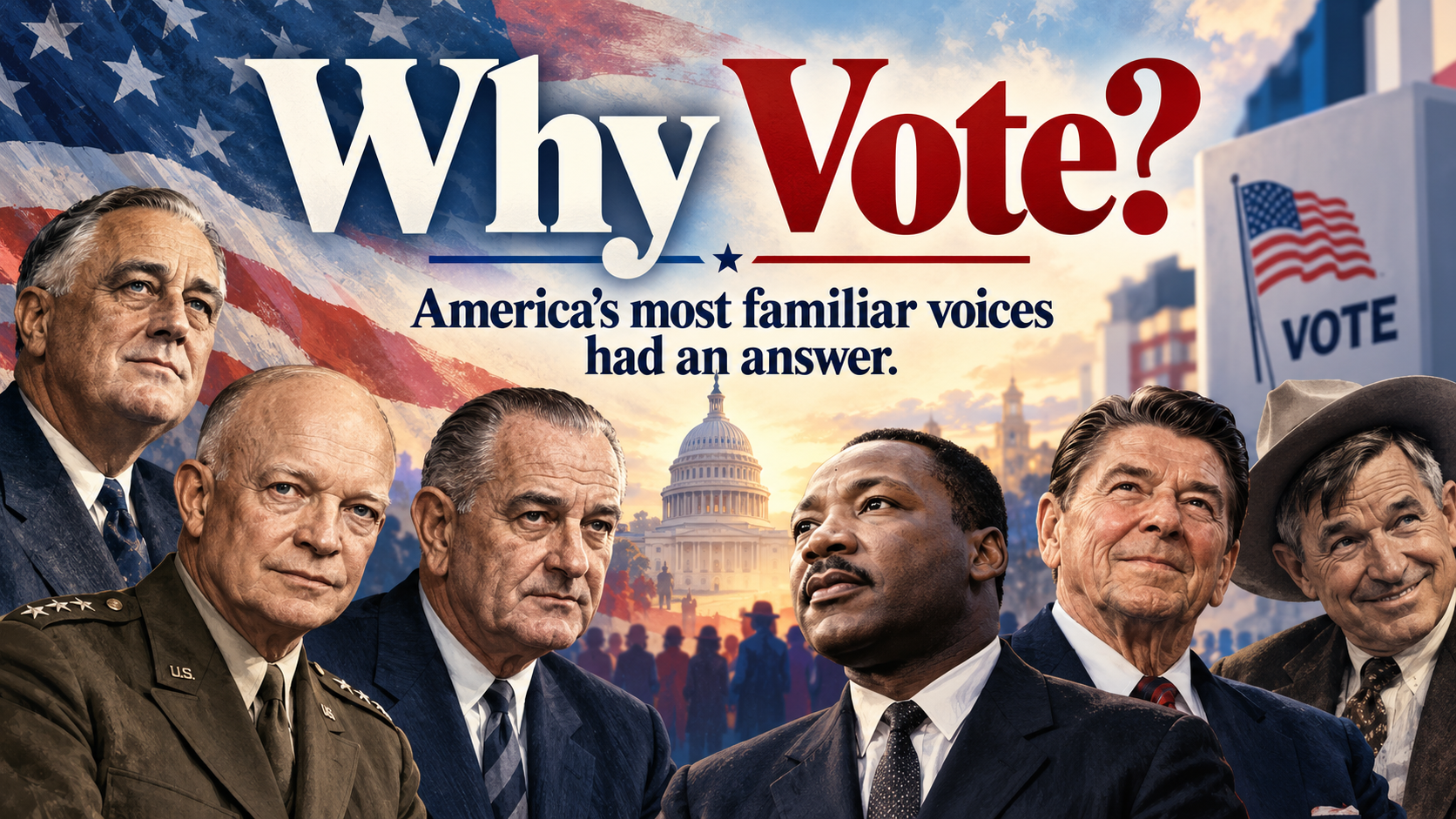
Presidents, civil rights leaders and America’s favorite humorists disagreed about plenty. On the importance of citizens showing up, their message was remarkably similar.
By George D. Rotsch, Publisher of Delaware LIVE
WILMINGTON, Del. — Americans have never needed much encouragement to complain about politics.
Will Rogers made a career out of it.
“I don’t make jokes. I just watch the government and report the facts,” the beloved humorist famously observed. The line, attributed to Rogers in a later Saturday Review quotation, still sounds surprisingly current.
But behind the jokes, arguments, campaign signs and partisan disagreements is a responsibility Americans across generations have repeatedly been reminded not to ignore:
Vote.
Not because everyone agrees.
Not because every voter loves every candidate.
And certainly not because politics suddenly becomes pleasant.
Americans vote because choosing the people who govern them is one of the fundamental privileges — and responsibilities — of citizenship.
The future is in voters’ hands
Dwight D. Eisenhower put it simply in 1949:
“The future of this Republic is in the hands of the American voter.”
Eisenhower, the general who commanded Allied forces in Europe during World War II before becoming president, went further in that speech. Americans, he argued, should stop treating politics as something that belongs only to politicians and stop assuming one vote does not matter.
His point was straightforward: Self-government requires citizens to participate in governing themselves.
Franklin D. Roosevelt delivered a similar warning during a 1944 radio address.
Roosevelt argued that Americans were unlikely to lose the right to vote because someone simply took it away. The greater danger, he said, was Americans surrendering its power by choosing not to use it.
That idea may be especially relevant in an era when political frustration sometimes becomes an excuse for staying home.
Not voting is also a choice.
It simply leaves the decision to everyone who does vote.
A powerful instrument
For millions of Americans, the right to vote was not always guaranteed in practice.
That history was central to President Lyndon B. Johnson when he signed the Voting Rights Act in 1965.
Johnson called the vote “the most powerful instrument ever devised by man” for confronting injustice.
His message was directed particularly toward Black Americans who had been systematically denied access to the ballot, but the broader lesson survives: A legal right acquires its political power only when citizens exercise it.
Martin Luther King Jr. made much the same argument during the civil rights movement, repeatedly linking voting with the ability of ordinary citizens to turn demands for change into political action.
The ballot is different from almost every other tool available to citizens.
You can complain about your taxes.
You can yell at the television.
You can argue with your neighbor.
You can post something online.
But voting is the moment when opinion becomes a decision.
A ‘crown jewel’
Republican President Ronald Reagan approached the question from another direction.
“The right to vote is the crown jewel of American liberties,” Reagan said while advocating an extension of the Voting Rights Act in 1981.
That sentiment helps demonstrate how deeply the principle crosses ideological lines.
Roosevelt was a Democrat.
Eisenhower and Reagan were Republicans.
Johnson was a Democrat.
King challenged leaders in both parties.
Yet all recognized essentially the same principle: The legitimacy of representative government ultimately rests with the people who choose it.
And there is something wonderfully American about that.
A president’s vote counts once.
A billionaire’s vote counts once.
The person standing beside you in line whose political opinions drive you absolutely crazy gets one, too.
So do you.
You don’t have to love politics
Perhaps one reason Americans sometimes tune out elections is that politics can feel exhausting.
The advertisements are relentless. The arguments are predictable. Candidates sometimes seem more interested in explaining why the other person is terrible than why they themselves deserve the job.
Will Rogers would probably have found plenty of material.
Another old political saying captures the problem neatly: “Bad officials are elected by good citizens who do not vote.”
The phrase has long been attributed to critic George Jean Nathan, although research suggests its precise origin is uncertain, and versions of it were circulating by the 1920s.
The authorship matters less than the point.
Choosing not to participate does not remove politics from your life.
Elected officials will still make decisions about schools, roads, taxes, public safety, business regulations, energy, health care and countless other issues.
The only question is whether you participate in choosing them.
Your neighbor doesn’t have to be wrong
There is another reason to vote that sometimes gets overlooked.
Voting does not require believing that everyone who disagrees with you is ignorant, dishonest or dangerous.
In fact, the American system was built around the assumption that citizens would disagree.
Sometimes loudly.
An election gives Americans a peaceful way to settle those disagreements for the moment and then return later and reconsider the decision.
The winner governs.
The loser gets another opportunity.
Citizens continue arguing.
And the country continues.
That process is imperfect, frequently frustrating and occasionally messy.
It is also extraordinary.
The simplest argument
So why vote?
Roosevelt might say because a right unused can lose its meaning.
Eisenhower might say because the future of the republic belongs to the voter.
Johnson might remind us that the ballot can change society.
Reagan might call it one of our most precious liberties.
And Will Rogers would probably make us laugh about whichever candidates we elected.
Different generations. Different political philosophies. Different ways of saying essentially the same thing.
You don’t have to agree with your neighbor.
You don’t have to belong to a political party.
You don’t have to believe your candidate is perfect.
You don’t even have to enjoy politics.
Learn about the people asking to represent you. Make your own decision.
Then participate.
Because democracy ultimately depends on ordinary Americans deciding that their voice is worth using.
TO GO
What: Learn more about the history and importance of voting in America
Why it matters: Voting allows citizens to choose their representatives, hold government accountable and peacefully decide the direction of their communities and country.
Learn more: The Eisenhower Presidential Library, Franklin D. Roosevelt Presidential Library, Ronald Reagan Presidential Library and Lyndon Baines Johnson Presidential Library maintain speeches and historical materials documenting presidents’ views on voting, citizenship and representative government.
Delaware LIVE collaborates with a network of professional journalists to cover a diverse range of stories across various fields. Staff Writers include experienced journalists and young professionals. If you have questions, please feel free to contact [email protected] or our publisher, George D. Rotsch, at [email protected]