- In central Mozambique’s Tónduè Forest, uncontrolled fires destroyed 70% of replanted trees, leaving surviving saplings stunted and fire-damaged.
- Post-planting monitoring remains one of the greatest obstacles to forest maintenance in Zambézia province, where sites receive an average of just one visit a year — a frequency officials consider negligible and ineffective for plant growth.
- Local communities are calling for tangible benefits to encourage forest conservation, at a time when a portion of the carbon credit funds allocated to them remains unpaid because beneficiaries lack official documentation.
See All Key Ideas
MOCUBA, Mozambique — Mozambique ranks among the 10 countries with the highest deforestation rates in the world. Each year, it loses about 267,000 hectares (660,000 acres) of forest, with the heaviest rates concentrated in the provinces of Nampula, Zambézia, and Manica. To counter this, a decade ago the country set an ambitious goal to reforest 1 million hectares (2.5 million acres) by 2030, alongside a 2025 target to restore 52,000 hectares (128,500 acres) per year through 2029 on a budget of 105 billion meticais ($1.65 billion).
To date, however, only 58,000 hectares (143,300 acres) have been reforested — a total that includes tree plantations established before the million-hectare goal was set, according to data compiled by Sá Nogueira Lisboa, a forestry professor and researcher at Eduardo Mondlane University (UEM) in Maputo.
Zambézia province in central Mozambique holds one of the country’s main forest areas, key to conserving biodiversity, regulating water resources, protecting soil, storing carbon, and supporting local communities. Yet it also faces severe pressure from deforestation, suffering some of the nation’s steepest losses in tree cover.
Between 2000 and 2024, cumulative forest loss across the province reached 1.26 million hectares (3.11 million acres) — roughly 19% of its total forested area — according to the Provincial Directorate of Territorial Development and Environment (DPDTA). Replanting is critical to restore degraded landscapes, but inadequate follow-up monitoring has squandered much of that effort.
A technician from the District Service for Economic Activities (SDAE) among trees with charred stems in the Tónduè Forest, Zambézia province, Mozambique. Image by Far Vubil.
Recent DPDTA figures point to an improving trend in deforestation. After losing 65,600 hectares (162,100 acres) in 2021, the province saw forest loss drop to 46,800 hectares (115,600 acres) the following year and to 42,200 hectares (104,300 acres) in 2023. The agency attributes the decline to reforestation projects and efforts to curb deforestation across the province.
Covering more than 22 hectares (54 acres) of protected land in the community of the same name in Munhiba, Mocuba district, the Tónduè Forest illustrates that replanting alone is not enough: monitoring is crucial if young trees are to survive.
Three years after the last trees were planted, parts of the forest are regularly scorched by uncontrolled fires set by local residents, according to Ordem Maugete, president of the Natural Resource Management Committee in Tónduè. The fires broke out just a year after planting, wiping out 70% of the replanted trees across a 10-hectare (25-acre) area, said Uilson Malango, a technician with the Mocuba District Service for Economic Activities (SDAE) who accompanied Mongabay into the forest.
Some surviving seedlings have completely charred stems. Others, three years on, remain stunted at just 30 centimeters (1 foot) tall.
“They are 3 years old, the same time [since replanting] as the ones [unaffected by fire] that are currently about 5 meters [16 ft], but they remain so small because they burned; their leaves fell off but they didn’t die, so they tried to regenerate amid unfavorable conditions,” Malango said.
The area is part of the miombo woodland, an ecosystem covering nearly two-thirds of Mozambique’s forested land, according to 2018 World Bank data. Dominant native timber species include chanfuta (Afzelia quanzensis), mbaua (Khaya anthotheca), umbila (Pterocarpus angolensis), and murroto (Cordyla africana), alongside medicinal plants such as giraro and wild fruit trees including wild guava (Psidium guajava), colodja (Thespesia garckeana), maphidge (Vangueria infausta), and themá (Landolphia kirkii).
In 2025, the government transferred management of the Tónduè Forest to the local community, hoping residents would monitor the woodland more consistently and compensate for weak state oversight.
Shortly after the handover, however, the trees replanted three years earlier burned again. Malango said uncontrolled fires in the Tónduè Forest are primarily driven by land clearing for farming and housing, as well as hunting. During a visit to the area, Mongabay saw wire traps set to catch small animals — mostly rodents known locally as bush rats, hunted for subsistence — making walking through the forest hazardous.
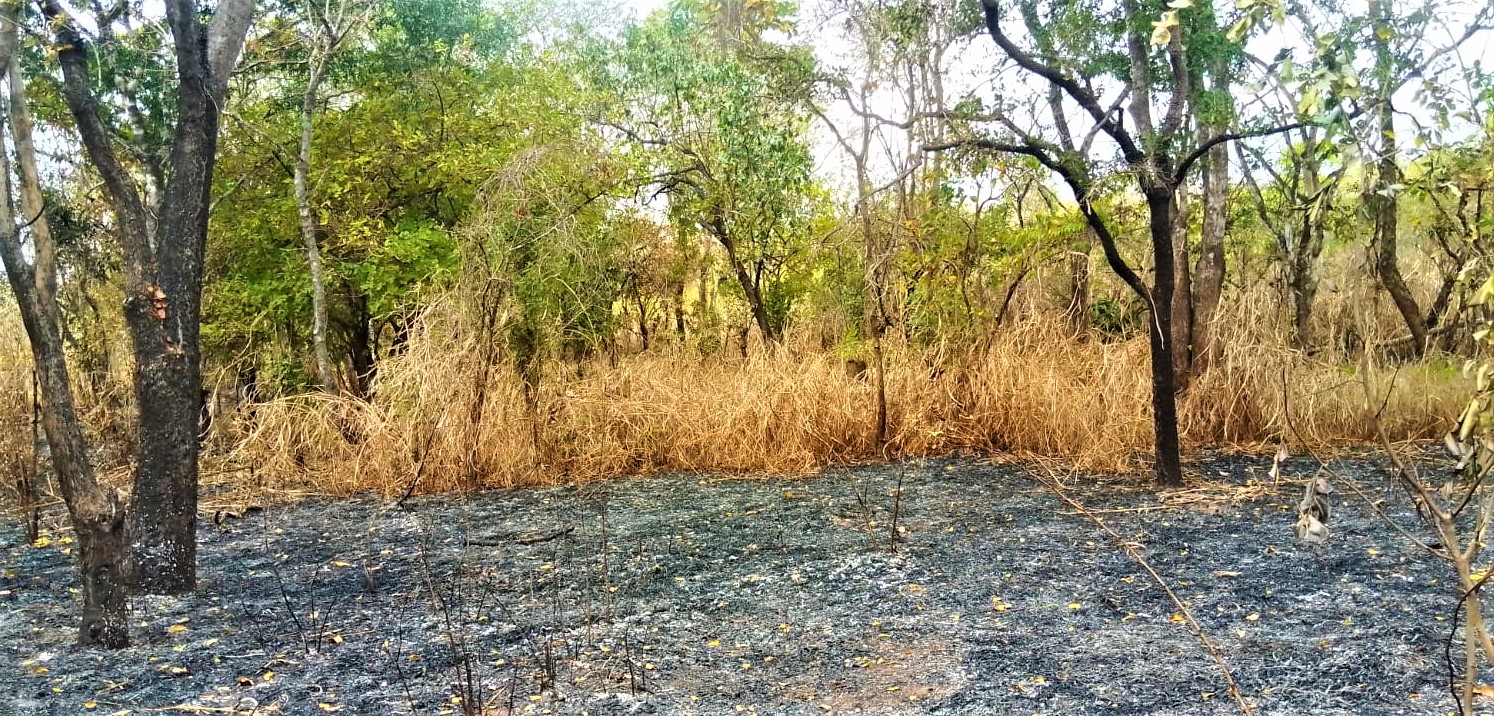
Typical vegetation of the miombo woodland ecosystem in Tónduè, Mozambique. Image by Far Vubil.
At the entrance to a settlement of just over 2,000 homes in Munhiba, Mongabay observed fresh clearing across at least 2 hectares (5 acres), with trees cut down and small branches scattered across the ground to make way for houses and agriculture.
Further inside the settlement, about 10 kilometers (6 miles) from National Road 11 between Mocuba and Milange, stands the entrance to the Tónduè Forest. Vast tracts of once-green woodland now lie in ashes. District government data show that just 30% of the trees replanted in 2023 survived the fires.
The government hired a contractor to carry out the replanting, but conducted no follow-up monitoring. The land was subsequently turned over to community management last year, “but the biggest challenge is that the same community needs machambas” — small plots for subsistence farming, often state-owned and used communally by family members — “for agriculture,” Malango said.
Local residents said most fires are set deliberately and without clear purpose. They noted that environmental education is lacking in the area and that families have few other ways to survive. Most households earn their living from small-scale farming, growing pigeon peas and cassava to process into flour for sale. Living far from the city with no formal jobs, they reside in adobe-brick homes thatched with straw.
That reality is typical across rural Mozambique, where most of the population resides and where household economies depend directly on natural resources such as forests, fisheries, and fertile soil.
“There are bad people who burn the forest for no apparent reason,” said Nonita Maurício, a young farmer born. “I believe other energy sources like electricity could reduce pressure on resources, because what causes the most devastation to the forest in our community is the search for firewood for cooking.”
Maurício walks more than 10 km every day between her home and the machamba with a baby in her arms. According to a 2018 World Bank report, 80% of Mozambican households relied on wood and charcoal for their household energy needs.
For fellow resident Zita Lampião, the woodland provides more than just firewood, charcoal, and medicine; it is life itself, shielding fragile homes from strong winds. “But as long as the lack of almost everything persists in the region, harm to nature will continue,” she said.
Under Mozambican legislation, the state establishes forest management units in designated areas governed by participatory plans. These frameworks are intended to ensure sustainable oversight of forest resources, organize local communities, and guarantee public participation in managing them.
Although the law recognizes community-based forest management, nongovernmental organizations report that citizen participation remains weak, regulations do little to curb resource extraction, and government enforcement is sporadic. As early as 2007, a study published by the Foundation for the Conservation of Biodiversity (BIOFUND) found that effective community management requires addressing both internal and external obstacles, securing community rights to access and own natural resources, and cutting bureaucratic hurdles.
Ordem Maugete, president of the Natural Resource Management Committee, gives an interview in front of a house made of adobe blocks with a thatched roof, typical of the region. Image by Mariano Mucueia.
Community funding mechanisms are inefficient
Across Mozambique, uncontrolled fires — 90% linked to human activity — devastate roughly 30 million hectares (74 million acres) of forest each year. The practice is driven by poverty: burning is the fastest and cheapest method for rural families to clear agricultural fields and strip brush around homes to keep wild animals away.
In Zambézia alone, DPDTA data show that uncontrolled fires consume 65,000 hectares (160,600 acres) each year.
Florentino Cardoso, director of the SDAE, told Mongabay that the district has set up several programs to curb forest loss. Most notably, the World Bank funded 33 community-based organizations (OCBs), including one in Tónduè, to promote alternative livelihoods like beekeeping. These community groups received 37.8 million meticais ($591,000) through the Carbon Fund to protect local forests.
“We feel that awareness messages to communities are not yet taking hold. Community consciousness is geared more toward cultural aspects. One of the funded programs was beekeeping; we showed them that without forests there is no beekeeping, so it would be necessary to keep the forest standing to continue the activity,” Cardoso said.
Alongside government oversight designed to foster new sources of income, communities are expected to patrol the forest continuously, Cardoso said, noting that where the program is in place, at least 75% of planted trees in the district survive beyond the seedling stage.
Cardoso noted that the initiative ran for five years and has now ended. With that funding gone, the government must find other ways to protect replanted areas, where illegal logging damages roughly 60% of young saplings.
Maugete, the Natural Resource Management Committee head and a Tónduè community leader, said residents saw tangible benefits from forest management for the first time last year, when 22 members received beehives for honey production.
“We do have hives, installed last year, but the lack of technicians to help us manage them is causing beneficiary members to drop out. We haven’t made any [financial] gains from the activity yet, because we started nearly a year ago and haven’t been able to harvest for sale yet,” he said.
Keeping someone to guard the forest full-time is difficult, Maugete said, explaining why fires broke out even after management passed to the community. He identified the lack of environmental education as the greatest hurdle, alongside poverty that forces residents to exploit natural resources to survive.
Official visits usually amount to inspecting seedlings and reminding residents to protect forest resources, Maugete said. Meanwhile, the community has received no word on when the next round of replanting will take place.
Lack of data, community support and money challenges monitoring
The fires and destruction in the Tónduè Forest reflect the wider deforestation crisis across Zambézia, said Marcos Sapateiro, provincial director at the DPDTA. He pointed to shifting cultivation — farming a plot until the soil is depleted, then clearing fresh land — as the primary driver of forest loss.
Sapateiro said planting trees is not the main difficulty in the province. Instead, chronic underfunding makes it nearly impossible to monitor saplings until they mature or to build the community awareness needed for residents to value the standing forest.
A seedling planted three years ago in the Tónduè Forest that has grown to only 30 cm due to fires in the area. Image by Far Vubil.
The government does not yet know how much money comprehensive monitoring would require, Sapateiro added, because officials have not completed those calculations.
“Under normal conditions, monitoring should be done every three months until the plants reach maturity, and even then continuous contact would be needed with communities where reforestation took place, so that they serve as the primary conservation actors,” he said.
The current practice of visiting forests just once a year is negligible and yields no real benefit for plant growth, particularly in the absence of programs that coordinate among state agencies, Sapateiro noted.
“The ideal solutions are not implemented due to lack of financial resources. If we had the financial capacity to carry out monitoring, a positive result of more than 50% could be observed,” he said.
Carbon credits: Community inclusion remains a challenge
Despite those funding shortfalls, Zambézia is a national pioneer in the REDD+ initiative, short for “reducing emissions from deforestation and forest degradation.” The province received $6.4 million for cutting 1.28 million metric tons of carbon emissions across nine districts: Mocuba, Mulevala, Mocubela, Alto-Molócuè, Maganja da Costa, Pebane, Ile, Gilé, and Gúruè.
Sapateiro said the funding was disbursed in two phases starting in 2021, supporting forest restoration in Mocuba, Maganja da Costa, and Alto-Molócuè. Large eucalyptus stands now grow in those areas under agroforestry projects that combine tree planting with food crops to sequester carbon. In both phases, World Bank funds channeled through the National Sustainable Development Fund (FNDS) were divided among provincial authorities, district administrations, and local communities, he added.
“The communities were not prepared to receive the carbon credit funds due to a lack of identification documents and bank accounts. These are rural communities and most of them do not have documentation. For this reason, most of these communities have not yet received the funds properly. This experience makes us reflect on what must be done if another opportunity arises,” Sapateiro said.
Delivering money to communities is only one of the hurdles facing the province’s carbon credit initiatives. Officials also struggle with inaccurate carbon measurement tools, a shortage of trained technicians, and the challenge of keeping replanted forests standing.
A 2024 report by the Center for Public Integrity (CIP) noted that the Zambézia Integrated Landscape Management Program (ZILMP), which aimed to curb deforestation across the nine districts between 2018 and 2024 while generating $50 million in carbon revenue, was undermined by slow disbursements and rising deforestation rates, leaving local communities with few benefits.
Another report published in December 2025 by the Rural Observatory (OMR) reached a similar conclusion, pointing to the social and environmental shortcomings of carbon offset projects registered across Mozambique, particularly under REDD+.
The FNDS did not respond to phone calls and emailed requests for comment prior to publication of this story.
Building a relationship between planted trees and communities
Following the fires in Tónduè, building a stronger connection between communities and replanted trees is critical to securing local commitment to conservation, according to OMR, which researches forestry issues.
That relationship begins with choosing the right tree species, Almeida Sitóe, a researcher at OMR, told Mongabay. Programs must consider what trees communities actually want and ensure the plantings deliver direct economic benefits, he said.
Burned forest area in Mozambique’s Zambézia province. Image by Far Vubil.
Land tenure is just as important. Whether planting takes place on land owned by the state, a community, an individual family, or a private company fundamentally shapes how areas are monitored and protected from harm.
Handing the Tónduè Forest over to local control was the right step, but communities need adequate training if they are to manage the land effectively, according to OMR.
That training must cover regular monitoring so oversight continues even without a forestry technician or government extension officer, which also keeps costs down.
“In a year with a cyclone, for instance, monitoring funds could be diverted to emergency response. As a result, there would be no monitoring. But if communities are trained to take care of it, the process becomes much easier,” Sitóe said. He added that initiatives must also tackle other pressures on the forest, including agricultural clearing, firewood collection, charcoal production, and hunting for wild rats.
Supplying farmers with better agricultural inputs to boost crop yields would ease pressure on woodlands and lower deforestation rates, Sitóe said.
Using early burning techniques — such as cool burns, a well-established method in miombo ecosystems — can prevent catastrophic wildfires later in the hot season.
“The fires often set when hunting wild rats mean people are looking for animal protein; I think they could be given the opportunity to raise small livestock like chickens and ducks, and alongside that, income-generating activities such as honey production using modern beehives could be developed,” Sitóe said.
To reduce woodcutting for fuel and charcoal, he suggested promoting alternative energy sources such as electricity and natural gas. Though natural gas is a fossil fuel, it emits less greenhouse gas than burning wood, and Mozambique is already a major gas producer.
Country needs to stop just planting trees and start establishing forests
True reforestation means more than putting seedlings in the dirt; it requires ensuring they survive to form a functioning canopy. Success should no longer be judged simply by hectares planted or saplings distributed, but by how many trees survive, how they mature and whether restored tracts endure over time.
Lisboa, the UEM forestry professor, called for investing in long-term site maintenance: replacing dead saplings, managing fire risk, shielding plots from activities that disrupt natural regeneration, and choosing species well-adapted to local conditions.
“A planted sapling is only the first investment; the true result is the tree that survives, grows and remains on the land. If some of the saplings do not survive, the number initially planted ceases to be an adequate indicator of success,” he said.
Weighing Mozambique’s reforestation goals — an annual target of 52,000 hectares and 1 million hectares by 2030 — Lisboa noted that the yearly goal nearly matches the country’s entire existing planted area of roughly 58,000 hectares. Meeting it would require Mozambique to replicate each year everything it has planted to date.
“The annual target is very demanding and requires a significant shift in the sector’s implementation capacity. There are few years left until 2030, and we need to substantially increase the planting pace while also ensuring that what was planted survives,” he said.
Communities cannot be viewed simply as the cause of deforestation; they must be central to the solution, Lisboa said. He noted that environmental education should start in primary schools and expand through local leadership, producer associations, and community management bodies.
Lisboa said he sees clear opportunities ahead in monitoring technology. A combination of satellite imagery, drones, geographic information systems, and ground-level surveys now makes it possible to track large forested landscapes far more effectively.
This story was first published here in Portuguese on Oct. 2, 2026.
Citation:
Muatendauafa, A. S. R., & Come, S. F. (2023). Participação das comunidades locais na mitigação de queimadas descontroladas no Parque Nacional de Chimanimani em Moçambique. RECIMA21 – Revista Científica Multidisciplinar, 4(8), e483777. doi:10.47820/recima21.v4i8.3777
Banner image: Burned forest area in Mozambique’s Zambézia province. Image by Far Vubil.