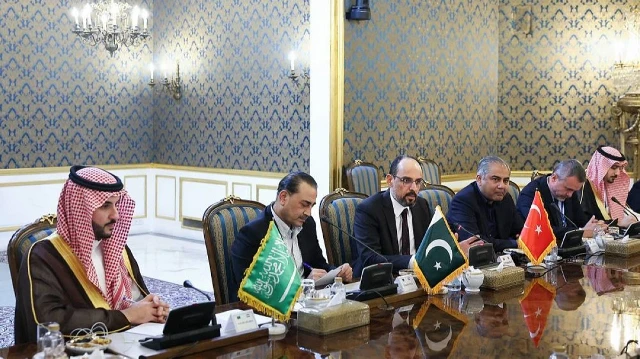
The critical diplomatic meetings held in Türkiye and the region over the past few days carry the potential both to shape the future of the Middle East and to limit the global economic consequences of the Iran war. As Netanyahu and Trump enter a critical election week, their threats to restart the Iran war have increased concerns that their own political agendas will create a new spiral of conflict in the region, while also intensifying regional diplomatic activity. The gathering of European countries and parties to the Mecca Agreement in Istanbul also showed the extent of the concerns about the war flaring up. The meeting of Mecca Alliance countries with Iran in Tehran was aimed at preventing the war from flaring up again and becoming regionalized. It is difficult for these efforts to produce results in a short time, but at least the emergence of a regional initiative marks a significant difference from earlier conflict periods in which the US and Israel were decisive. Filling the diplomatic vacuum left by the US and limiting the instability created by American policies is of vital importance for regional countries.
THE FIRST FRUITS OF THE MECCA AGREEMENT
The Mecca Agreement is actually a response to the attitude of American strategists who have long advocated withdrawing from the region. America’s demonstration that it does not want to pay costs in the region and that it will not protect an ally like Saudi Arabia in a war it entered under Israel’s pressure has been a lesson for regional countries. America’s clear declaration, especially since October 7, 2023, that it will pursue policies that create instability rather than order in the region has shown that regional initiatives are a necessity. The leadership of Türkiye, one of the rare countries capable of approaching the region with a strategic vision, made it possible to take a concrete step like the Mecca Agreement. It is also noteworthy that this formation is an effort in favor of the region, not against America. That is why the issue is not whether to be on America’s or Iran’s side, but to be able to establish dialogue with everyone in order to ensure stability.
The fact that the parties to the Mecca Agreement focus on diplomacy rather than resorting solely to military methods to stop the Houthi attacks on Saudi Arabia shows that the alliance is not based solely on military cooperation. Their talks with European leaders concerned about the cost of the war flaring up again, on the one hand, and their establishment of diplomatic contact with Iran, a party to the war, on the other, show that these countries are acting with a strategic vision, not to save the day. Moreover, their activation of preventive diplomacy without waiting for the war to restart may have been effective in suspending the attacks expected last weekend. The Mecca Alliance members’ moving to protect each other’s security also shows that the region may no longer be condemned to agendas imposed by the domestic political dynamics of Washington and Tel Aviv.
THE US-ISRAEL-IRAN TRIANGLE
Time is needed for the alliance and solidarity efforts within the region to succeed, because it is not possible to say that many countries prioritize regional stability. It is also clear that they are not accustomed to thinking on behalf of the region, because countries that for a long time thought they could guarantee their own security by receiving Washington’s support have seen that this is not the case. Israel, which, despite being a Middle Eastern country, mentally sees itself as above the region, is trying to ensure the continuation of unconditional American support by maintaining a regional war with Iran. American administrations, too, follow the policies preferred by Israel, both because of the power of the Israel lobby in domestic politics and for various strategic reasons. When Iran’s asymmetric but sectarian war effort, maintained under the slogan of a “regional resistance front,” is added to this duo, an equation emerges in which regional stability does not depend solely on regional countries.
The conflict environment created by this triangle, and which it has not seen much harm in continuing, not only prevents the region’s development but also makes it impossible for regional countries to go beyond the security agenda. The fact that lasting international alliances also begin primarily with security explains well why the Mecca Agreement focuses on this. In an insecure region, it is extremely difficult to speak of concepts such as cooperation, trade, diplomatic engagement, and cultural exchange without first ensuring security. It is, of course, not easy to remove one of the actors in the US-Israel-Iran triangle from the conflict equation through diplomacy, because the discourses of “fight to the end,” “existential struggle,” and “resistance” have a very great political function. From this perspective, it is extremely important to be able to break the conflict dynamic created by this triangle by engaging with Iran. Ending Iran’s targeting of Saudi Arabia through its proxies will be a very great success for the Mecca Alliance, but it does not mean this war will end.
After the elections in Israel and America, we may see administrations that either become more aggressive or are forced to step back under domestic political pressure. Netanyahu’s defeat in Israel and the formation of a minority government that does not include him could weaken the hawks, albeit in a limited way. If the Republicans lose their congressional majority, Trump could also face pressure from Congress to end the war. In this scenario, tensions could decrease, but there is also the possibility that both Trump and Netanyahu will use the war as domestic political material. From this perspective, the picture that will emerge from the elections in the coming days is of critical importance for the future of the Middle East, but independent of that, it is much more important that regional initiatives continue to strengthen. Achieving lasting stability in the region is only possible if regional countries cut their own umbilical cords. It would be naive to say that regional countries can easily agree with one another, and perhaps agreement will only be possible after much longer bargaining. However, lasting stability comes not from agreement texts accepted through external impositions, but from understandings reached by the parties through direct negotiation among themselves.