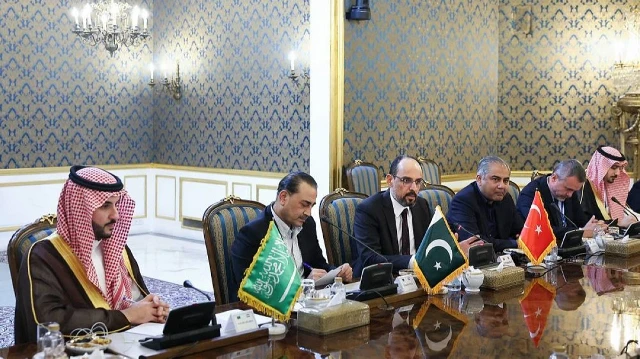
A Turkish parliamentary committee on Tuesday approved a bill ratifying a mutual defense agreement with Saudi Arabia and Pakistan that treats an armed attack on one member as an attack on all, clearing the way for a vote in the full legislature.
The Turkish Parliament’s Foreign Affairs Committee approved the three-article ratification bill for the 16-article Mecca Joint Defense Agreement, signed by President Recep Tayyip Erdoğan, Saudi Crown Prince Mohammed bin Salman and Pakistani Prime Minister Shehbaz Sharif in Mecca on August 7.
The general assembly must now approve the bill for Turkey to complete its domestic ratification process. Saudi Arabia and Pakistan have already completed their domestic approval procedures and submitted the required official notifications, Deputy Foreign Minister Zeki Levent Gümrükçü told lawmakers during Tuesday’s meeting.
Under Article 2 of the agreement, an armed attack from outside their borders against any of the three countries is considered an attack on all of them. The pact provides for assistance to the country under attack, including through military capabilities, with measures to be determined through consultations and carried out in accordance with each country’s constitutional procedures and domestic law.
Foreign Affairs Committee Chairman Fuat Oktay, a lawmaker from President Erdoğan’s ruling Justice and Development Party (AKP), stressed during Tuesday’s debate that the collective defense provision would not automatically result in military action.
Oktay said any measures would be taken within the framework of the countries’ constitutional requirements and national legislation following consultations among the parties. He described the alliance as resting on three main pillars: collective defense, counterterrorism cooperation and the development of domestic capabilities in the defense industry.
He also rejected suggestions that the pact amounted to an offensive alliance or the formation of a bloc against third countries, saying prospective members could join only with the consent of the founding parties.
Gümrükçü similarly told the committee that the agreement was “entirely defense oriented” and “does not target any country,” saying it envisioned regional integration rather than the creation of competing blocs.
He said it is open to countries in the region that respect international law, state sovereignty and territorial integrity and would neither replace nor undermine Turkey’s existing alliance commitments. Oktay separately rejected suggestions that the pact could constitute an alternative to NATO.
The agreement also calls for closer defense industry cooperation, including joint production and technology sharing, as well as intelligence sharing, logistical support and counterterrorism cooperation. It also seeks greater interoperability among the three countries’ armed forces through personnel exchanges, joint training programs and military exercises.
A Strategic Political and Defense Committee comprising the foreign and defense ministers and military chiefs of the participating countries oversees implementation of the pact. A permanent secretariat is to be based in Saudi Arabia, with the secretary-general rotating among the three founding countries for three-year terms and the first secretary-general coming from Pakistan.
The agreement will enter into force once the final instrument of ratification is deposited with the committee’s secretariat.
It will remain in force indefinitely, but none of the parties can withdraw during its first 10 years. After that period, a member can leave by giving the other parties at least three months’ written notice through diplomatic channels.
The provision has attracted criticism from the opposition, which has warned that the pact could draw Turkey into conflicts involving Saudi Arabia or Pakistan.
Opposition politicians have particularly raised concerns about the war in Yemen and Saudi Arabia’s confrontation with the Iran-backed Houthis. Earlier this month opposition figures also criticized the government after Turkey and Pakistan agreed at an emergency meeting in Riyadh to move toward implementing their collective-defense commitments following Houthi attacks on Saudi Arabia.
Any deployment of Turkish military personnel would require separate parliamentary authorization. An AKP lawmaker told Reuters last week that the government plans to seek such approval for sending military personnel to Saudi Arabia after the defense pact itself is ratified.
The three countries have already begun establishing the pact’s institutional mechanisms. The Strategic Political and Defense Committee held its first meeting in İstanbul on August 31 and convened for an emergency meeting in Riyadh on October 5 following attacks on Saudi Arabia.
Turkish Foreign Minister Hakan Fidan has previously described the agreement’s collective-defense provision as technically similar to NATO’s Article 5 while saying the alliance is not directed against Iran or any other country. He has also said the pact was designed to admit additional members as part of what he called a new regional “security and cooperation architecture.”