Synopsis: Both nations advance regional stability, commercial trade growth, technical expertise exchange plus enhanced defence cooperation without donor dependency.
Japan and Cambodia should advance their Comprehensive Strategic Partnership into a new era of co-creation, combining technology, economic cooperation and shared expertise to address common challenges, Japanese Ambassador to Cambodia Ishizuki Hideo said.
Speaking with Khmer Times following the seminar on “Japan-Cambodia Co-Creation: From Longstanding Partnership to Shared Future” in Phnom Penh on Friday, Ambassador Ishizuki said the two countries should move beyond traditional donor-recipient relations towards a partnership based on mutual trust and jointly developed solutions that benefit both nations and the wider region.
He said both countries faced increasingly complex challenges arising from digital transformation, artificial intelligence (AI), green transformation and emerging technologies, requiring closer collaboration to identify problems and develop practical solutions.
“Japan and Cambodia are facing the same challenges, like digital transformation, or green transformation, or the technology, like how to use AI or how to use space technology,” he said.
“To face these common challenges, we should collaborate together,” he added, explaining that both countries could combine their respective strengths and expertise to develop solutions that could be applied in Cambodia, Japan and potentially the wider region.
Ambassador Ishizuki said the concept of co-creation built on decades of bilateral cooperation, during which Japan had supported Cambodia’s reconstruction and development through official development assistance, infrastructure projects and technical cooperation.
He said water supply cooperation demonstrates how the two countries have developed practical solutions together, citing collaboration involving Cambodian officials and Japan’s Kitakyushu City.
“Through that long-standing partnership, they have created solutions to the water supply to improve the water supply in Cambodia. So actually, the model is here,” he said.
Ambassador Ishizuki said the next phase should build on these achievements while extending cooperation into emerging fields such as AI, space technology and digital innovation.
“The world is getting more complex, and we have to find a solution together,” he said, adding that identifying shared challenges and bringing together expertise from different institutions would be central to the co-creation process.
Ambassador Ishizuki said his personal commitment was to advance this approach during his tenure in Cambodia, helping the two countries enter a new phase of bilateral relations.
“I think we are entering into maybe a new phase. So starting from this donor-recipient relationship to another phase, and this another phase should be based on mutual trust, through the co-creation process,” he said. “So I’m trying to advance this concept of co-creation with Cambodia.”
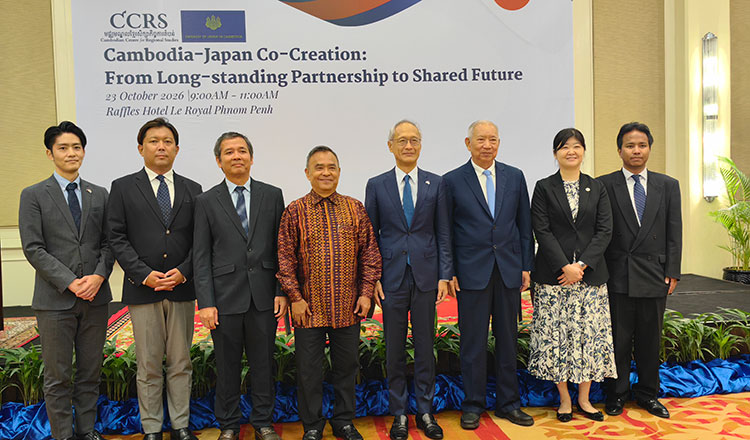
The seminar was organised by the Cambodian Centre for Regional Studies with support from the Japanese Embassy to examine the achievements of bilateral cooperation and identify opportunities for a shared future.
Former Cambodian Ambassador to Japan and Cambodian Centre for Regional Studies Distinguished Senior Adviser Pou Sothirak said the Comprehensive Strategic Partnership, upgraded in 2023, provided opportunities to deepen economic cooperation, strengthen security collaboration and create shared economic value.
“Cambodia and Japan, though geographically distant, have become increasingly close in the contemporary context because of so many things that bind us historically and the numerous values we share today and going forward well into the future,” he said.
Sothirak identified economic co-creation, peacebuilding and development, security and maritime cooperation, and regional and multilateral cooperation as key pillars for advancing bilateral relations.
Japan has supported Cambodia’s development through infrastructure, education, healthcare, demining and cultural preservation. Major projects include national roads, bridges, schools, hospitals and the expansion of Sihanoukville Autonomous Port, a key gateway for Cambodia’s international trade.
Bilateral trade reached $2.53 billion in 2025, up 17.3% from the previous year, according to the Ministry of Commerce, making Japan Cambodia’s fifth-largest trading partner.
Economic ties have also expanded through Japanese investment. Ambassador Ishizuki cited Toyota’s vehicle assembly plant, which began operations in 2024, and the construction of Minebea Mitsumi’s second plant in Pursat province as examples of growing business cooperation.
Sothirak said the Japan-Cambodia Business Co-Creation Team, launched in January, supports Japanese investors, addresses business challenges and improves Cambodia’s investment climate.
The two countries have also expanded cooperation in defence, digital technology and artificial intelligence. In April 2025, Japanese Maritime Self-Defense Force vessels made the first port call by foreign naval vessels at Ream Naval Base.
In July, the two countries signed an exchange of notes for Japan’s first provision of official security assistance to Cambodia. The programme committed ¥500 million ($3.2 million) in security-related assistance in 2026, Sothirak said.
He said closer cooperation with Japan could help Cambodia maintain its strategic autonomy amid intensifying geopolitical competition while supporting ASEAN centrality and a rules-based international order.
Japan and Cambodia established development cooperation in 1959 through an Agreement on Economic and Technical Cooperation. After assistance was suspended during Cambodia’s civil war, Japan resumed its official development assistance in 1991 and expanded full-scale cooperation in 1992 following the Paris Peace Agreements.
The two countries elevated their relationship to a Comprehensive Strategic Partnership in 2023. During Prime Minister Hun Manet’s visit to Japan in May 2025, the two countries issued a joint statement and announced an economic co-creation package aimed at promoting Japanese investment and supporting Cambodia’s economic development.
Japan’s cooperation with Cambodia also extends to maritime and digital connectivity and humanitarian mine action. Ambassador Ishizuki said collaboration with the Cambodian Mine Action Centre has supported mine action efforts in Cambodia and beyond, including Ukraine and several African nations.
Ambassador Ishizuki and Sothirak said the next phase of bilateral relations should build on the achievements of longstanding cooperation while creating new opportunities through joint innovation, economic partnerships and collaboration on regional and global challenges.