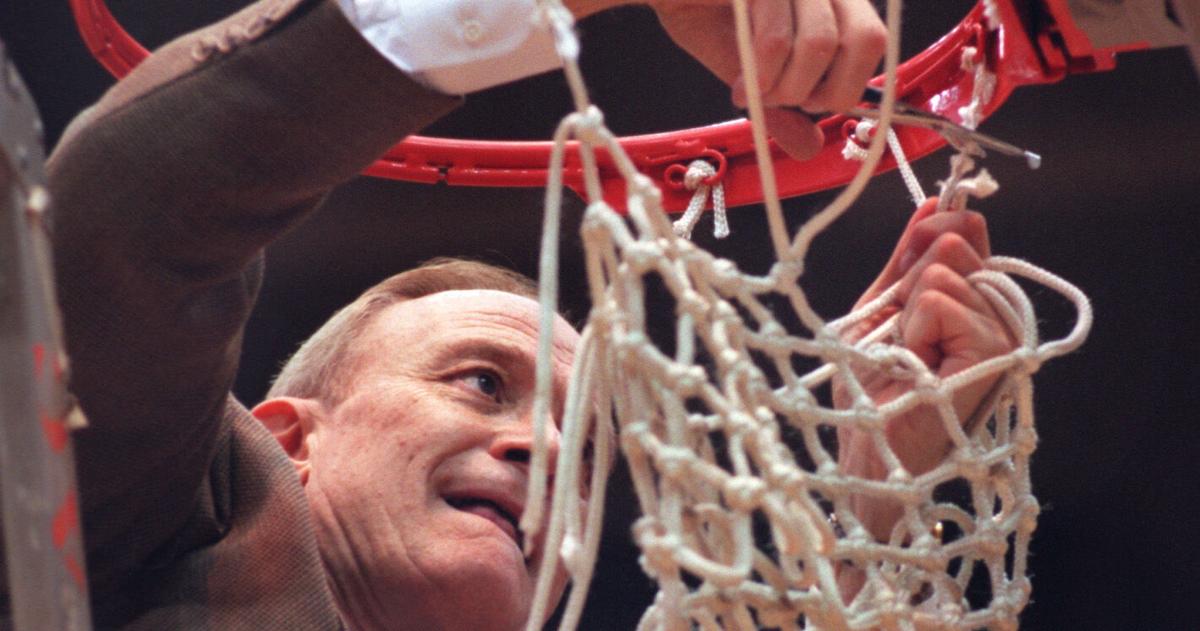
LSU men’s basketball coach Dale Brown cuts down the net after winning his last game coached at the Pete Maravich Assembly Center against Arkansas on March 1, 1997.
STAFF FILE PHOTO BY TRAVIS SPRADLING
“Unique” is one of the most overused words in English language.
But for Dale Brown, no word better applies.
The hall of fame LSU men’s basketball coach, who died Friday at age 90, was a true American original, his life a bona fide Oliver Twist-like tale of a boy who grew up fatherless in the height of the Great Depression to scale the heights of his chosen field.
When Brown retired in 1997 after 25 years as LSU’s coach he had 448 wins, second-most in Southeastern Conference history behind only Kentucky’s Adolph Rupp. Nearly three decades later, Brown impressively still ranks fourth on the SEC’s all-time list.
But mere wins are only a small part of Brown’s legacy. For him, basketball was the highly visible platform from which he championed countless causes.
Make no mistake. Brown wanted to win. He couldn’t have led LSU to two Final Fours, four SEC regular-season titles, the Tigers’ only SEC tournament championship and a total of 15 NCAA and NIT appearances (when the NCAA tournament was smaller and making the NIT was a bigger deal) if he didn’t have a drive to win.
For Brown, though, the struggle, the journey, the battle against what he saw as injustices and inequalities in the world, was more important than what the scoreboard read when the buzzer sounded.
Without question, Brown’s world view extended far beyond the basket or the baseline. As he once said of himself, “I know the Louvre isn’t an in-bounds play.”
There were times when his passion bubbled over the top. Got him into trouble. Like the famous incident at the 1992 SEC tournament when he ran onto the court to shove Tennessee’s Carlus Groves away from Shaquille O’Neal, Brown’s greatest player, after Groves intentionally fouled him.
Brown drew a reprimand from the SEC and Will Wade-like ire from SEC basketball fans.
LSU lost O’Neal to an ejection but won the game, 99-89.
In November 1985 Sports Illustrated, then the unrivaled authority on American sports, wrote a cover story on the wild antics of LSU athletics, it put Brown on the cover under the banner headline “Crazy Days at LSU.” Inside, the profile of LSU’s controversial coach read, “Hello, trouble, I’m Dale Brown.”
“From the moment they snipped the umbilical cord,” Brown said in that 1985 profile, “I’ve been in the middle of controversy.”
Brown spent his life challenging authority and making waves, like how he referred to the NCAA and its draconian rule makers as “Gestapo bastards.” People may have frequently questioned Brown’s antics or motives, but he never wavered in his convictions that he was doing the right thing. Trying to do the right thing for people.
It showed up in the way he stayed after former players to go back to college and earn their degrees, often for years. Or the way he tried to champion rights for players everywhere. That took years too, but agree or not, in true Dale Brown-fashion, many of the things he wanted for student-athletes in terms of NIL compensation, stipends for cost of attendance and relaxed rules on simple things training tables have come to pass.
“He was a motivator,” John Tudor, a guard on Brown’s 1981 Final Four team, told KLAX in Alexandria. “He was always an optimist. He was an excellent coach and a good human being who cared equally for all of his players.”
The “excellent coach” part some of Brown’s detractors quibbled with. His amazing 1989-90 team that included four future NBA first-rounders — O’Neal, Stanley Robers, Chris Jackson (Mahmoud Abdul-Rauf) and Geert Hammink — only reached the second round of that year’s NCAA tournament. In his three NCAA tournament matchups against the fiery Bobby Knight, Brown was 0-3, including that 1981 Final Four. A 1987 one-point loss to Knight’s Indiana team in the Elite Eight in Cincinnati kept LSU from making a Final Four appearance at the Caesars Superdome.
But in his career, Brown’s Tigers beat 28 top-10 teams, including Kentucky’s 1978 national champions in overtime after all five LSU starters fouled out. If you had one game to win and needed someone to coach your team, especially as an underdog, you wanted Dale on your bench.
Brown once traveled the length of the Mississippi River in a speedboat (with my former sports editor and mentor, Sam King, tagging along), tried to climb the Matterhorn and searched for Bigfoot.
“I always thought if I was to die it would be in a fall off the Matterhorn or being eaten by Bigfoot,” Brown said after recovering from a stroke at 67.
Bigfoot wouldn’t have had the guts.