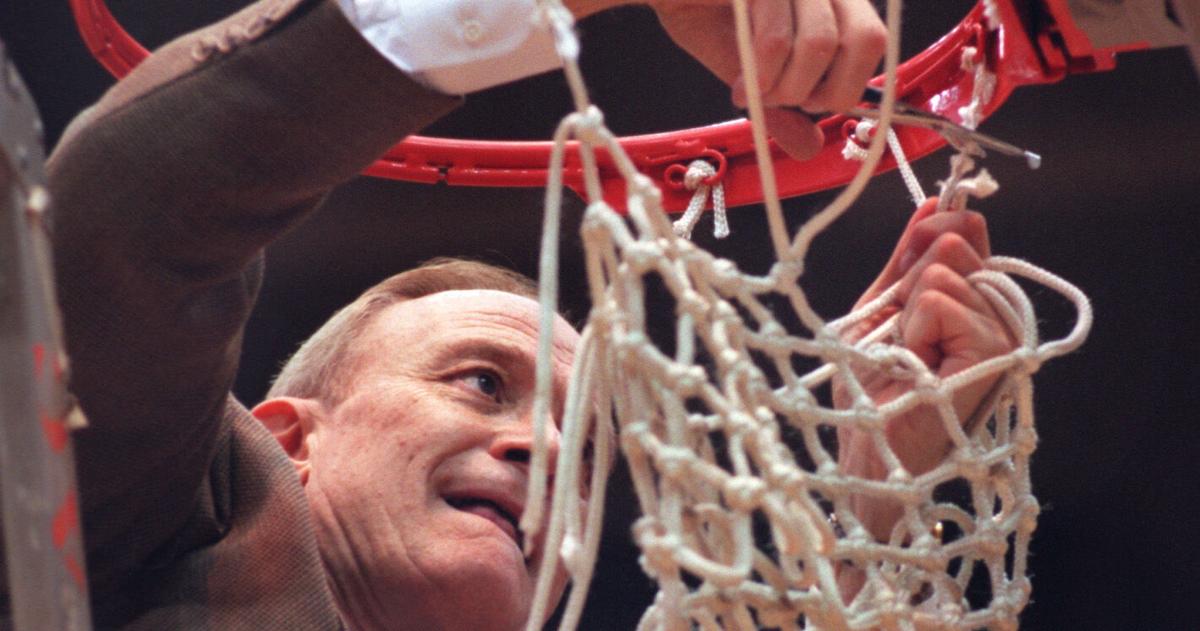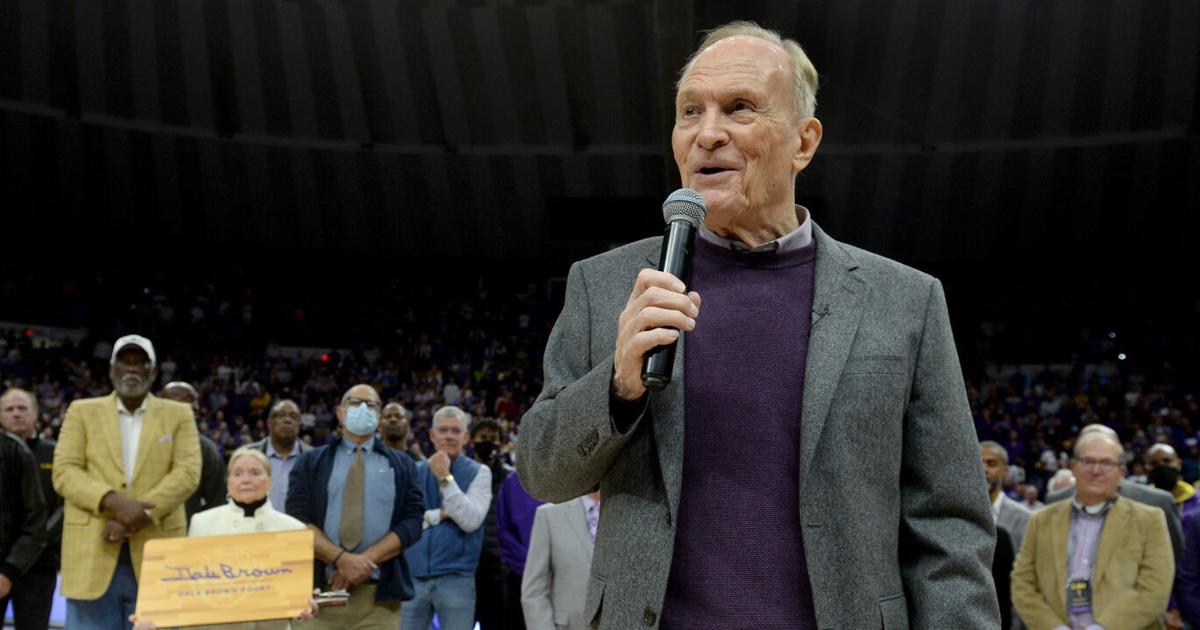
Dale Brown, who built the LSU men’s basketball team into a consistent title contender and became the second-winningest coach in the history of the Southeastern Conference in the process, died at the age of 90 on Friday.
Brown was a seminal figure at LSU, in the SEC and nationwide. He directed the Tigers for 25 years, won four league championships, was runner-up four times, made 13 appearances in the NCAA tournament and reached the Final Four twice, just barely missing a third.
“We have lost the most loving and most loved man any of us have ever known,” his family said in a statement released on Friday. “Dale Brown always put others first. He was always a great humanitarian before anything else.
“Dale long ago fell in love with Louisiana. And the people of Louisiana loved him right back. We are forever grateful for that.”
On Tuesday, Brown was named the 2027 recipient of the John R. Wooden Legends of Coaching Award by the Los Angeles Athletic Club.
When you consider his success on the court and his impact on the game as a whole, Brown certainly fit the description of a legend.
Brown’s total of 448 wins is second only to Kentucky’s Adolph Rupp, who coached the Wildcats to 876. But Brown’s 301 losses also give him the most by a coach in SEC history — mostly the result of his last four seasons, when the Tigers were a cumulative 45-68.
Brown coached Shaquille O’Neal, Chris Jackson (now Mahmoud Abdul-Rauf) and Rudy Macklin, each an All-American — although some of his best teams were filled more with overachievers than superstars.
A Washington State assistant, Brown, a native of North Dakota where he was a noted athlete at Minot State Teacher’s College, was hired in 1972 on the recommendation of former LSU basketball player and future Athletic Director Joe Dean to then-AD Carl Maddox. Brown ultimately lifted the program higher — and for longer — than it had ever been before.
The achievements of Brown, a compassionate rebel with many causes, were overshadowed somewhat by his quixotic quest for universal justice and his striving for a near-perfect world. Brown, a compulsive defender of the underdog and the man whom Norman Vincent Peale once said motivated him, used his job as a bully pulpit against social ills for 25 years — a trademark that defined Brown every bit as much as his coaching acumen.
Sports were part of Brown’s life, but not his entire life.
“I know the Louvre isn’t an out-of-bounds play,” Brown reflected before his last home game in 1997, making the point that basketball didn’t consume him as it does so many others. “I can talk about the planets, Michelangelo and that ‘Blue Boy’ is not a cadaver.”
Still, Brown left an indelible imprint on Louisiana basketball.
He was a complex man who seldom received praise for his basketball achievements by LSU fans, even though he was SEC Coach of the Year or runner-up nine times, and National Coach of Year twice. Fifteen of 16 basketball coaches at LSU before Brown forged 374 victories. Harry Rabenhorst, the other coach, guided LSU to 340 victories and two NCAA tournament victories. Brown built his win total on schedules sprinkled with opponents from the nation’s elite, and he made tournament play an annual occurrence for the Tigers.
LSU had four winning seasons in the previous 18 before Brown’s arrival. He ended his career with four consecutive losing seasons, but before that he forged 17 consecutive non-losing seasons.
In 1980-81, Brown’s Tigers were 31-5, the most victories in the nation and still the best season ever at LSU, which lost to Indiana in the Final Four. Five years later, the Tigers became the first No. 11 seed to reach the Final Four, beating their region’s top three seeds to get there. He also coached two more teams to the Elite Eight.
In the midst of his basketball success, Brown reveled in championing the underdogs of society. He used his position to point out the inequities of life, from the underprivileged to the under-educated, from the hypocrisy of government to the hypocrisy of the NCAA, which he once famously characterized as “Gestapo bastards” for the uneven way he believed it governed. Once, he even dared the organization to give him a lie-detector test to prove him wrong.
In the process of openly challenging the NCAA, to hear Brown tell it, he brought on the wrath — and a personal vendetta — of the organization against him.
In 1981, the LSU program was shaken when guard Mark Alcorn was diagnosed with terminal cancer. Alcorn was from St. Louis, and he hoped three of his teammates and closest friends could attend a dinner for him. Brown informed the NCAA that he wanted to fly the three there, but he was told that was a violation of NCAA rules — that it would be considered “off-campus entertainment.”
Brown gave the three players $300 apiece to attend. That brought on the enmity of the NCAA, which hounded Brown’s program for years with only minor success, none of it involving the coach.
The NCAA finally nabbed Brown when he recruited Baton Rouge’s Lester Earl in 1996. Earl only lasted 11 games before being suspended. He transferred to Kansas, where he said an LSU assistant gave him money. The NCAA could find no evidence of such a transaction, but it did find a booster had given the player $5,000, and LSU was placed on probation.
Years later, Earl recanted his statements and said he was intimidated and manipulated by the NCAA to give them anything they could use against Brown — or else he would lose years of eligibility. He publicly apologized to Brown and LSU.
Brown parlayed his basketball pulpit into access to some of the world’s luminaries, such as Mother Teresa and President George H.W. Bush, who sent Brown a personal note upon learning of the coach’s retirement.
His often unorthodox behavior — which endeared him to some and baffled others — made Brown a compelling figure. He traveled the length of the Mississippi River in a 19-foot speedboat; knocked heads with the KGB in an unsuccessful effort to sneak a player out of the Soviet Union; brought his players to the Carville leper colony and to Angola State Prison to show them the realities of life; and successfully fought for the freedom of a prisoner whom he met during a team scrimmage at the prison.
“I never considered myself white,” Brown once said. “I never considered myself a North Dakotan. I never considered myself a basketball coach. I never considered myself a Yankee. I always think of myself as a human being. I look at people that way.’’
At LSU, where football was always the bell cow and other sports simply tolerated, what Brown did as much as anything was change the attitude toward basketball, making it a major force in the athletic department.
Brown recalled Dean telling him: “If you take the job, you will raise the flag, you will sing the national anthem, you will keep your own stats and you will sweep the floor. (LSU is) totally uninterested in basketball.”
That was not entirely true. LSU basketball was still in the afterglow of the Pistol Pete Maravich era, and the seeds had been sown in Louisiana for a basketball harvest. But there is also no question that basketball was a second-class citizen in the LSU athletic department.
Brown accepted the job, then forced the sport down the doubters’ throats. He refused to accept anything less than equal treatment for his team.
“It was exhausting just dealing with your own school — much less Kentucky, Tennessee and the other people we were trying to compete with,” Brown said.
Brown caught the attention of Tigers fans in his very first game, when LSU defeated No. 3 Memphis State, a team that finished the season in the NCAA tournament title game against UCLA. That was the first of 28 top-10 teams LSU beat under Brown.
To put Brown’s achievements in perspective, consider Kentucky, always the measuring stick of SEC basketball. LSU defeated the Wildcats a grand total of two times in its 63-year history before Brown arrived in 1972. After going 1-9 against the Wildcats in his first five years, in the next 34-game stretch, from 1977 through the regular season of 1991-92, the Tigers were 17-17, making Brown the most successful coach against Kentucky in history.
Austin Wilson, the late sports editor of the Associated Press bureau for Louisiana and Mississippi and a former Tulane athlete, used to say ruefully of cynical Louisiana and Brown: “In any other state, they’d build a monument to the guy. Here, they won’t.”