Synopsis: While the United Nations helps to bring the Cambodia-Thailand dispute onto the international stage, competing narratives and limited enforcement powers underscore why lasting peace depends on the two sides’ willingness to negotiate and honour agreements.
The United Nations has helped internationalise the Cambodia-Thailand border dispute and create space for diplomacy, but its inability to enforce settlements highlights the limits of multilateral diplomacy in securing lasting peace, an international relations analyst said.
The UN first addressed the Cambodia-Thailand border conflict on July 25, 2025, when the United Nations Security Council convened an emergency meeting following armed clashes between the two countries a day earlier.
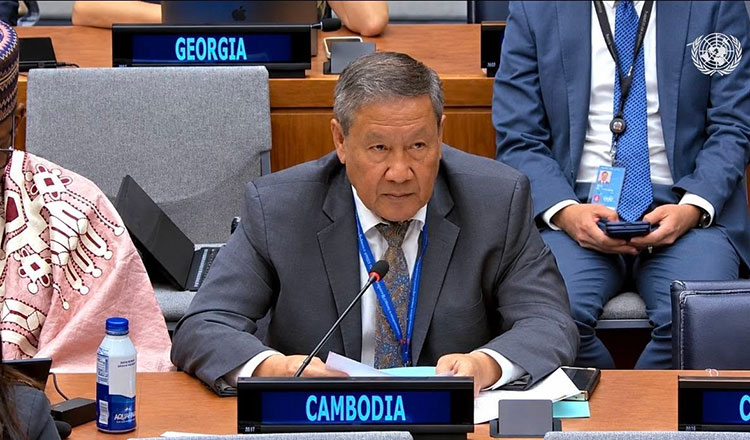
Cambodia’s Permanent Representative to the UN, Keo Chhea, called for a formal Security Council resolution demanding an immediate ceasefire, a fact-finding mission and referral of the dispute to the International Court of Justice. Thailand’s ambassador, Cherdchai Chaivaivid, condemned unprovoked attacks and incursions deep into Thai territory, maintaining that his country’s military actions were proportionate responses under international law.
At the conclusion of the meeting, council members expressed concern over casualties, displaced civilians and fighting near temples such as Ta Moan Thom Temple. They urged both countries to exercise restraint, pursue peaceful dialogue and support regional mediation.
Although the meeting did not end the fighting or prevent a subsequent outbreak of hostilities, it brought the dispute to the attention of the world.
“The Security Council’s July 2025 meeting brought the crisis to the attention of its members, while the Secretary-General’s public statements reinforced calls for restraint,” said Kevin Nauen, dean of the Faculty of Social Sciences and International Relations at Paññāsāstra University of Cambodia and senior research fellow at the Asian Vision Institute.
“Those steps helped make international discussion part of the conflict’s management. They did not, however, establish a shared account of events or settle the disputed boundary.”
The meeting marked the beginning of sustained diplomatic exchanges over the dispute at UN headquarters in New York and in Geneva.
Cambodian diplomats have used the platform to criticise Thailand’s aggression and provocative actions, while drawing attention to displaced civilians who have been unable to return home following renewed border clashes. They have raised the issue in meetings of the General Assembly and other UN bodies and agencies.
Thai diplomats have rejected Cambodia’s accusations, defended their country’s position and questioned Phnom Penh’s decision to internationalise the dispute, arguing that Cambodia has not acted in good faith.
The exchanges have been broadcast through UN channels, allowing media to amplify the competing accounts.
One prominent example came during the 81st session of the UN General Assembly in September. Foreign Minister Prak Sokhonn urged Thailand to fully implement bilateral agreements, resume border demarcation through the Joint Boundary Commission and allow more than 20,000 displaced Cambodian civilians to return home. Thai representatives countered that their country had acted in good faith, accused Cambodia of instigating previous clashes and laying new landmines, and maintained that maritime issues should be addressed through boundary delimitation.
The exchanges illustrate the value and limitations of the UN as a diplomatic forum. It gives states a recognised platform to present their positions, challenge opposing claims and seek international support, but does not necessarily bring them closer to agreement.
“The UN’s contribution is not limited to producing an agreement. It provides a forum where states can pursue a dispute through argument, law, and diplomatic pressure rather than relying on force. That alternative matters even when the forum cannot compel a settlement,” Nauen said.
“The UN gives governments a recognised place to make claims, answer criticism, and signal that they remain engaged in diplomacy. In this case, Cambodia and Thailand used UN channels to present sharply different accounts.”
Nauen said the UN is a meaningful and necessary but insufficient platform for resolving the dispute. The ceasefires depended more directly on negotiations led by Malaysia, initially supported by the United States and subsequently accompanied by prolonged closed-door diplomacy involving China.
“However, the true significance of the ceasefires is found in their durability, and that depends on Cambodia and Thailand,” he said.
“The UN can widen the space for peaceful bargaining, but it cannot bargain in the states’ place or guarantee that they will honour an agreement.”
Internationalising the dispute can help contain tensions despite Thailand’s objections, Nauen added, because it subjects both governments’ conduct to scrutiny beyond their bilateral relationship.
“Once both governments have to explain their conduct before other states, the conflict is no longer only a military contest at the border,” he said.
“It becomes a diplomatic contest in which reputations, legal arguments, and the prospect of outside scrutiny matter. That can raise the cost of escalation and give each side a way to press its case without immediately resorting to force.”
However, international attention does not automatically moderate the language used by either side. Nauen said repeated accusations can reinforce incompatible narratives and make it politically harder for governments to acknowledge uncertainty or compromise.
“Public claims can become political commitments: once leaders have portrayed the other side as acting in bad faith, accepting a joint inquiry or compromise may look like backing down,” he said.
Nauen said the distinction lies in whether public diplomacy leads to a practical process for resolving the dispute.
“If accusations are accompanied by evidence, a proposal for neutral verification, or an offer to meet, they can help move the dispute toward a process. If they are mainly rebuttals aimed at winning international opinion, they risk hardening positions. Unfortunately, to a large extent, this has been the result.”
The UN therefore has a dual role: it provides a peaceful channel for competing claims and exposes the dispute to international scrutiny, but it can also become another arena in which opposing narratives are reinforced.
For Nauen, a practical contribution would be to help the two countries establish mechanisms to prevent border incidents from escalating, including direct military communication, timely reporting and observer access where mutually agreed.
“The states themselves must be the engines of resolution. Neither the UN nor outside mediators can decide a border settlement that Cambodia and Thailand will accept and implement,” he said.
“The UN’s role is to help make that state-led process more possible, safer, and harder to abandon when tensions rise.”
Youk Chhang, director of the Documentation Center of Cambodia and ambassador to the Cabinet of King Norodom Sihamoni, said the UN is an important platform for facilitating communication and pursuing peace between parties in conflict.
“There is no doubt that the UN is not the exclusive solution to resolving the conflict between Cambodia and Thailand. But it is an indispensable platform for discovering a solution that endures,” Youk said.