Synopsis: Mr Hun Sen criticises opponents for condemning the publication on the policy he championed as premier, saying they did so without reading it.
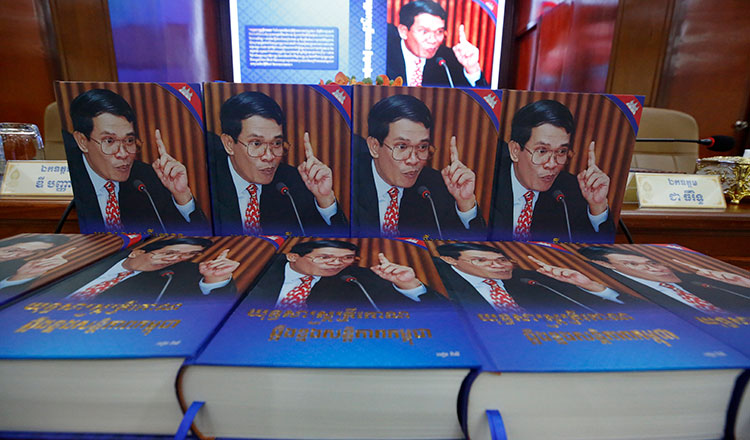
Senate President Hun Sen on Wednesday ridiculed critics who accused a newly launched book documenting his Triangle Strategy of distorting the Kingdom’s history, questioning how they could condemn a 1,111-page publication without reading it, and noting with surprise that some Thai media outlets had amplified the criticism.
In a strongly worded social media post, Mr Hun Sen defended Triangle Strategy: The Backbone of Cambodia’s Peace, written by the deputy director of his Cabinet, Ieng Pisey and launched on Monday.
Mr Hun Sen said the book records the Triangle Strategy he introduced on December 2, 1998, during the inaugural Cabinet meeting of the then-new government formed under the National Assembly’s second legislature.
He singled out an opposition figure, who he described as the leader of an extremist group, for allegedly dismissing the publication as fabrication and distortion before even opening it.
“I commend those who have not even looked at the book yet dare to make such claims,” Mr Hun Sen wrote sarcastically.
He said the reaction reflected a tendency among what he called extremist groups to oppose everything, including matters about which they had little or no knowledge.
Mr Hun Sen added that what he found more peculiar was the decision by certain Thai media outlets to reproduce the criticism.
“The issue of extremists is one thing, but what is even stranger and more ridiculous is that some Thai media outlets have picked it up and published it,” he wrote.
“Is this a form of cooperation between Cambodian extremists and certain Thai media outlets?”
He ended his statement with another sarcastic remark, thanking Thai media organisations for regularly publicising stories about him, even those concerning a dog riding in a cart.
The book was the product of more than six years of research and writing, including extensive fieldwork in former conflict zones and border areas adjoining Vietnam, Laos and Thailand.
At its core, the Triangle Strategy set three priorities for the Kingdom’s post-war reconstruction: consolidating domestic peace and preventing renewed armed conflict; accelerating integration into the international community; and strengthening domestic institutions while promoting economic and social development.
Pisey described the strategy as a continuation of Mr Hun Sen’s Win‑Win Policy, which dismantled the Khmer Rouge’s remaining structures and ended the civil war, laying the foundations for the Rectangular and Pentagonal Strategies now being implemented by the government
He added that the publication was intended to preserve a historical record for younger generations, enabling them to understand the difficulties the Kingdom endured before achieving reconciliation.
Senate Deputy Secretary-General Dy Panha, who facilitated the research and publication, said it is irresponsible to accuse a historical work of distortion without reading its contents.
“Historical debate should be based on facts, documented research and credible sources, not political prejudice or a desire to discredit someone,” Panha said.
“Such baseless accusations risk misleading the public, particularly younger generations who deserve to learn about Cambodia’s history through serious research and evidence.”
Panha noted that those who genuinely care about the Kingdom’s history should welcome research, examine the evidence and engage in constructive debate rather than condemning a book out of political hostility.
“The Triangle Strategy is an important chapter in Cambodia’s journey towards peace and national reconstruction,” he said.
“Anyone who disagrees with its historical interpretation should present evidence and reasoned arguments instead of making sweeping accusations before even reading the work.”