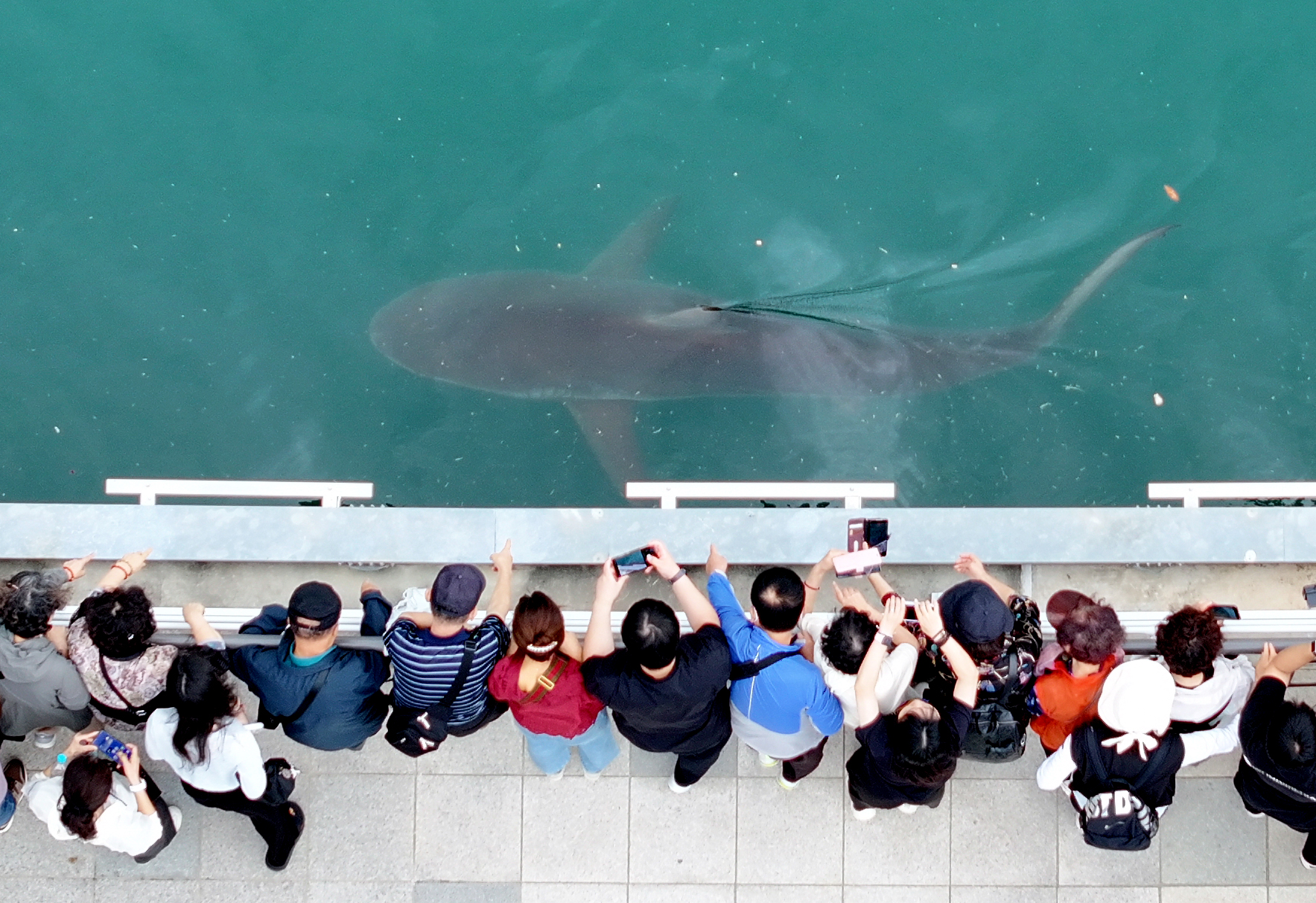
- A female dusky shark trapped in a waterfront park in the South Korean city of Busan has become an instant celebrity, attracting nearly 1.4 million spectators since she was first sighted in mid-September.
- Some say that the shark’s appearance may be a troubling sign of climate change effects on marine life and ecosystems in South Korea.
- In its latest report, South Korea’s meteorological service said that over the past decade, sea surface temperatures around the Korean Peninsula have risen 0.7°C (33.2°F), more than twice the global average.
- The country’s authorities have recorded a spike in shark sightings and shark bycatch in recent years.
See All Key Ideas
SEOUL — Wedged between skyscrapers and a bustling passenger ferry port in Busan, South Korea’s second-largest city, a celebrity of sorts is drawing thousands of admirers as it has been swimming for weeks now in a shallow city canal.
Bukangi, a shark named after the waterfront park where she is trapped, has attracted nearly 1.4 million spectators since she was first spotted in mid-September in the southeastern coastal city, according to local authorities.
At least two failed attempts to guide the shark from the canal to the open sea have added to the spectacle. Meanwhile, online videos of the marine creature swimming amid Busan’s urban landscape have gone viral on social media.
The 3-meter (10-foot) female dusky shark (Carcharhinus obscurus), categorized as endangered on the IUCN Red List, is so popular that she has been named an official “honorary ambassador” to the city.
On Oct. 6, South Korea’s National Institute of Fisheries Sciences (NIFS) identified Bukangi as a dusky shark from the ridge between its dorsal fins. Image by NIFS, 수산자원연구부 via Wikimedia Commons.
The Busan city government deploys more than 100 workers daily to monitor her condition and watch out for signs of poor health.
Meanwhile, the city’s baseball team released special edition merchandise in her likeness, with a local distillery offering the same treatment on its bottles of soju rice liquor.
The public has “developed a sense of affection” for Bukangi, said Hong Sun-kee, director of the Institution for Marine and Island Cultures at Mokpo National University in South Korea. “In a maritime city like Busan, this encounter with wildlife has become a special part of everyday life.”
However, some say Bukangi’s appearance may be a troubling sign of climate change effects on marine life and ecosystems in South Korea.
South Korea’s Green Party issued a statement in September, criticizing the levity around Bukangi’s newfound popularity and linking it to climate change. “The shark did not come here to entertain us,” it said. “Its appearance is a warning to all of us.”
In an editorial, the Hankyoreh newspaper also made a similar argument, saying the shark’s appearance “is a stark reminder” of “the damage we continue to inflict on the environment”.
The ferry port in Busan. Image by Bergmann from jawp via Wikimedia Commons (CC BY-SA 3.0).
Sightings of large sharks
Large sharks have been spotted in South Korean waters for a long time. Before the 2000s, sharks were found in warmer, shallower seas to the south and west of the Korean Peninsula.
However, at least 49 shark species currently live in seas surrounding South Korea, including the eastern waters, which have not historically been known as a hotspot for the dusky shark.
This coincides with data on warming seas. In the latest analysis released in August, the country’s meteorological service said that, over the past decade, sea surface temperatures around the Korean Peninsula have risen 0.7 degrees Celsius (33.2 degrees Fahrenheit), more than twice the global average.
In June, months before Bukangi’s appearance in Busan, South Korea’s National Institute of Fisheries Sciences (NIFS) warned of an increase in sightings of large sharks off the eastern coast.
“In particular, the increasing presence of shark species such as mako sharks, blue sharks, and copper sharks, which can pose a danger to people, requires extra precautions,” it said.
The NIFS also said that, as of mid-2026, it recorded 46 shark sightings in the eastern waters, nearly four times more than the 12 reported in 2025.
It attributed this to rising water temperatures, which had led to warm-current fish species such as yellowtail (Seriola quinqueradiata), Japanese horse mackerel (Trachurus japonicus), Japanese Spanish mackerel (Scomberomorus niphonius) and Pacific bluefin tuna (Thunnus orientalis), which large sharks prey on, moving further north.
Government researchers found warm-water fish species like yellowtail, filefish and squid in the stomachs of large sharks accidentally caught by fishers in the East Sea, as the eastern waters are called in South Korea.
A spike in shark bycatch in the eastern waters is also a telltale sign of sharks migrating north. The NIFS recorded at least 73 cases of shark bycatch from January to August 2026 — an increase of 2.5 times the number during the same period last year.
In contrast, only one such incident was recorded in 2022 before jumping to 15 in 2023 and 44 in 2024.
Bukangi’s appearance may be a troubling sign of climate change effects on marine life and ecosystems in South Korea. Image by hikangs 4K via Wikimedia Commons (CC BY 4.0).
People watching Bukangi at North Port Waterfront Park. Image by hikangs 4K via Wikimedia Commons (CC BY 4.0).
Migratory ‘cosmopolitan’ species
Described as a “cosmopolitan species”, dusky sharks migrate long distances. In East Asia, they are usually found in waters from southeastern Japan to southern China.
Kim Tae-won, professor at the department of ocean sciences at Inha University, South Korea, said that dusky sharks tend to prefer relatively warm waters with temperatures between 18 and 28°C (64-82°F).
Both Kim and Hong said that more research is needed to ascertain the reasons behind Bukangi’s appearance in Busan.
“We cannot conclude that global warming directly caused this particular shark to enter Busan’s North Port,” Hong told Mongabay. “The location of prey, ocean currents, tidal flows, and the configuration of the waterway also need to be investigated.”
But he acknowledged that “changes in water temperature can alter where fish live and when they move.”
“When the distribution of prey changes, the sharks that follow those prey may also appear in different locations,” he added. “In simple terms, warming seas can change the movement patterns of both prey species and their predators.”
Kim concurred. “As ocean temperatures rise, suitable habitats for these sharks may expand northward, potentially increasing their occurrence in Korean coastal waters,” he told Mongabay.
But “as a marine biologist, I would be cautious about directly attributing Bukangi’s appearance in Busan to climate change,” he added. “A single observation is not sufficient to establish such a connection scientifically.”
The Busan city government and the NIFS reportedly plan to continue monitoring Bukangi before deciding whether they should try another rescue operation. Earlier this week, authorities also said that they would work on ways to stop sharks from getting so close to beaches in the future.
Scientists hope the viral moment could lead to more research on marine life and climate change.
“Education and communication should help turn interest in Bukangi into a broader understanding of the changing sea and marine life and into participation in conservation,” Hong said.
“We need to observe changes in species distribution, food webs, and habitats over time, alongside changes in water temperature and currents,” he said, pointing out that it could make scientists and stakeholders more confidently “distinguish temporary events from long-term trends.”
Banner image: People gather to watch a trapped shark called Bukangi at the North Port Waterfront Park in Busan, South Korea, on Sept. 29, 2026. Image by AP Photos/Son Hyung-joo/Yonhap.
Cite this article
Kelly Kasulis-Cho (2026). Celebrity shark trapped in South Korean canal stirs concerns over warming seas. Mongabay Conservation news. DOI: https://doi.org/10.66709/news-332867