- A military-backed operation has shut down a major illegal gold mining operation in Nigeria’s Gashaka-Gumti National Park. More than 4,000 miners left the site, according to the Africa Nature Investors (ANI) Foundation, which supports the park’s management
- Former miners interviewed by Mongabay described losing their livelihoods, with some turning to other work and others moving to mining sites elsewhere in Nigeria and neighboring Cameroon.
- Nigeria’s top parks official has called the closure a success but warned that miners could return. The operation followed years of tensions around illegal mining.
See All Key Ideas
A military-backed operation shut down a major illegal gold mining site in Gashaka-Gumti National Park, driving more than 4,000 miners from Nigeria’s largest national park, according to the Africa Nature Investors Foundation (ANI).
The miners had already fled by the time Nigerian soldiers arrived at the Kila mining area in July, according to Tunde Morakinyo, executive director of ANI, a Nigerian conservation organization working with the government to manage Gashaka-Gumti. He said no shots were fired during the operation, and bulldozers were brought in to fill the mining pits and shafts.
As world leaders and conservation practitioners head to Armenia for the U.N. biodiversity summit Oct. 19-30, with the goal of protecting and conserving 30% of land and waters by 2030, the crackdown spotlights the complexity of safeguarding some of the most biodiverse places on the planet. Gashaka-Gumti is a stronghold for one of the rarest primates in the world: the Nigeria-Cameroon chimpanzee (Pan troglodytes ellioti). The park is also home to more than 1,000 plant species and hundreds of bird and butterfly species, with some of the highest rates of endemism on the continent.
A ranger patrols Nigeria’s Gashaka-Gumti National Park, where the Africa Nature Investors Foundation says it employs more than 180 rangers to help protect the park. Image courtesy of Africa Nature Investors Foundation.
The operation followed years of growing friction over mining in the park. Tensions came to a head in late 2025. Two rangers were killed by miners in October 2025, according to Morakinyo. The deaths deeply affected his team and strengthened his determination to stop the mining, he said. “We’re a small team and when two members of our team are killed, the impact and the morale of the entire team, it’s hard to state how traumatic this was,” Morakinyo told Mongabay via a Google Meet call.
Ibrahim Musa Goni, conservator-general of Nigeria’s National Park Service (NPS), confirmed the deaths to Mongabay. However, Mongabay could not independently verify the details of the incident and whether the killings directly prompted the military operation.
Goni said the governors of Adamawa and Taraba states supported the effort, alongside the military and ANI, which provided financial and technical assistance. The NPS is responsible for the park, while ANI supports its conservation and management activities.
“The efforts of the government are not enough,” Goni told Mongabay in an interview via Google Meet. “You need the support of development partners, nongovernmental organizations and international donors to complement the efforts of government.”
In July, after negotiations between ANI and community leaders and appeals from the NGO to the government, Nigerian soldiers entered the Kila mining area near the park’s northern boundary.
For park authorities, the immediate challenge is keeping the miners out. For the thousands of people who depended on Kila, it is finding another way to survive. Goni acknowledged that the miners could return, raising questions about how long the closure will hold and and whether it will have lasting impact on conservation efforts.
But interviews with former miners and local residents suggest that the economic pressures driving people into the park remain. Mining provided work not only for gold diggers but also for food sellers, traders and others who depended on the income it generated.
A park under pressure
Before its closure, the Kila gold mine in Nigeria’s Gashaka-Gumti National Park attracted more than 4,000 artisanal miners, according to the Africa Nature Investors Foundation. Image courtesy of Africa Nature Investors Foundation.
Gashaka-Gumti, like many protected areas across Africa, faces mounting pressure from illegal mining, poaching and insecurity. The park, created in 1991, spans 6,731 square kilometers (2,599 square miles) across Adamawa and Taraba states along Nigeria’s border with Cameroon.
Morakinyo said mining spread from outside the park into protected forest. ANI alleges that politically connected financiers and armed groups profited from the trade in gold.
“These are guys with a lot of money and serious political backing,” Morakinyo said.
Mongabay could not independently verify those links. However, it reflects a dynamic seen in the illegal gold trade in other parts of Nigeria.
Goni called mining a growing threat to Nigeria’s protected areas, associated with other wildlife crimes and insecurity. He said that in addition to the two rangers who were killed in Gashaka-Gumti in 2025, another ranger was stabbed that year. ANI said it also helped close a second mine at Bodel in the park’s southern sector.
Across Nigeria, insecurity has shaped the management of other parks. Goni insisted Nigeria’s 13 operating national parks still have ranger patrols, although he acknowledged that tourism has been suspended in parts of Kainji Lake and Chad Basin parks. Nigeria has 17 national parks.
Asked who financed the mining, Goni pointed to mining-license holders but did not identify the individuals behind Kila or supply prosecution records during the interview. He said the service challenges licenses that extend into protected areas.
“The illegal ones have no place in our protected areas,” he said. Goni also cautioned that some mining occurs just outside park boundaries.
When the gold economy ends
Bulldozers filled mining pits and shafts at the Kila gold mine after the miners fled the site. Image courtesy of the Africa Nature Investors Foundation.
Mongabay spoke with Iliyasu Jussaini, 64, the village head of Kila, who described the mine as an important source of income for the community. Traders, food sellers, young people and traditional leaders all benefited from the mining activities, he said. Jussaini acknowledged that he, too, received payments linked to the mine and that miners had promised to build him a house. He spoke to Mongabay via WhatsApp through an interpreter.
Those benefits disappeared with the closure. Some residents who were earlier involved in mining now transport passengers by motorcycle, he said. Others have gone to new mining sites. Still, he supported conserving the park and called for talks on alternative livelihoods.
Musa Yuguda, 40, who formerly mined at Kila, was interviewed by Mongabay via WhatsApp through an interpreter. Yuguda said he turned to gold mining because other employment opportunities were scarce. Although he knew mining inside the park was illegal, the earnings were difficult to resist and helped him build part of his house. He said he would now prefer to make a living from farming or motorcycle transport. Other miners, he added, had moved to mining areas elsewhere in Nigeria or across the border into neighboring Cameroon.
Adamu Salihu, 21, said he had washed gold-bearing material and operated mining equipment. He now has no job and wants support to start a business. These interviews were facilitated by ANI and conducted by Mongabay via WhatsApp through interpreters. The English accounts reflect those interpretations.
Research offers clues to why mining took hold in this region. A 2021 field study in Gashaka Local Government Area, in Taraba state, noted that some form of gold extraction has existed in the region for more than a century. “Artisanal gold mining is an important livelihood activity in the study area despite the fact that many of them are carried out illegally,” the authors noted.
A 2024 survey of 118 women in the same area, focused largely on gemstone mining, found livelihoods tied to selling food and trading minerals as well as extraction.
‘We’re still building the park’
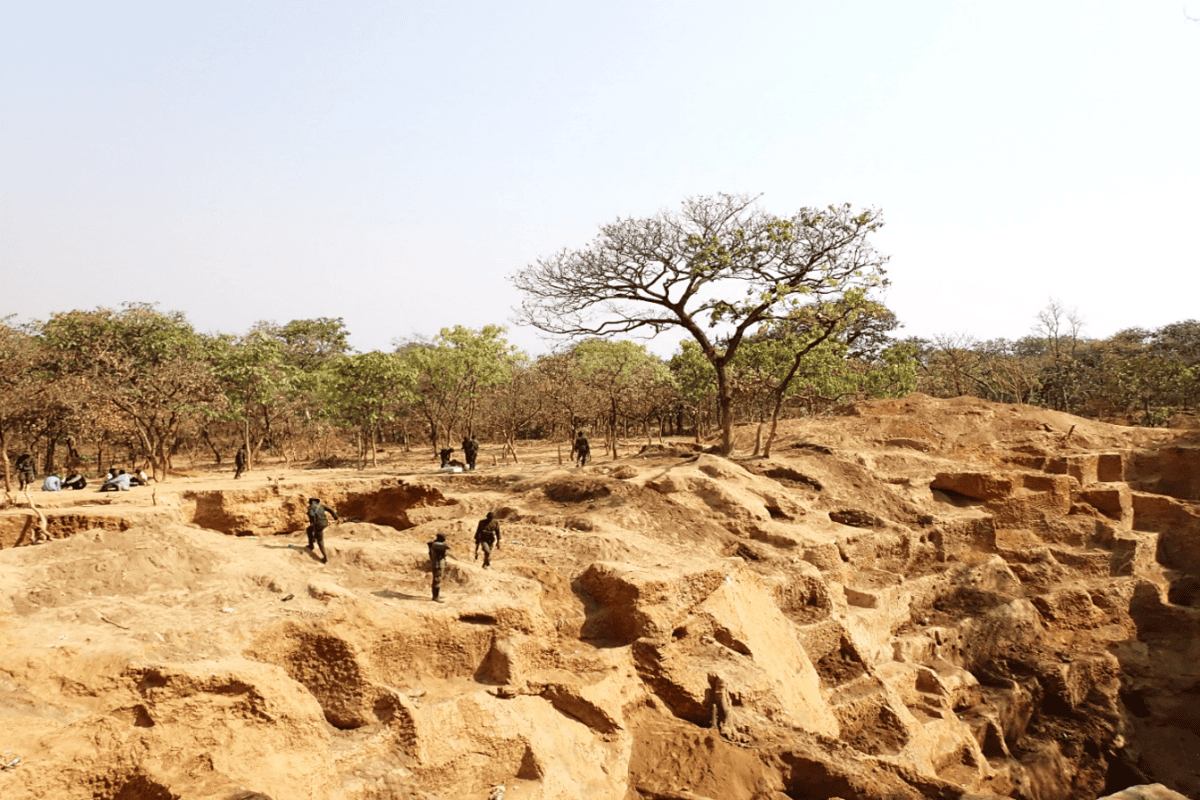
The Kila gold mine, on the northern edge of Nigeria’s Gashaka-Gumti National Park, before its closure in July 2026 by Nigeria’s National Park Service and the Africa Nature Investors (ANI) Foundation, with support from the Nigerian military. Image courtesy of the Africa Nature Investors Foundation.
Morakinyo at ANI knows that sealing a mine does not remove the pressures behind it.
“There is no point employing hundreds of rangers and equipping hundreds of rangers and deploying them, unless you address the root cause of these illegal activities, which is poverty,” he said.
A 2025 study of communities near Gashaka-Gumti found that many respondents said they would stop entering the park illegally if alternative income were available. A 2023 survey of 1,500 people around four Nigerian parks, including Gashaka-Gumti, documented demands for jobs, roads, water, schools and healthcare.
ANI has been involved in a host of activities that respond to these needs.
ANI said it employs more than 180 rangers, but it also supports farming, livestock, microfinance and education initiatives. It is building a school in Kila. Goni at NPS credited ANI with supporting some 1,200 farmers and said the partnership had created more than 5,000 direct and indirect jobs.
He said the park service was also helping young people apply for government jobs and discussing skills training, scholarships and small businesses with partners. No Kila-specific transition plan, funding or timeline was provided.
Nigeria’s Gashaka-Gumti National Park is home to the endangered Nigeria-Cameroon chimpanzee. Image courtesy of the Africa Nature Investors Foundation.
Jussaini raised a long-held grievance: He said some families lost land when the park was established without compensation. Goni disputed that account, saying, “There is no land that the government takes over in Nigeria that compensation is not paid for.” Mongabay could not verify whether those families were compensated.
Goni said rangers now monitor Kila and nearby buffer areas, drawing intelligence from local vigilantes. But he offered no guarantee the miners were gone for good. “There is a tendency the miners might come back in a different way,” he said.
At Kila, the pits may be closed. Whether people find ways to earn a living without reopening them is another question. “We’re still building the park,” Morakinyo said. “We have a long way to go.”
Banner Image: The Kila gold mine, on the northern edge of Nigeria’s Gashaka-Gumti National Park, before its closure in July 2026 by Nigeria’s National Park Service and the Africa Nature Investors (ANI) Foundation, with support from the Nigerian military. Image courtesy of the Africa Nature Investors Foundation.
Citations:
Ojeh, V. N., & Elijah, E. (2024). Impact of mining on the livelihood of women in Gashaka local government area, Taraba state. Journal of Contemporary Research in Social Sciences, 6(1), 1-17. doi:10.55214/26410249.v6i1.800
Ahmed YM, Oruonye ED, & Abdulkadir Usman Adamu. (2021). Dynamics of artisanal gold mining in Gashaka local government area of Taraba state, Nigeria. International Journal of Scientific Research Updates, 2(1), 001-009. doi:10.53430/ijsru.2021.2.1.0033
Umaru, R., Mamman, G., Ali, A., & Tanko, M. (2025). Implication of Gashaka Gumti National Park staff and support zone community demography on conservation. Journal of Research in Forestry, Wildlife and Environment. Retrieved from https://www.ajol.info/index.php/jrfwe/article/view/313637
Osunsina, I. O., Osunsina, O., & Ogunjinmi, A. A. (2023). Biodiversity conservation and rural development: Inseparable options for protected area management. a case study of four Nigerian national parks. Nature Conservation Research, 8(1). doi:10.24189/ncr.2023.006
Feedback: Use this form to send a message to the author of this post. If you want to post a public comment, you can do that at the bottom of the page.
Cite this article
David Akana (2026). Nigeria drove thousands of gold miners from a national park. But can it keep them out?. Mongabay Conservation news. DOI: https://doi.org/10.66709/news-333049