A three-way race for a seat on a powerful state board that regulates utility companies is drawing extra interest as concerns about data centers and utility rates both locally and nationally mount ahead of the November midterms.
The next person who holds the Public Service Commission seat for District 1, which covers the southeastern portion the state, will vote on whether to approve the rate increases companies propose – and whether to approve plans for companies like Entergy to build new infrastructure for projects like AI data centers.
The race features state Rep. Stephanie Hilferty, R-New Orleans, who has served in the Louisiana Legislature for 10 years; Chris Justin, a no-party chemical engineer who formerly consulted for the PSC; and Democrat Connie Norris, a nurse who has been fighting before the PSC for lower water rates.
It will be the first time in over a decade that the district has a new commissioner. Commissioner Eric Skrmetta, who has held the post for 16 years, is term-limited.
Hilferty, who edged out two major opponents in the spring Republican primary, is the favorite to win the reliably-Republican district, which includes Orleans, Jefferson, St. Tammany, Livingston and several other parishes. But the presence of a no-party candidate on the ballot could shake up the race.
All three candidates say they are passionate about the Public Service Commission and have tried to make their cases to voters about why they are the best choice to lower utility rates.
State Rep. Stephanie Hilferty, R-Metairie, smiles alongside New Orleans Mayor Helena Moreno in support of House Bill 573, a bill that deals with the New Orleans Sewerage and Water Board. Hilferty is running to represent District 1 on the Public Service Commission.
Photo by Javier Gallegos / The Advocate
Hilferty is casting herself as a consensus-builder who is in touch with the community, saying she has a proven track record of making utilities more affordable through state legislation. Justin argues he is better-qualified than Hilferty to be a watchdog due to his expertise, and he has attacked Hilferty for accepting campaign donations from utility companies.
“I’ve gotten contributions from businesses all over the state of Louisiana, from different aspects and segments of industry and residents and ratepayers,” Hilferty said. “It speaks to the fact that they’ve seen my ten-year record in the Legislature, and they know that I’m somebody that will look at issues and make an informed decision.”
Hilferty also argued that she won the primary because she was the best watchdog candidate; many of the utility companies did not want her to come out ahead, she said.
Meanwhile, Norris said she has been fighting for two years to make the state address concerns about Magnolia Water, which St. Tammany Parish residents say more than tripled their water bills after buying up failing water systems. Customers have also complained about brown water and boil-water advisories; as a customer, Norris said she has been personally impacted.
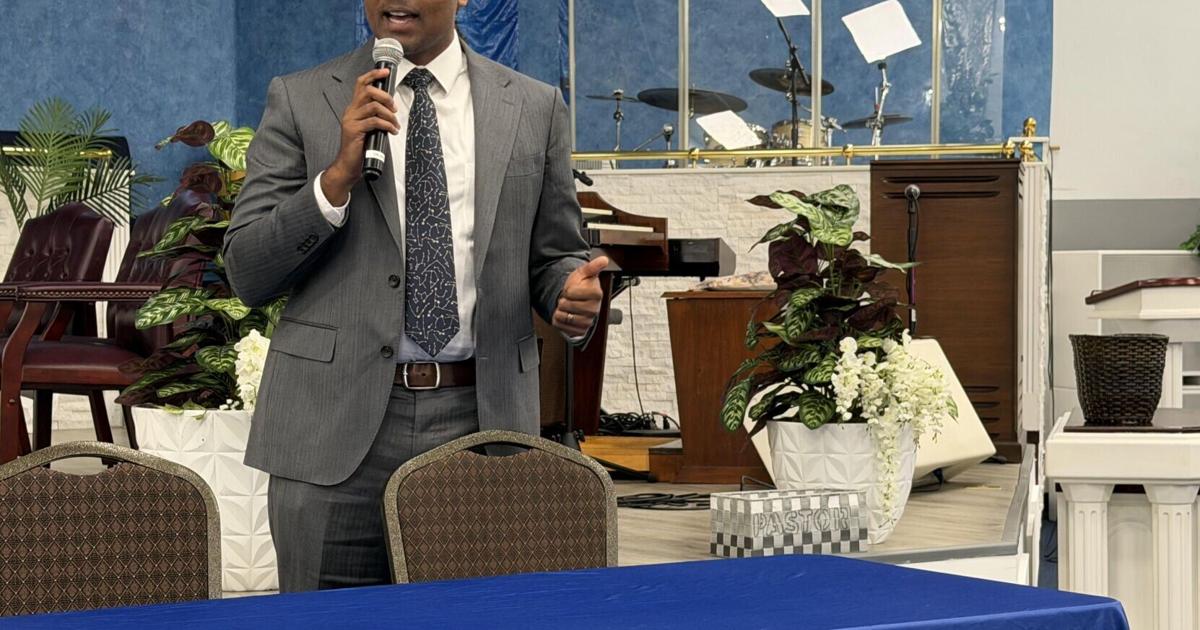
Connie Norris, a Democrat who is running to represent District 1 on the Louisiana Public Service Commission, speaks at a candidate forum on Oct. 8, 2026 at the Corinne Missionary Baptist Church in Violet, La.
Meghan Friedmann | Staff writer
Steve Ernst, director of Louisiana regulatory relations for Magnolia Water, said all rate increases were approved by the PSC and tied to needed water system improvements. Those changes were needed “primarily because of the lack of investment from the previous owners.”
The company occasionally receives complaints about brown water, which is typically tied to the high level of manganese in Louisiana, Ernst said. The U.S. Environmental Protection Agency does not regulate manganese.
Key issues in the race
The problems with Magnolia Water have emerged as a key issue in the race. In June, the PSC approved the company’s rate plan – a decision panned by Norris – but also ordered an investigative audit into its financial practices.
Meanwhile, fears that households could be on the hook for power costs associated with data centers represent an increasingly widespread concern for voters.
Polls have shown that data centers are unpopular nationwide. In Louisiana, where state leaders have largely welcomed them with open arms, Meta’s data center in Richland Parish is expected to use 4,500 megawatts of power.
Advocates for the project say it would be a groundbreaking economic investment for the state, leading to job growth and community investment. Entergy, which is currently seeking the PSC’s approval to build power plants to expand the project, says its deal with Meta has plenty of protections for ratepayers and would lower rates across the board.
Critics, however, note Meta’s contract is shorter than the life of the energy infrastructure and say ratepayers could have to foot a several-billion-dollar bill for power they don’t need if Meta decides to leave the state. Entergy has argued the state will need that power either way.
In the past, the PSC has largely been supportive of Meta’s proposals. The board is expected to vote on a proposal that would expand the project in December, a month before new members take their seats.
All candidates agree that the PSC needs to make sure that companies like Meta pay for their own power needs. Justin and Norris have harshly criticized how the PSC has functioned in recent years, arguing it is not working for the people and only acting as a rubber stamp to whatever big companies want.
Both Justin and Hilferty say the PSC should wait until after the board turns over to make its decision on Meta.
Candidates make their cases
All three candidates said addressing problems with Magnolia Water and protecting customers from power costs associated with data center are priorities for them – but each gave different arguments for why they are the best choice for voters.
Hilferty, a commercial real estate agent who joined the Louisiana House of Representatives in 2016 and is term limited, said voters need only look at her track record in the Legislature to know that she is the best person for the job.
Since 2017, Hilferty said, she has worked on legislation to improve the New Orleans Sewerage and Water Board. She wrote legislation that helped residents who had been paying erroneous bills get relief, she said.
“So, when I say, like, ‘I’m going to help the constituents’ or ‘I’m going to work for them,’ that’s not me just saying that,” Hilferty said. “I’ve already done it, and I can do it on a bigger scale.”
Meanwhile, with his background in engineering and as a PSC consultant, Justin said he has better know-how to spot when companies unfairly raise rates.
Utility companies “have a fiduciary responsibility to make as much money as they can, and they are very creative and relentless, and there are many mundane ways in which they do this that commissioners do not understand, and that is how they’re able to get away with it,” Justin said. “I understand this stuff. I’m not going to let them pull one over on me.”
Justin also said he will require cheaper, alternative solutions to powering the state that avoid building new infrastructure. Utility companies receive a return on investment for infrastructure they build, he said, arguing the arrangement disincentivizes firms from finding cheaper ways to get power, such as investments in energy efficiency.
Norris, the Democrat in the race, said she decided she would run for the commission because of how frustrated she became with Magnolia Water, and what she felt was a failure by the PSC to address customers’ concerns.
“This campaign is driven by conviction, not cash,” she said. “There’s an immediate harm that needs to be fixed.”
Norris said she would work to increase transparency, making the PSC more accessible to the public and requiring utility companies to hold community meetings to hear customer concerns.
Even with three candidates in the race, it is likely that Hilferty can bank on a win, according to John Couvillon, a pollster and political consultant in Louisiana.
U.S. President Donald Trump carried District 1 with 68% of the vote in 2024, and U.S. Sen. John Kennedy won it with 71% of the vote in 2022, he said. Both are Republicans.
“There’s Republicans to spare,” Couvillon said.