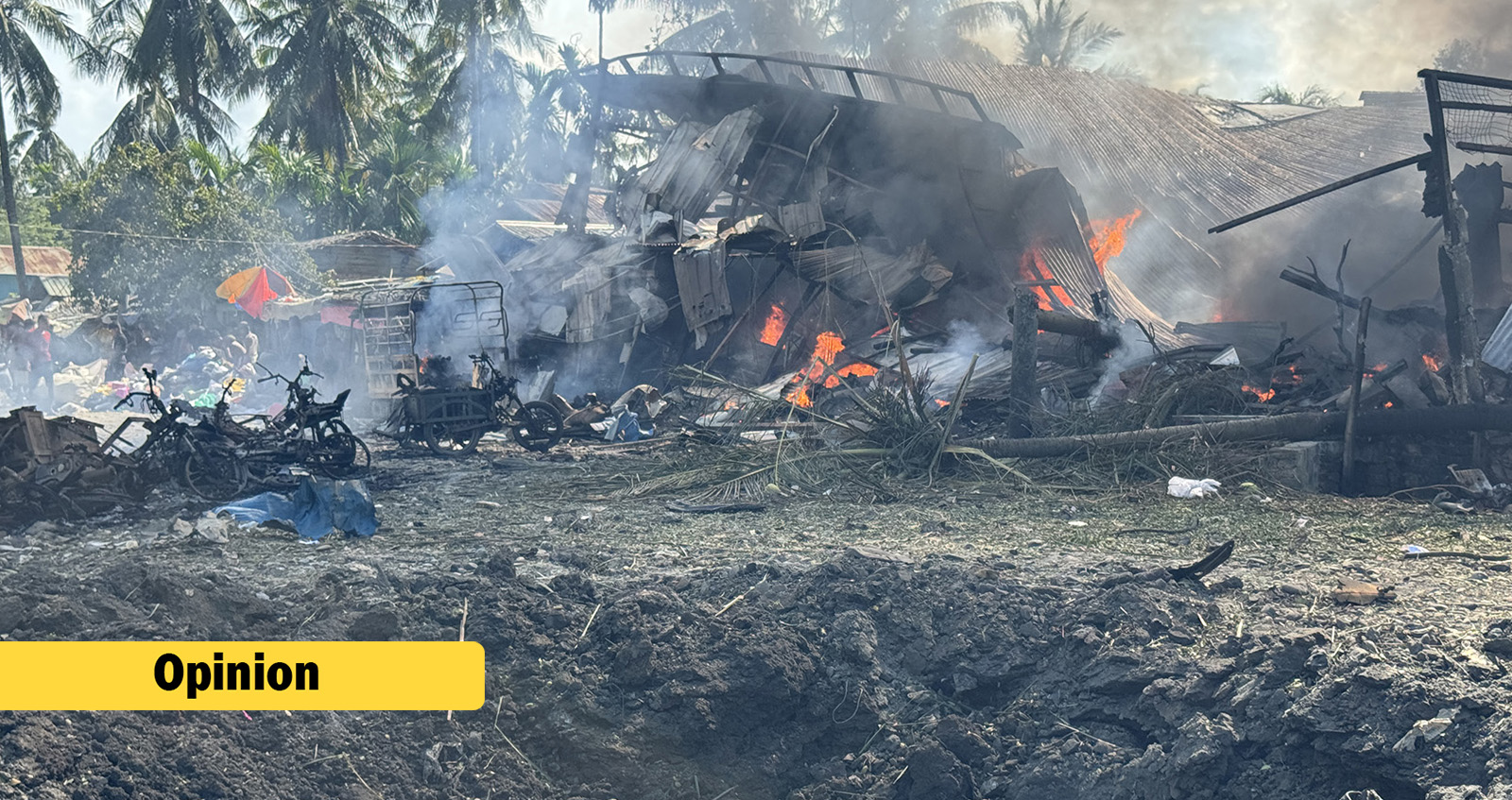
In the week after the Sept. 28 massacre on Kyauktaw’s Indian market that killed 50 people and injured at least 58 others, Rakhine State endured another wave of aerial attacks. Local media reported at least nine bombing incidents across the townships of Ponnagyun, Rathedaung, Pauktaw, Kyauktaw, Thandwe and Kyaukphyu that killed at least another 12 civilians and injured more than 37 others. Some strikes hit locations where displaced people were sheltering.
The attacks were part of a wider pattern. The UN says aerial attacks killed more than 190 people in Rakhine in 2025. ACLED, an independent global conflict monitor, says Rakhine has suffered Myanmar’s highest reported casualties from airstrikes on local markets, recording at least 11 such attacks and 49 deaths even before the Sept. 28 massacre.
The immediate question for civilians under air attack is how they can know where a military aircraft is heading and reach safety in time.
Communities in Rakhine have improvised ingenious early-warning networks. To understand how they work, I spoke with six residents in Kyauktaw and Mrauk-U and reconstructed the warning timeline leading up to the Sept. 28 massacre.
A military jet is sometimes airborne one or two hours before an attack. What people often cannot know is where it will strike until the bombs have already begun to fall.
Watchers, channels and loudspeakers
The locals told me how warnings reach civilians in areas under Arakan Army (AA) control. What emerges is a kind of relay network: volunteer scouts track aircraft leaving airfields; their reports appear on public Telegram channels with takeoff times, directions and regions at risk; and in some communities those alerts are then announced through sirens and loudspeakers.
Warnings begin with a beeping alarm, followed by a spoken announcement. One Mrauk-U resident said at least three locations now broadcast such warnings, a system that began three or four months ago and can sometimes give people 10 to 15 minutes to find cover.
The timeline of Sep. 28
A reconstruction based on posts from a volunteer air-scout channel and the AA’s account of the strike times clearly shows the problem.
A Telegram channel with about 13,000 subscribers reported a fighter jet leaving Naypyitaw toward the southwest at 10:16 a.m., and another from the same airbase in the same direction at 11:08 a.m. Both alerts covered Rakhine, Ayeyarwady, Magwe, Bago, Karen and Chin. At 11:36, the channel reported another jet leaving Meiktila, with Mandalay, Rakhine, Magwe and Chin potentially at risk.
Yet the warning narrowed too late. An observation that a jet was circling over Kyauktaw at 12:10 was posted at about 12:13. A second observation, saying the aircraft was still circling at 12:15, appeared at about 12:16. But the AA says the first bomb struck at 12:10 and the second at 12:14.
The scouts were quick, but their information still had to pass from observer to channel operator before reaching the public. Even a few minutes matter. By the time the warnings narrowed down the target to Kyauktaw, the attack was already underway.
What’s more, phone and internet services have been severely restricted in much of Rakhine for years, and many residents cannot reliably access Telegram alerts. Repeated alarms can also cause warning fatigue.
“We can never assume where the jets are heading based only on the direction they take off in,” one resident told me. “Sometimes they appear to be flying toward another city, then turn back to drop the bombs.”
Ground observers may also lose track of sudden changes in course or altitude. The problem is not simply the speed of the volunteers, but the limits of the available information and ways to relay it.
What should change
International support should go beyond diplomatic statements. Donors, humanitarian organizations and local authorities should invest in warning systems that do not depend entirely on internet access, including radio networks, sirens and community warning posts. Air raid drills and clear protocols could reduce warning fatigue, while tiered alerts could distinguish a general aircraft warning from an imminent local threat.
Similar systems have been used elsewhere. In Syria, volunteer aircraft spotters fed flight information into warning networks that used social media, radio and street sirens to give civilians several minutes to seek cover.
The responsibility for the attacks lies with the Myanmar military. But local authorities can reduce civilian exposure by breaking up large commercial hubs into smaller neighborhood trading points, adjusting market hours to avoid peak crowds, taking any locally observed patterns of air patrols into account, and mandating the provision of proper shelters near hospitals, schools, markets and displacement sites.
Shelter is especially important for displaced families. Two people who fled Sittwe for Kyauktaw and Mrauk-U told me that many displaced people can afford only basic rented housing or makeshift accommodation, which offer no proper protection from airstrikes. Even a timely warning has limited value if there is nowhere safe to reach.
Historically, communities under heavy bombardment have adapted. During the Vietnam War, for instance, communities in North Vietnam built collective shelters, trenches and tunnels, while authorities adjusted school, work and market hours to reduce large daytime concentrations of people. Such measures cannot stop an air campaign, but they can reduce exposure.
International statements of concern will continue. But for civilians on the ground, the immediate challenge is to turn an early alert into a warning they can actually use. Closing the gap between knowing that a jet is airborne and knowing where it is heading may not prevent an attack. But it could give more people enough time to reach safety.
Khine is a researcher from Rakhine State with a decade of experience in peace processes, conflict issues, and human rights documentation. She is pursuing a master’s degree in Human Rights and Democratization at Mahidol University.