Guest contributor
James Shwe
Professor Thitinan Pongsudhirak, a prominent Thai political scientist at Chulalongkorn University, has published a candid assessment in the Bangkok Post. He argues that Myanmar’s resistance has lost ground politically and diplomatically, though not militarily, and he attributes this to what he calls an “insurgency-industrial complex”: an ecosystem of exiles, donors, rights organizations and Western governments, centered on the National Unity Government.
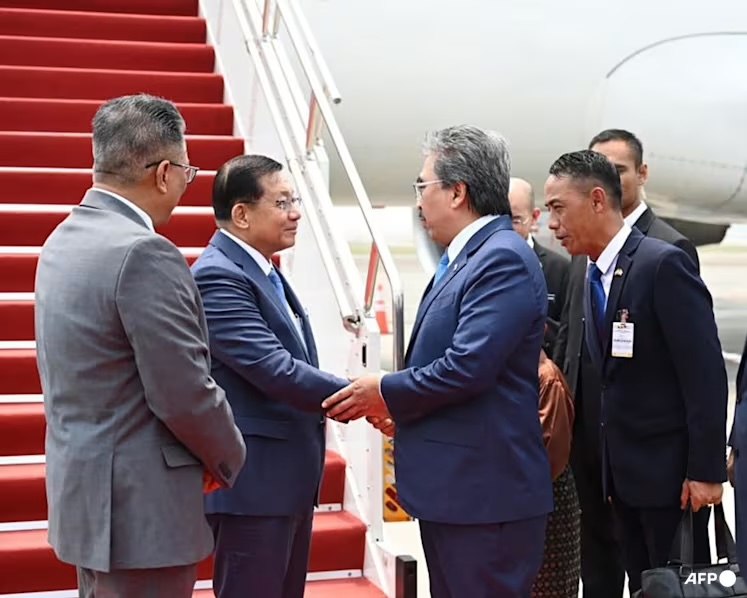
His perspective deserves respect, and much of it rings true. Min Aung Hlaing has been received in Beijing, New Delhi, Moscow and five of the 10 other ASEAN capitals.
Western aid has declined sharply. China helped broker ceasefires that returned the northern Shan State regional capital, Lashio, to the military.
In the same constructive spirit, a few points merit further consideration. In order of significance:
- The resistance’s new coordinating structure is not mentioned. The column calls for the resistance to regroup around those fighting inside the country. That process is already under way. In March, the NUG and the CRPH formed the Steering Council for the Emergence of a Federal Democratic Union (SCEF) with the Kachin, Karen, Karenni and Chin armed organizations. The council has since added federal units from the central heartland and set up a military coordination body. Its success is not yet assured, but it is central to the question the column raises.
- China’s motives may have been the reverse of what the column suggests. The column says Beijing backed the junta once it judged that the resistance lacked the capacity to win. The ISEAS – Yusof Ishak Institute dates China’s intervention to after the resistance captured Lashio, the regional capital of northern Shan State near the border of China. That suggests Beijing’s concern was the resistance’s success near its border, not its weakness.
- The 2024 territorial picture was more mixed. The column says the resistance held more than half the country by mid-2024. The BBC’s village-level survey found 42 per cent under resistance control, 21 per cent under full military control, and the rest contested. The opportunity may have been narrower than the “missed chance” framing implies.
- Western governments are not uniformly on one side. The column places them within the “complex,” yet Washington has opened direct talks with Naypyidaw.
- The proposed overall commander raises practical questions. The Arakan Army’s battlefield record is impressive. However, it is not a member of SCEF, and its leader has long described the group’s goal as a confederation rather than a federal union. Researchers note this sets it apart from most resistance groups that seek federal democracy.
I read the column as constructive realism. Professor Thitinan notes that many exiles are sincere and that “at issue are incentives, not intentions.”
His central point stands: neighbors engage whoever appears likely to last.
His critique of the “insurgency-industrial complex” rests on international advocacy and the funding that sustains it. In his words,
“Donations, aid and grants flow into the insurgency-industrial complex,” and “its output is advocacy.” The thesis is not supported by evidence of how funding shapes decisions.
Still, those of us engaged in advocacy abroad should take the question seriously rather than defensively.
The reflections below are offered in that spirit, as a response to his critique and not as a judgement of any individual or organization.
Two patterns deserve gentle attention. First, well-meaning advocates sometimes emphasize divisions within the resistance more than they intend to.
Over time, this can unintentionally reinforce the junta’s narrative that only the military can hold the country together.
Second, when diaspora voices reach policymakers mainly through a few professional channels, community perspectives can be filtered, even unintentionally.
Expertise is valuable, but it is not the same as a mandate. Experienced organizations add the most value when they help open doors for constituents to speak directly to their elected representatives.
This is why “one ask, many messengers” matters. A consistent request from many credible voices persuades more than any single channel can.
The principle has a condition, though. If each group brings its own version of the task, officials hear competition rather than consensus, and fragmentation concerns are confirmed rather than eased.
The messengers may be diverse, but the message should be agreed and coordinated.
Every campaign should also be inclusive, and should be honestly assessed before it begins.
The diaspora’s time, money and political capital are real but limited. Every meeting, letter and public appeal draws on goodwill that cannot easily be replenished.
Before launching an effort, it is worth asking: Does this genuinely advance the revolution as a whole? Who is the decision-maker, and what is a realistic objective? Is the expected result worth the time, expense and goodwill it will consume?
Campaigns that cannot answer these questions are better redesigned or set aside, however well intended.
It would also help to move beyond identity politics. Myanmar’s communities have distinct histories and legitimate grievances, and federalism exists to honor them.
This does not ask any community to set aside its specific grievances; it asks that we pursue them together.
When advocacy becomes a competition for attention among communities, it risks pitting them against each other, and outsiders may conclude that we cannot govern together.
A shared civic foundation offers a stronger basis: equal citizenship, accountability for abuses against every community, and a federal democratic union.
Finally, objective assessment builds credibility, and over-dramatization can quietly erode it.
Predictions of imminent collapse that do not materialize, or claims that every diplomatic contact amounts to recognition, make it easier for officials to discount us. Clearly separating fact, analysis and forecast earns lasting trust.
Raising the political cost of engagement
Governments engage Min Aung Hlaing because they judge that the benefits outweigh the costs. Normalization creep slows when that balance shifts.
Our task is therefore twofold: to make engagement without conditions more costly, and to show that its benefits are smaller than they appear.
To raise the cost:
- Hold governments to their own words. Malaysia states that hosting Min Aung Hlaing “does not mean we recognize the Myanmar government,” even as it supports Myanmar’s reintegration into ASEAN. This deliberate ambiguity allows engagement without formal endorsement. Respectfully and publicly measuring each government’s actions against its own disclaimer makes ambiguity harder to sustain. The thresholds that still carry weight are the ASEAN summit seat, U.N. credentials and sanctions relief. The Manila summit in November is the next opportunity to ask for public benchmarks, including a halt to airstrikes, the release of political prisoners and humanitarian access.
- Engage the domestic politics of engaging states. In Washington, Representative Gregory Meeks, the top Democrat on the House Foreign Affairs Committee, has warned that direct talks confer legitimacy on the regime without enforcing congressional sanctions. Congressional hearings, parliamentary questions and constituent letters in host countries ask governments to explain what engagement has achieved.
- Document outcomes. Pairing each high-level visit with a verified record of conditions on the ground allows the promise of “engagement for peace” to be tested. Where violence continues, the cost of the next visit rises.
To lower the benefit:
- Show what the regime cannot deliver. The rare-earth deposits that interest Washington lie mainly in territory held by ethnic armies. The Arakan Army controls 14 of Rakhine’s 17 townships. Agreements with Naypyidaw alone may not be sustainable. As Joshua Kurlantzick of the Council on Foreign Relations observes, engagement is “unlikely to deliver access to rare earths.”
- Encourage balanced engagement. The U.S. official who met Min Aung Hlaing also met opposition and ethnic leaders. This can become the expected standard, with SCEF offering practical cooperation on scam centers, border security and refugee protection. Engaging only Naypyidaw then becomes the riskier choice. Europe, which is now preparing tools to counter Chinese coercion over rare earths, is a natural audience for this argument.
The role of middle powers
As Washington turns more transactional, the work of sustaining a rules-based international order falls increasingly to middle powers: European states, Japan, South Korea, Australia, Canada, and ASEAN’s own democracies.
They have a direct stake in Myanmar. If a government born of a coup can be normalized through state visits and resource deals, the precedent will not stay in Myanmar.
Middle powers need not confront anyone or act alone. By coordinating on the thresholds that still matter (the ASEAN summit seat, U.N. credentials and sanctions relief), they can keep engagement conditional and show that the rules still count.
Professor Thitinan writes that the resistance will struggle “until the fighters inside lead the leaders outside.” There is a constructive path forward.
Leadership inside the country should set the direction, and those abroad should carry one agreed message through many voices.
Advocacy should stay inclusive, weigh its costs honestly, rest on shared citizenship and be guided by facts.
Steady discipline, more than drama, is what slows normalization creep.
James Shwe is a Myanmar democracy advocate based in California.
DVB publishes a diversity of opinions that does not reflect DVB editorial policy. We’d like to hear what you think about this or any of our stories: [email protected]