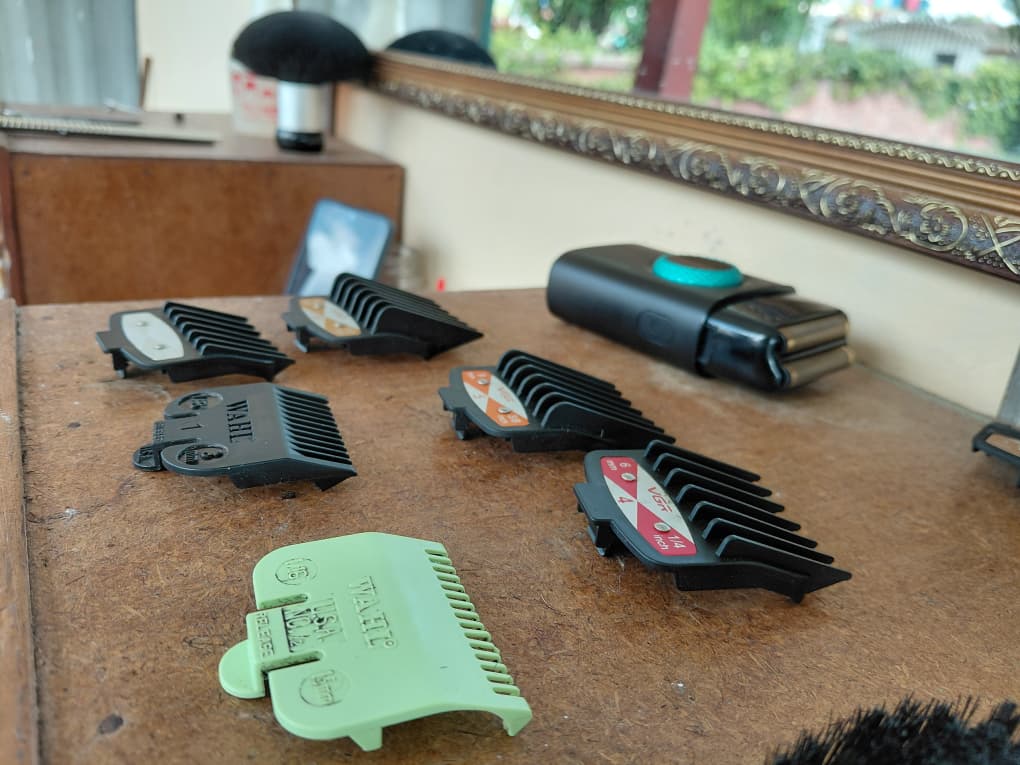
Guides or attachments I use to make the cuts
By Erick Hernandez
HAVANA TIMES – I met the young man in this story on a Tuesday morning. He came down the slope from the sidewalk to the porch and asked for a haircut. His Afro was cropped short, easy to work with. He wore loose-fitting pants that hung lightly on him, a Bob Marley T-shirt, white sneakers, and carried a backpack that looked full. Since it was the first time I had seen him, we didn’t have anything to talk about. I asked if he lived in the neighborhood, and he said yes, but that it was a complicated story.
“Since yesterday I’ve been renting a place nearby. Before that, I lived in Havana.”
I’m always glad when a client tells me he comes from the capital, because it’s like recovering a piece of that time when I belonged more to Havana than to my own city.
“I lived there for three years,” I tell him.
“Well, I was there for about five years, more or less. But I’m actually from Santiago de Cuba.”
It turns out the young man was a singer. He studied for a while in eastern Cuba and then, convinced of his talents as a showman, went to the capital in search of opportunities that would allow him to grow financially and professionally. His job was singing and dancing. He had his own show. He didn’t perform with orchestras or groups. Nor was he interested in doing “highbrow” musical work or pursuing a career beyond performing.
“So why did you come to Matanzas?”
“Because of Varadero. In Havana, I didn’t have many places left where I could work, because I don’t play with musicians or perform much Cuban music. What I do is more of a show, and that’s different. The hotels are here.”
“Yeah, but I imagine Varadero is pretty dead now too, isn’t it?”
“Sure. But there’s still some work. It’s enough to pay my expenses.”
During my final year of college, I met many musicians in Havana who made a living doing that kind of work. “Making soup” (hacer sopa) is the common expression for this type of musical gig. As part of my thesis, I spent time with artists who played in the country’s top orchestras, traveled abroad, and had won awards, yet their salaries were the same standardized wages that the cultural institutions paid their affiliated artists.
They would finish playing Schubert and Bach, change clothes, and walk barely four blocks to a bar in Old Havana, where they would play in hopes that a foreigner might leave them a tip. “Passing the brush” (pasar el cepillo) is what they call going from table to table with an upturned hat to collect foreign currency. Still, it’s true that most of them played Cuban music while the diners went about their business. They provided background entertainment, whereas my client had a show that not only demanded attention but was also interactive.
“Hey, haven’t you thought about leaving? You know, getting contracts to perform abroad?” I ask, because I also have friends who have done that. He takes his time answering.
“The problem is there’s a lot of racism, especially when it comes to the Middle East.”
He is referring to countries such as the United Arab Emirates, Egypt, Qatar, or Turkey, destinations where contracts almost never provide guarantees regarding immigration status, housing, or job stability.
“When you talk to any of those promoters, the first thing they ask about is skin color. With that kind of thing, how you look matters more than what you can actually do, so they’re very strict about it. They establish very rigid standards.”
At that point, I don’t know what to say, and I think about the rappers from the duo Obsesion, who talked to me so much about the struggle against racism and, above all, about the symptoms of racism. “Racism changes its form, it modernizes,” they say in one of their songs. The entertainment industry, as everyone knows, can be a crushing machine. When the show ends and the lights go out, all it leaves behind is frustration. That pursuit of an ideal of beauty is nothing more than a reproduction of some of the crudest things Western civilization has produced: sexism, fatphobia, racism, homophobia, and hypersexualization. However, in the dispute over language, the word racism makes little sense because it implicitly invokes the idea that there are several races of human beings. Terms such as ethnic differences would be more accurate.
We didn’t talk much more that morning. There is an unspoken agreement that once the haircut is finished, the barber gives his full attention to the next client. He left and didn’t return for quite some time. Several months later, we saw each other again, and he told me he is still working in Varadero, that the customers there are Cubans, and that they don’t tip very much. Even so, he earns enough that he doesn’t feel the need to consider other offers. He’s fine with things as they are.
Read more from the diary of Erick Hernandez here on Havana Times.