Judge rejects USDA’s timetable and clarifies immigrant eligibility, but federal rules aimed at improving state payment accuracy remain in place
DOVER, Del. — Delaware has won a court ruling that prevents the Trump administration from counting certain food assistance errors against states under a deadline a federal judge found unlawful. The victory protects the state from potential future costs tied to that deadline, but it does not resolve a separate problem: Delaware’s SNAP payment error rate was 16% in fiscal 2025, well above the national average.
The Sept. 17 ruling also confirmed that certain lawful permanent residents, including people who were previously refugees or granted asylum, remain eligible for the Supplemental Nutrition Assistance Program without waiting five years. It did not overturn the 2025 federal law requiring states with high payment error rates to pay a share of SNAP benefit costs.
The case for state accountability
Congress changed SNAP last year to give states a stronger financial reason to determine eligibility and benefit amounts accurately. Under the law, states with error rates of at least 6% can be required to cover 5%, 10% or 15% of benefit costs, depending on their rate. The requirement generally begins Oct. 1, 2027.
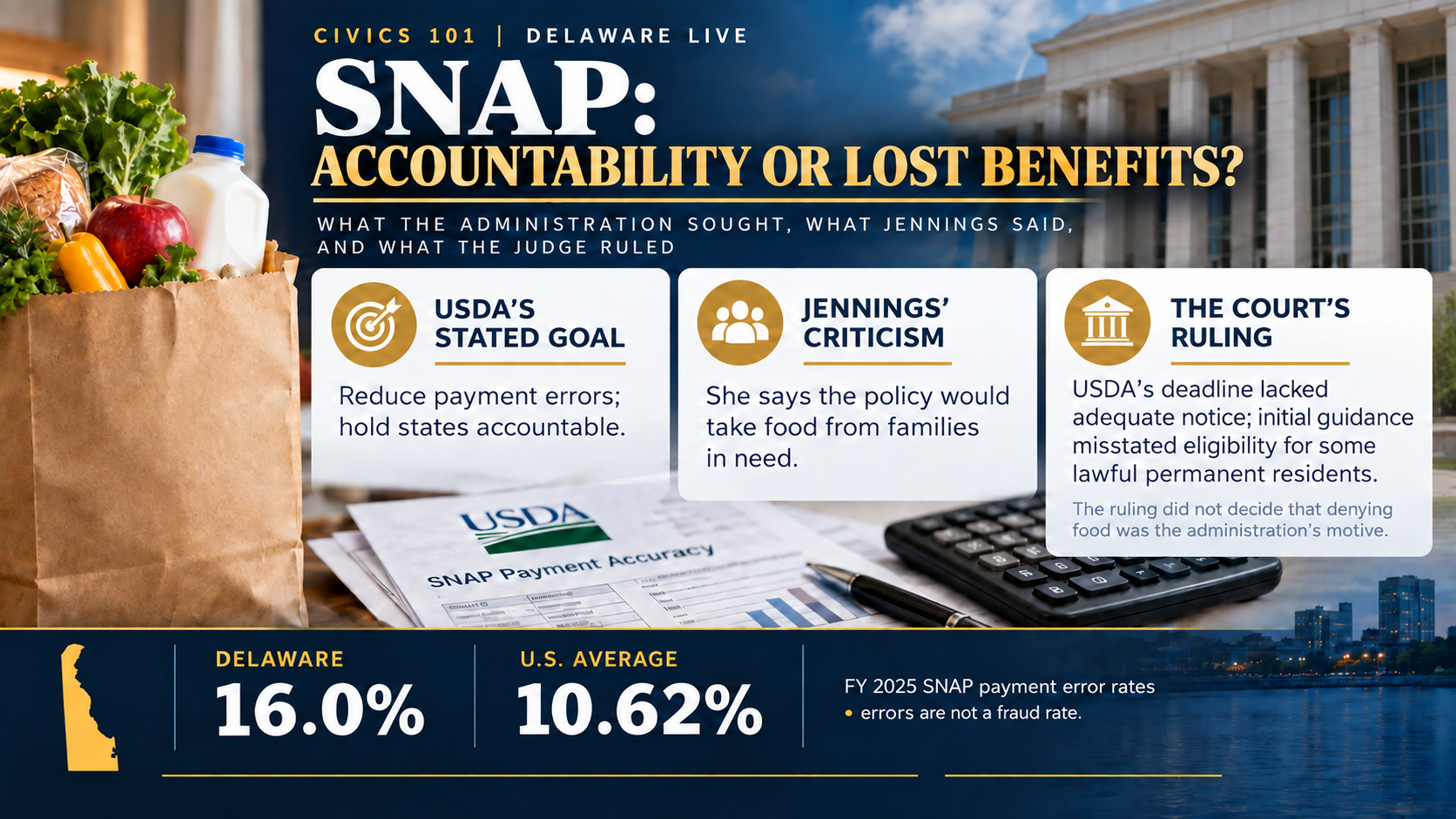
The U.S. Department of Agriculture reported a national payment error rate of 10.62% for fiscal 2025, representing $10.1 billion in improper payments. The measure includes benefits paid above and below the correct amount. It is not a fraud rate.
“These payment error rates are further proof that state accountability is severely lacking in SNAP,” Agriculture Secretary Brooke Rollins said when USDA released the figures. She said the department wanted states to curb waste while serving needy families and protecting taxpayers.
Delaware’s error rate
Delaware’s fiscal 2025 rate was 16%, compared with the 10.62% national rate and the law’s 6% cost-sharing threshold. That makes payment accuracy a substantial issue for the state, independent of its dispute with USDA over the new law’s implementation. The figure does not mean 16% of Delaware recipients committed fraud; it includes overpayments and underpayments.
Delaware’s rate is high enough to qualify it for a delay in the new benefit cost-sharing requirement. That gives the state more time to improve accuracy before it must begin paying a share of benefits under that provision. The delay comes from the law itself, separate from the court ruling.
Why the judge rejected USDA’s deadline
The lawsuit focused on how USDA put the 2025 law into effect. SNAP rules provide a 120-day adjustment period during which certain errors arising from a policy change are excluded from a state’s payment error rate. USDA said the period began July 4, 2025, when the law was enacted, and ended Nov. 1.
But USDA did not issue its guidance on noncitizen eligibility until Oct. 31, leaving states one day under that timetable. Other instructions arrived weeks or months after USDA said the clock had started. U.S. District Judge Mustafa Kasubhai ruled that the department had not given states adequate notice. He set aside its deadline and required a full adjustment period following proper implementation instructions.
The judge also found that USDA’s October guidance wrongly indicated that some lawful permanent residents were ineligible for SNAP or subject to a five-year waiting period. USDA issued a clarification in December. The ruling confirms that lawful permanent residents who were previously in specified humanitarian categories retain their exemption from the waiting period, provided they meet other SNAP requirements.
What Jennings’ criticism means
“This entire ordeal was a blatant attempt by the Trump Administration to take food away from families in need, to destroy a plank of the social safety net, and to degrade our state’s financial standing,” Attorney General Kathy Jennings said in announcing the decision.
Jennings’ accusation goes beyond what the judge decided about the administration’s intent. USDA says it is seeking to reduce improper payments, save federal money and hold states accountable for administering SNAP accurately. The court nevertheless found that USDA’s initial guidance misstated eligibility for some lawful permanent residents and that its deadline unfairly exposed states to future costs.
The distinction does not erase the effects of the broader 2025 law. The Congressional Budget Office expects its tighter eligibility and work rules to reduce the number of people receiving SNAP. Its projected $187 billion in federal savings over 10 years includes those changes; it is not an estimate of fraud eliminated. The court ruling establishes that USDA went beyond a lawful implementation of the changes at issue, but it does not establish that denying food to needy families was the administration’s purpose.
For Delaware, the ruling means USDA cannot use the deadline the judge rejected to count implementation errors against the state. Delaware must still follow the new law and address its high payment error rate. Both facts matter to understanding what the state won — and the work that remains.
TO GO BOX | The SNAP ruling
- Who: Delaware Attorney General Kathy Jennings joined other states in suing the Trump administration over USDA’s SNAP guidance and deadline.
- What: A federal judge set aside USDA’s deadline for counting certain implementation errors and clarified eligibility for some lawful permanent residents.
- When: The ruling was issued Sept. 17, 2026.
- Where: The decision came from the U.S. District Court for the District of Oregon and addresses USDA guidance to states.
- Why it matters: Delaware avoids errors being counted under the rejected deadline, but its 16% fiscal 2025 payment error rate remains high. The federal law requiring states with high error rates to share SNAP benefit costs remains in effect.
Delaware LIVE collaborates with a network of professional journalists to cover a diverse range of stories across various fields. Staff Writers include experienced journalists and young professionals. If you have questions, please feel free to contact [email protected] or our publisher, George D. Rotsch, at [email protected]