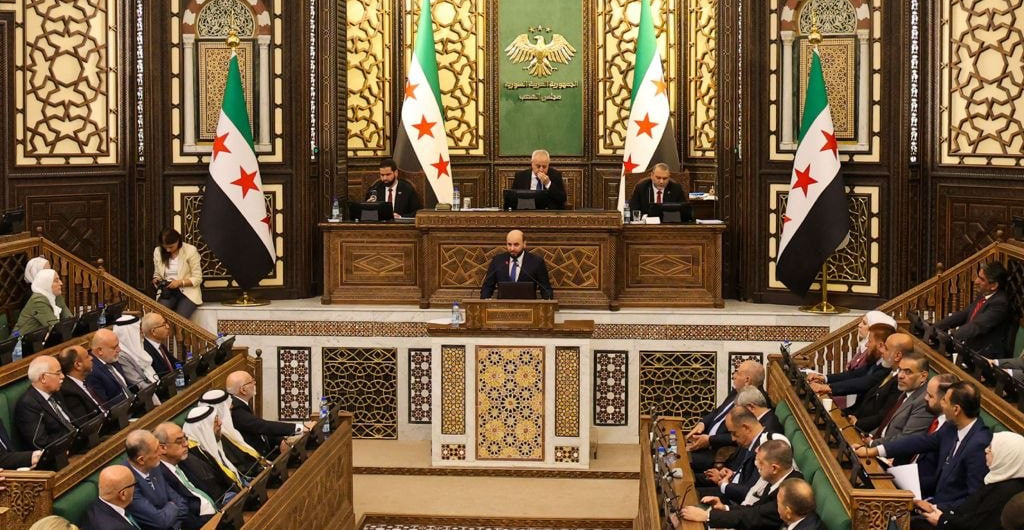
Syrian Minister of Energy Mohammed Al-Bashir delivered an extensive briefing on the country’s energy landscape before the People’s Assembly during a session devoted to petroleum derivatives and recent fuel price increases. He outlined a stark imbalance between domestic gas production and national demand, and emphasized the continued need to import large volumes of fuel amid rising consumption.
Al-Bashir presented a roadmap to expand oil and gas output, rehabilitate damaged fields and wells, modernize infrastructure, and digitize ministerial operations. “We will achieve self-sufficiency in oil by 2028, and we will need about seven years for gas production to reach satisfactory levels,” he said. He also stressed that the establishment of holding companies does not signal a move toward privatization, noting that all entities under the ministry remain state-owned.
The minister was summoned to parliament following protests in several Syrian regions over newly implemented fuel prices.
Gas Production and Petroleum Derivatives
Al-Bashir reported that Syria currently produces around eight million cubic meters of gas per day, compared with a national requirement of roughly twenty-four million cubic meters. Production had previously hovered near six million cubic meters.
“To address the crisis in securing petroleum derivatives, we resorted to electric refineries. As for gas, we now purchase 6.3 million cubic meters daily—equivalent to 140 million US dollars per month—from Azerbaijan and from a floating storage unit at Jordan’s Aqaba Port,” he said. The ministry is drilling new wells to narrow the deficit.
Turning to petroleum derivatives, Al-Bashir noted that the number of registered vehicles has risen from 2.5 million to 3.6 million, sharply increasing fuel demand. Syria’s refining capacity stands at about 150,000 barrels per day, and the country imports a similar volume to meet consumption needs.
He explained that the Syrian Petroleum Company sells gas to the electricity sector at nine dollars per million BTU, while international purchases cost roughly twenty-two dollars per million BTU. High global prices have forced a reduction of about two million cubic meters in monthly imports, directly affecting power generation. Meanwhile, the public electricity company’s accumulated debt to the gas supplier has reached 1.65 billion dollars, worsened by low collection rates in several governorates.
On oil production, Al-Bashir said Syria has seventy-eight oil fields. While peak output once reached 140,000 barrels per day, current production depends entirely on the operational readiness of wells. “Our local oil production is 112,000 barrels, and we face a shortfall of 200,000 barrels that we purchase from abroad,” he said.
Daily national needs include twelve million liters of diesel, eight million liters of gasoline, 8,500 tons of fuel oil for power plants and industry, and 1,300 tons of domestic cooking gas. “We are moving toward contracting with friendly oil-producing countries until we achieve self-sufficiency. We have also requested price quotes to complete the Arab Gas Pipeline from Jordan, a project valued at roughly a quarter of a billion dollars and funded by the Syrian Petroleum Company,” he added. Overall, Syria requires 831 million dollars per month to procure crude oil and derivatives.
Electricity Infrastructure and Reforms
Al-Bashir said the ministry has rehabilitated eight percent of the electricity transmission network, including regional interconnection lines with Turkey and Jordan. To reduce energy losses, the ministry is deploying smart meters, beginning with 300,000 units in Damascus and Idlib this year before expanding nationwide. A contract has also been signed with a Saudi company to build a smart grid command-and-control system at an estimated cost of sixty million dollars.
Industrial consumption accounts for forty percent of Syria’s total electricity use. Al-Bashir noted that power generation stood at just 915 megawatts—providing one to two hours of electricity daily—when Damascus was entered. Today, production has reached 3,500 megawatts, supplying eighteen to twenty hours of electricity daily in most governorates. Strategic plans include constructing four new gas-fired power plants and expanding the Tishreen thermal station.
Water and Wastewater Management
Beyond energy, Al-Bashir reviewed progress in the water sector. He reported the construction of five new wastewater treatment plants across several governorates and the restoration of water services to 2.3 million people who had endured prolonged outages. The ministry has repaired 6,000 water pumps, drilled 308 new drinking-water wells, rehabilitated 1,051 existing wells, and built or restored 110 water reservoirs as part of its broader mandate to secure essential public infrastructure.
This article was translated and edited by The Syrian Observer. The Syrian Observer has not verified the content of this story. Responsibility for the information and views set out in this article lies entirely with the author.