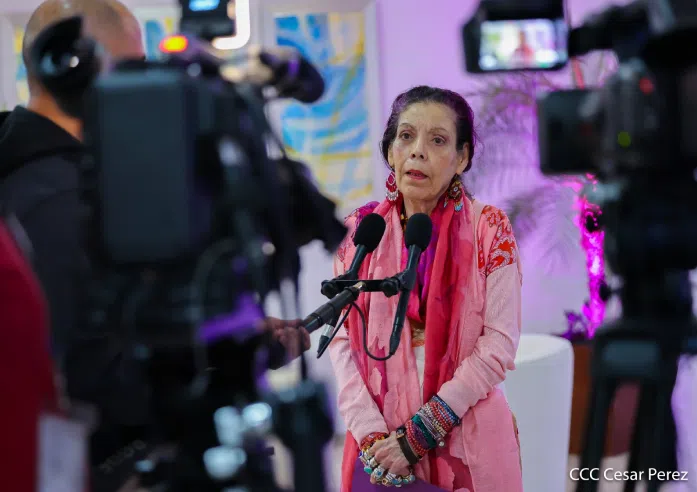
Nicaraguan “co-president” Rosario Murillo, speaking with the official media. Photo: CCC
The dehumanizing images in Rosario Murillo’s insults are neither a coincidence nor the product of an attack of rage – it’s a strategy for power.
By Thelma Brenes Muñoz (Confidencial)
HAVANA TIMES – Over the past few weeks, there’s been an uptick in the offensive and dehumanizing language in Rosario Murillo’s daily discourses, directed at anyone who criticizes the regime or emits any opinion contrary to its interests. “Bacteria”, “fungi”, “termites”, “scoundrels”, “sicko’s”, “little nothing people”” are only some of the terms she uses – the list appears endless.
Her language brings to mind the Nazi propaganda posters I saw during a visit to the German Historical Museum in Berlin. Jews are depicted with exaggerated noses, caricatured expressions, and an appearance designed to evoke revulsion. The intention was clear: to make the population stop seeing Jews as human beings and start viewing them as dangerous and a threat.
When I first arrived in Germany, I had a hard time understanding how a segment of the population could remain unaware of what was happening during the Nazi era. Later, I came to understand that the propaganda machine was a key factor in dehumanizing the “other.” The goal of propaganda wasn’t just to persuade; it also sought to make people stop empathizing with others and to foster indifference.
In the same way, the dehumanizing images in Rosario Murillo’s insults are neither a coincidence nor a fit of anger. The language of dehumanization serves a well-known political function. Totalitarian regimes use dehumanization to strip opponents and minorities of their humanity. The goal is to generate hatred toward those who think differently, to eliminate empathy, and thereby to normalize exclusion and justify persecution and violence.
The Historical Legacy of Hate
History is full of examples. Nazi propaganda systematically resorted to medical and biological terms when referring to Jews. Their propaganda machine described them as “bacilli,” “parasites,” “rats” and “viruses,” that contaminated the body of the nation and should be eliminated. Propaganda alone didn’t create the Holocaust, but contributed to creating an atmosphere in which persecution and violence were accepted, tolerated and ignored.
Mussolini’s regime in Italy wasn’t far behind. Opponents were branded as anti-Italian and traitors to the homeland; they were considered a disease, a tumor, an infection that threatened the nation and therefore had to be eradicated. In the 1990s, during the events leading up to the Rwandan genocide, the radio and print media constantly broadcast hate speech against the Tutsi ethnic group, who they frequently referred to as inyenzi—cockroaches. The result: 800,000 people murdered between April and June 1994.
That’s why it is dangerous to think that Rosario Murillo’s words are mere tantrums or mad ramblings. They are not. The historical contexts are different, of course, and this is not to say that Nicaragua is Nazi Germany or Rwanda in 1994. However, the rhetoric exhibits patterns reminiscent of the dehumanization tactics used by authoritarian regimes throughout history. And history teaches us that words matter, because they pave the way for actions—action on the part of some and inaction on the part of others.
Rosario Murillo’s dehumanizing message serves two clear purposes. First, it reinforces the hatred encouraged in her supporters—for example, by normalizing social media comments that political prisoners should die in prison. Second, it uses fear to paralyze any expression of empathy or solidarity with those who are in prison or in exile. The problem is that this paralysis helps normalize the violence that the regime exercises against the political prisoners and the opposition. The effect of this strategy is that the populace doesn’t dare to look, or ask questions, but merely goes about their own lives.
The paradox of the “tiny groups”
Umberto Eco, in his essay “Urfascism” (Eternal Fascism), identified a common feature of totalitarian discourse: the enemy is despicable and too weak to be respected, yet strong enough to pose an imminent threat.
This paradox is very present in the rhetoric of Ortega and Murillo. On the one hand, they attempt to belittle the opposition by calling them “tiny groups” and “dregs” and claiming they are insignificant minorities. However, in Murillo’s daily audio messages, she accuses them of having the capacity to organize coups, international conspiracies, and terrorist acts. This contradiction is not a flaw in the discourse; it serves the political function they need: to belittle and ridicule the opposition while exaggerating its power to justify the state repression.
Political Dehumanization
Another mechanism common to authoritarian regimes is the myth of national treason. The person ceases to be an individual with rights, and is instead labeled a “sellout,” “traitor,” “puppet,” or “foreign agent.” Stalin’s regime in the Soviet Union used the term vrag naroda, “enemy of the people,” to reinforce the idea of an internal enemy. In Nazi Germany, the term Volksverräter (“traitor to the people”) was used to strip dissidents and Jews of their humanity and civil rights. The Nazis also promoted the so-called “stab-in-the-back” myth, according to which Germany lost World War I because it had been betrayed by internal enemies. That idea paved the way for the notion that certain citizens don’t deserve to belong to the German nation, hence justifying the exclusion of the Jews from the national community and later the abolition of their rights under the 1935 Nuremberg Laws.
In Nicaragua, anyone who criticizes the regime is accused of working for the United States, the European Union, or the CIA to destabilize the country. When the regime calls opponents “traitors to the homeland” (as it does with my father, Carlos Brenes Sanchez, sentenced to fifteen years in prison), or when it strips 442 Nicaraguans of their citizenship, it’s hard not to see the similarity. Not because the historical circumstances are identical, but because the tactic is the same: first, the political adversary is turned into an enemy of the nation; then, they are stripped of all the civil, political, and social rights of citizenship and their right to belong to the territory where they were born.
As the daughter of a political prisoner, I know that behind every insult that comes out of Rosario Murillo’s mouth there is a person, a family, and a story. When she speaks of “bacteria” or “fungi” that must be eliminated, those “bacteria” have names and faces. They are my father and his wife Salvadora, whose children and grandchildren want to know where they are and how they’ve been for the past 13 months—to give them a hug and see them safe and sound in their old age. That is why it’s important to call this process what it really is: not mere madness or anger, but a strategy of power.
Imprisonment, disappearance, and the loss of rights do not begin with a judge’s sentence. They begin much earlier. They begin when the State promotes a society in which some of its citizens do not deserve to be seen as human beings, and the use of violence, exclusion, loss of identity, dignity and the most elemental rights are justified.
First published in Spanish by Confidencial and translated and posted in English by Havana Times.
Read more from Nicaragua here on Havana Times.