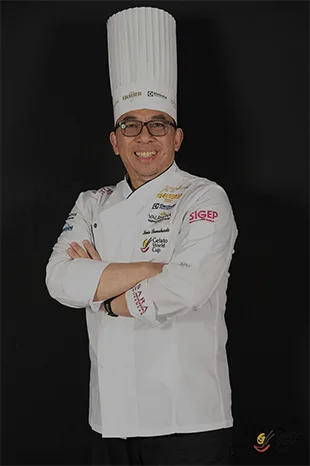
Jakarta, IO – Indonesia has never lacked culinary talent. What it has often lacked is the infrastructure capable of turning talent into professional excellence, and professional excellence into global competitiveness. For Louis Tanuhadi, that gap has become a life’s work.
Today, Tanuhadi is best known as President of the Academy of Pastry and Culinary Arts Indonesia, as well as its Director and Executive Pastry Chef. But his role is better understood not simply as that of a pastry chef or educator. Over the past several years, he has increasingly positioned himself as a builder of Indonesia’s Pastry & Culinary, creating the conditions in which young chefs can move from enthusiasm to discipline, from technical ability to professional readiness, and from local kitchens to international stages. That distinction matters.
Culinary education is often romanticised. The public sees the finished plate, the precise chocolate work, the elaborate pastry or the gleaming restaurant kitchen. What it rarely sees is the repetition, physical stamina, discipline, failure and technical rigor required to produce a professional chef. At APCA Indonesia, Tanuhadi has deliberately tried to make education resemble that reality.
Students in its intensive programmes spend around nine months in training, with approximately 90 percent of their education conducted through hands-on practice. Class sizes are kept relatively small, and students can spend at least seven hours a day in the kitchen. The idea is straightforward: professional chefs cannot be produced through theory alone.
“Culinary and Patisserie is not just about technique, but also about forging discipline, creativity, and resilience,” Tanuhadi said at APCA Indonesia’s fifth graduation in 2026. (APCA Indonesia). That sentence perhaps reveals more about his approach than any list of credentials.
From pastry chef to institution builder
(Source: Special)
Tanuhadi’s own journey began long before APCA Indonesia. His introduction to pastry came through his father’s bakery, before his professional development took him into European pastry traditions and chocolate. He later worked in a Konditorei in Hannover, Germany, and undertook training at institutions including Lenôtre and Bellouet Conseil in France. His career subsequently moved through the commercial side of the pastry and chocolate industry, including more than a decade in Asia-Pacific business development at PT Freyabadi Indotama.
This combination of craft and industry experience is important. Tanuhadi did not come to education solely from the kitchen. He understood ingredients, supply chains, commercial realities and the demands of the professional market. By the time APCA Indonesia opened in 2019, he had already been thinking about establishing a professional pastry school in Indonesia for years. The Jakarta Post reported at the academy’s opening that the idea had been in his mind since around 2002.
The eventual establishment of APCA Indonesia therefore represented something larger than opening another cooking school. It was an attempt to create an institution capable of narrowing the gap between Indonesian culinary ambition and international professional standards.
Producing talent, not simply graduates
This is perhaps where Tanuhadi’s contribution deserves closer attention. The success of Pastry and culinary school should not ultimately be measured by the number of certificates it awards. It should be measured by the quality of professionals it sends into the industry. APCA Indonesia has increasingly built its education around that principle.
(Source: Special)
Students are exposed not only to technical instruction, but also to visiting international chefs, masterclasses, professional competitions and opportunities for international internship. The academy has brought globally recognised pastry figures to Indonesia, including Meilleur Ouvrier de France Jean-François Arnaud, World Pastry Champion Ming Ai Loi, Manuel Bouillet and Wang Qing, among others. Also Chef Wei Loon Tan as World Pastry Champion. APCA also offers pathways connected to City & Guilds qualifications and international internship exposure, including restaurants in France. The objective is not simply to import foreign expertise.
Read More: Rahmi Hatta’s Centenary: From The Fashion Performance Art “RUMAH” To 40 Couples Bonding In Love
It is to expose Indonesian students to the level of precision, discipline and professional expectations that define the upper end of the global industry, and then allow them to build from that foundation. That distinction is critical for Indonesia. A country can possess extraordinary culinary heritage and still struggle to compete internationally if it lacks strong professional institutions. Culinary and Pastry identity and professional capability are related, but they are not interchangeable. Indonesia has thousands of recipes, extraordinary ingredients and deeply rooted food traditions. But turning those assets into internationally competitive restaurants, pastry programmes, hospitality businesses and pastry culinary intellectual property also requires trained people.
Tanuhadi’s focus has increasingly been on those people. Creating a generation that can compete His work extends beyond formal classroom education. Tanuhadi established the Indonesia Pastry Bakery Society, helping create another platform through which pastry professionals can exchange knowledge and develop younger talent. He has also been involved in building Indonesia’s presence in international pastry competitions, including leading Indonesian teams at the Asian Pastry Cup and supporting Indonesia’s debut at the Gelato World Cup. Competition matters in a very particular way.
It forces chefs to benchmark themselves beyond their immediate environment. Technique becomes measurable. Discipline becomes visible. Standards become international.When an Indonesian chef competes against teams from countries with mature culinary training systems, the question is no longer whether the food is “good for Indonesia.” The question becomes whether the work can stand against the best anywhere. That is precisely the mindset shift required if Indonesia wants to produce globally competitive pastry culinary professionals.Building knowledge around Indonesian ingredients
Tanuhadi’s approach is also increasingly relevant to another major opportunity: moving Indonesia higher up the pastry culinary value chain. Indonesia is rich in agricultural commodities and raw materials, yet much of the greater economic value associated with those ingredients is often created elsewhere. Chocolate is an obvious example.
Tanuhadi has spent decades working with chocolate, and APCA Indonesia recently introduced professional bean-to-bar education designed to teach the entire process from cacao harvesting and fermentation through processing and finished chocolate production. He also serves as Director of Carpigiani Gelato Pastry University Indonesia. (APCA Indonesia)
The larger implication goes beyond chocolate.
A country that only supplies raw ingredients captures one kind of value. A country that possesses the chefs, chocolatiers, designers, entrepreneurs and brands capable of transforming those ingredients into premium products captures something much greater: knowledge, craftsmanship, intellectual property, employment and cultural prestige. Talent development therefore becomes an economic strategy. A different definition of culinary legacy.
The culinary industry often celebrates individual achievement. Michelin stars, awards, restaurant openings, television appearances and social-media visibility create recognisable figures. But another form of achievement is quieter. It is the chef who produces other chefs.The educator who creates a system that continues after him. The professional who opens doors that the next generation no longer has to knock down themselves. That may ultimately be Louis Tanuhadi’s more significant contribution.
His own technical knowledge matters. His experience in pastry and chocolate matters. His involvement in international competitions matters. But the larger story is what happens when that knowledge is transferred.
Every graduate who enters a professional kitchen better prepared, every Indonesian pastry chef able to compete internationally, and every young professional who believes a global culinary career can begin in Indonesia expands the capacity of the entire industry. For a country that increasingly speaks about gastronomy, creative economy and cultural influence, that infrastructure is indispensable. Indonesia’s culinary future will not be built only by preserving recipes or celebrating famous dishes. It will also be built inside classrooms, training kitchens and laboratories, through thousands of hours of repetition and mentorship. And in that less visible part of the ecosystem, Louis Tanuhadi has spent years doing something strategically important: not simply creating excellent food, but helping Indonesia create excellent chefs. (des)