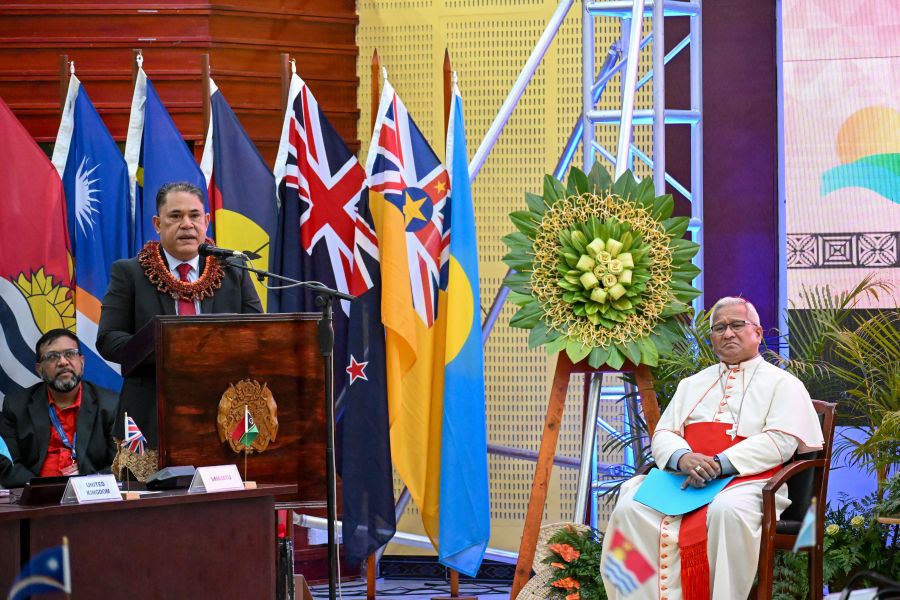
The Pacific region’s National Meteorological and Hydrological Services (NMHSs) convene today in Nuku’alofa, Tonga, for the opening of the Eighth Pacific Meteorological Council (PMC-8), running from 10 to 14 September 2026, part of Pacific Meteorological Week.
The biennial meeting brings together Directors and Heads of NMHSs from across 26 member countries and territories to review a decade of progress since the Council last met in the Kingdom, and to set the region’s climate services agenda for the next ten years.
PMC-8 follows a series of pre-meetings that began on 7 September, including the Expert Panel meetings, the Media Mana Training and inaugural Weather Ready Pacific Programme Liaison Platform. Pacific Meteorological Week will conclude with the Fourth Pacific Ministerial Meeting on Meteorology (PMMM-4) on 16 September, 2026.
More than 177 participants have registered for the week’s proceedings, including 101 PMC members, technical partners, CROP agency representatives, development partners, UN agencies and regional media, reflecting the scale of coordination the Pacific now brings to weather, climate, water and ocean services.
Officiating the opening, Hon. Dr. Viliami Uasike Lātū, Deputy Prime Minister of the Kingdom of Tonga warmly welcomed delegates, with a reminder that in the Pacific, that thereis no community too small nor too remote to receive early warnings.
“We have faced destructive tropical cyclones, droughts, volcanic eruptions, tsunami and other hazards. The eruption of Hunga Tonga–Hunga Haʻapai in January 2022, and the tsunami that followed, demonstrated with extraordinary force how quickly a hazard can cascade across the natural environment and across our societies. It also reminded us that the atmosphere, ocean and solid Earth do not operate according to the institutional boundaries that we sometimes create. A volcanic eruption became an atmospheric event, an ocean event, a tsunami emergency, a communications crisis and a national disaster. This is why the Pacific must continue moving towards a genuinely multi-hazard, Earth-system approach to early warning.”
He expressed that “Technology will continue to change. Our satellites will improve, forecasting systems will become more powerful, and AI will increasingly support our science. Our understanding of atmosphere and oceans will continue to advance. But technology alone will not make us weather ready. The most important investment we can make is in our people, like our meteorological observers, hydrologists and technicians, disaster managers, communicators and communities who can amplify the early warnings for action.”
A priority among this week’s agenda is the deliberation of a new Pacific Islands Meteorological Strategy (PIMS), alongside a revised Terms of Reference, Rules of Procedure and governance arrangements including a Unified Steering Committee. The new Strategy will guide the region’s meteorological and hydrological services through to 2036, building on the commitments set out in the 2015 Nuku’alofa Ministerial Declaration and the 2023 Namaka Ministerial Declaration, and aligning the sector’s work with the Pacific 2050 Strategy for the Blue Pacific Continent.
Pacific estimates show that even a 1% reduction in weather-related damage from improved forecasts and warnings could generate regional savings of about US$3.6 million, with benefit–cost ratios around 6:1 for improved meteorological services, while global evidence shows benefit–cost ratios for early warning systems ranging from 1:4 to much higher.
For Pacific communities, this means fewer lives lost, less disruption to schools and services, more reliable water and food supplies, and greater confidence to plan and invest in a changing climate where El Niño and La Niño events can sharply alter rainfall, temperature and cyclone risk.
Over the past decade, PMC has anchored major regional gains: the establishment of impact-based multi-hazard early warning systems, the operation of a Regional Climate Centre and bi-annual Pacific Islands Climate Outlook Forum, and the founding of a WMO Regional Training Centre to build regional research and forecasting capacity.
The new PIMS is designed to consolidate these gains while sharpening the region’s focus on sustainability, early warning coverage under the Early Warnings for All initiative, and the long-term resourcing of National Meteorological and Hydrological Services.
“When I assumed the Chairmanship of the PMC in 2024, I accepted this responsibility knowing that much work remained ahead of us. Today, I am proud to stand before you and say that we have made progress,” said Mr. Levu Antfalo, outgoing Chair of the PMC and Director Vanuatu Meteorological and Hydrological Services.
“But our work is far from complete. Earlier this year, some of our members faced the impacts of tropical cyclones, including communities in the Solomon Islands and the Federated States of Micronesia. We are also dealing with the impacts associated with El Niño, while another Pacific tropical cyclone season will soon be upon us. These events remind us that the services we provide are about protecting lives, livelihoods and the future security of our Pacific people,” he explained.
Across the three days of PMC-8, sessions will cover country reports from NMHSs, an expert panel spanning aviation, marine and ocean services, climate and hydrological services, and multi-hazard early warning and support services. Delegates will also review the projects underpinning the sector’s work, including COSPPac, CIS-Pac5, CLIPSSA and the EU-funded ClimSA Pacific Programme, alongside emerging priorities such as COP31, ocean productivity services, and the Systematic Observations Financing Facility (SOFF).
The series of meetings culminate in the Ministerial segment, where Ministers responsible for meteorology will review progress against the Namaka Ministerial Declaration, consider how meteorological services can better support the Blue Pacific Agenda, and adopt a Ministerial Outcome to guide the sector’s direction going forward.
“Strengthening meteorological, climate, ocean and early warning services is fundamental to the resilience, security and prosperity of the Blue Pacific. The Pacific must continue to shape and lead its own priorities, while drawing on the strength of our regional and international partnerships,” said Mr. Salesa Nihmei, Director Climate Science and Information, SPREP.
“I acknowledge our PMC Members, technical agencies, private-sector partners, members of the media, and particularly our development partners who continue to support our collective ambition and the Pacific-led approach,” expressed Mr. Nihmei.
PMC-8 and PMMM-4 reaffirm a principle that has held since the Council’s first meeting in Majuro in 2011, where it was mandated that reliable, science-based weather and climate services, delivered through strong national institutions and coordinated regionally, are foundational to the safety and prosperity of Pacific communities. As the region enters a season shaped by a strengthening El Niño, that coordination becomes even more crucial.
Shortly after the official opening, the ceremonial handover of the chair’s role was done with outgoing chair Vanuatu welcoming Tonga as the new chair.
Source: SPREP