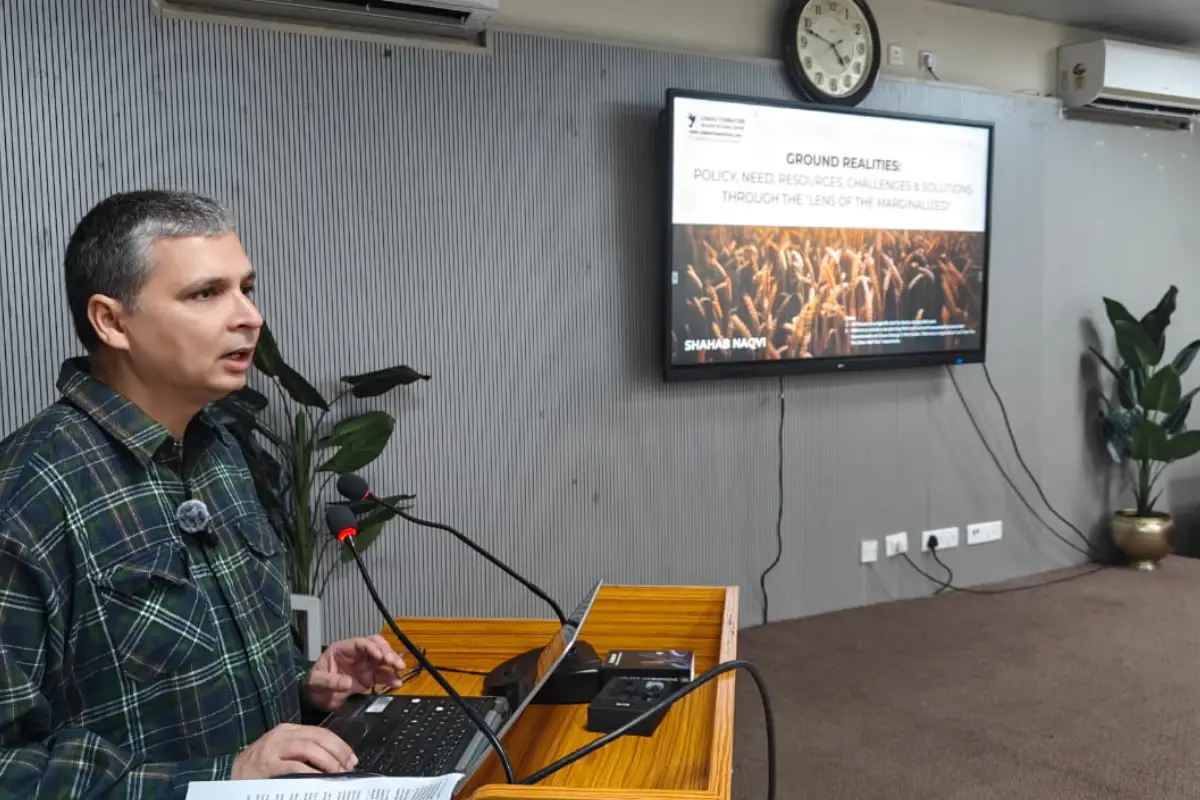
Dehradun: A public dialogue examining the gap between development policies and the lived realities of marginalized communities was held at the Doon Library and Research Centre on Tuesday. Organized jointly by the Doon Library and Research Centre and Saahas Foundation, the programme was titled “Ground Realities: Policy, Need, Resources, Challenges and Solutions Through the Lens of the Marginalized.”
The discussion brought together perspectives on agriculture, migration, rural employment, labour, disability, traditional knowledge and local economies, with an emphasis on understanding development from the experiences of communities directly affected by policies and programmes.
Social entrepreneur and development sector practitioner Shahab Naqvi, who led the dialogue, said development programmes often fail to deliver their intended outcomes when they are designed and implemented through top-down approaches without adequately understanding local conditions and the actual needs of communities.
Drawing on his field experience across North India, particularly in the Garhwal Himalayas, Naqvi highlighted the challenges faced by rural communities, small and marginal farmers, artisans and persons with disabilities.
He stressed that local communities possess valuable traditional knowledge, an ability to adapt to changing circumstances and a practical understanding of the resources available in their surroundings. Development planning, he said, should therefore move beyond centralised and uniform models and give greater importance to decentralised, community-based approaches rooted in local knowledge and participation.
Changing Agricultural Practices Raise Concerns
The changing nature of agriculture was one of the key subjects discussed during the programme. Participants examined the transition from traditional multi-cropping systems towards chemical-intensive monoculture, the declining autonomy over indigenous seeds and the gradual weakening of traditional farming practices.
The discussion noted that these changes can increase economic pressures on small and marginal farmers while also affecting rural ecosystems, biodiversity and the resilience of local food systems.
Particular attention was given to the role of traditional grains, indigenous seeds and community-based agricultural systems in Uttarakhand’s mountain regions. Participants pointed out that these practices should not simply be viewed as remnants of the past. They are closely connected with local food security, ecological balance, cultural traditions and the economic resilience of rural communities.
The need to preserve and strengthen such systems while creating viable contemporary livelihood opportunities was highlighted as an important policy challenge.
Migration and Rural Employment at the Centre of Discussion
Migration, rural employment, labour and the increasing workload borne by women also featured prominently in the dialogue.
Referring to data from the Periodic Labour Force Survey (PLFS) and the NITI Aayog Multidimensional Poverty Index, Naqvi highlighted continuing disparities in labour income, employment opportunities and access to social security.
The discussion also focused on the migration of young people from mountain villages in Uttarakhand, largely driven by limited local employment opportunities. Participants noted that sustained outmigration is not only an economic issue but also affects the demographic, social and cultural fabric of villages.
Speakers argued that mountain-specific development policies need to take into account local geography, agricultural practices, traditional skills and available natural and human resources. These strengths, they said, could be connected with new livelihood opportunities to make rural economies more sustainable and reduce the pressure to migrate.
Disability: From Welfare to Opportunity
The discussion on disability emphasised the need to move away from viewing persons with disabilities primarily through the lens of charity or welfare.
Naqvi said greater attention should instead be given to creating accessible environments, providing appropriate assistive devices, developing technical and vocational skills, and expanding opportunities for dignified employment.
Examples of connecting the skills and capabilities of persons with disabilities with local micro-enterprises were also shared during the session. Such approaches, participants noted, can help shift the focus from dependence to participation, economic independence and inclusion.
Open Question-and-Answer Session
An open question-and-answer session formed a significant part of the programme, allowing participants to engage directly with the issues raised during the discussion.
Questions covered a wide range of subjects, including agriculture, indigenous seeds, rural employment, migration, traditional knowledge, the condition of artisans, skill development and employment opportunities for persons with disabilities, as well as the ground-level effectiveness of government and non-government development programmes.
Responding to the questions, Shahab said the success of a development policy should ultimately be judged not by the language of policy documents or the number of schemes introduced, but by the tangible changes visible in people’s everyday lives.
He underlined the importance of sustained dialogue with communities and meaningful participation of local people in shaping development interventions.
Doon Library as a Space for Public Dialogue
The programme also highlighted the evolving role of the Doon Library and Research Centre as a public space for dialogue on social, cultural, academic and contemporary issues.
Speakers noted that the library is not limited to books, reading and research but also provides a platform where researchers, academics, social workers, young people and citizens can engage with pressing questions facing society.
The participants emphasised the importance of bringing diverse perspectives together in an open and constructive environment, particularly at a time when policy decisions can have far-reaching consequences for communities at the grassroots.
There was also a call for more such public discussions that can help bridge the gap between academic research, policy formulation and people’s lived experiences. Such forums, participants said, can contribute to making development debates more grounded, inclusive and responsive to local realities.
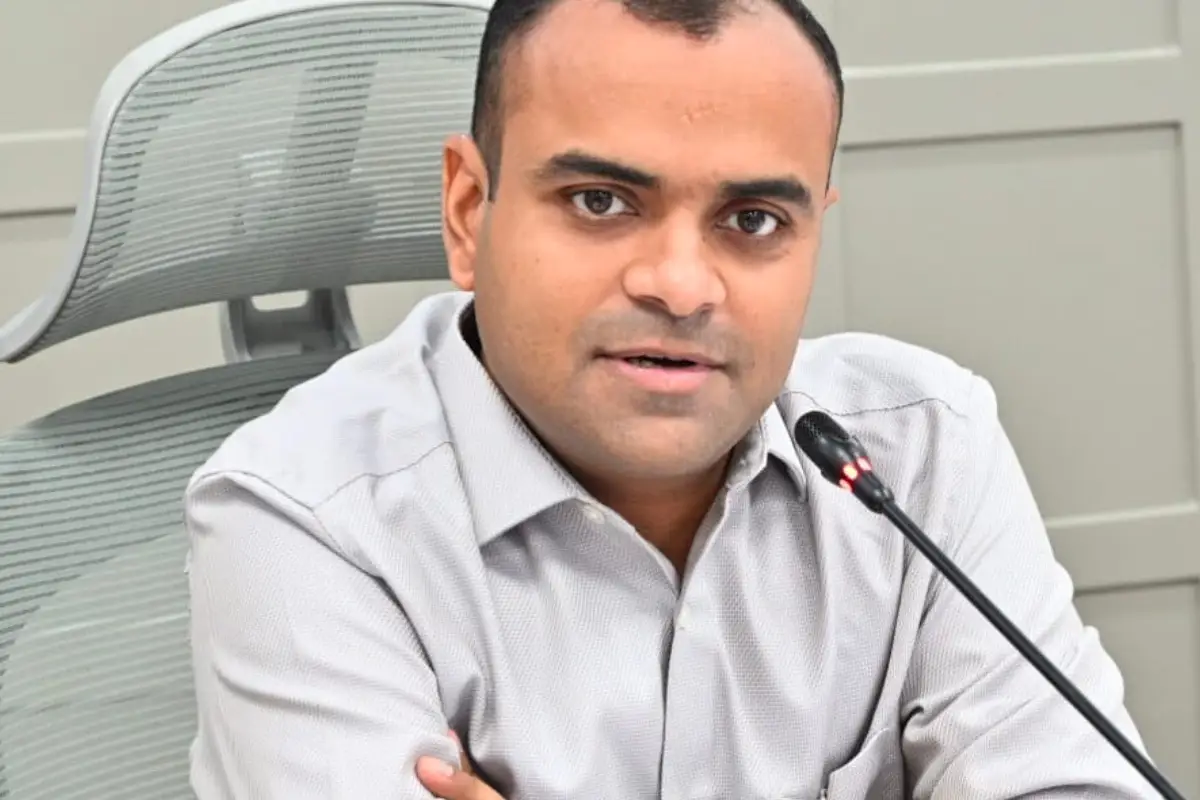
The programme was attended by Chandrashekhar Tiwari, Programme Officer, Doon Library and Research Centre; D.K. Pandey, Librarian; Sundar Singh Bisht, along with library officials and staff, researchers, social workers, academics, young people and citizens from different fields.
Putting People at the Centre of Development
The discussion concluded with a central message: development cannot be measured only through statistics, schemes or policy documents; its real measure lies in the changes it brings to people’s lives.
The dialogue underscored the need to recognise communities not merely as beneficiaries of development programmes but as active participants and knowledge-holders. Local experience, traditional knowledge, community participation and access to appropriate resources can play a critical role in designing solutions that are both practical and sustainable.
For regions such as the Garhwal Himalayas, where geography, ecology, traditional livelihoods and migration are deeply interconnected, participants stressed that development solutions must emerge from an understanding of these ground realities.
The event at Doon Library thus provided a platform for moving the conversation beyond policy frameworks and towards the people whose everyday experiences ultimately determine whether development interventions succeed. The emphasis on listening to marginalised voices and strengthening community participation emerged as one of the key takeaways of the dialogue.