By: Tuífua Vailena
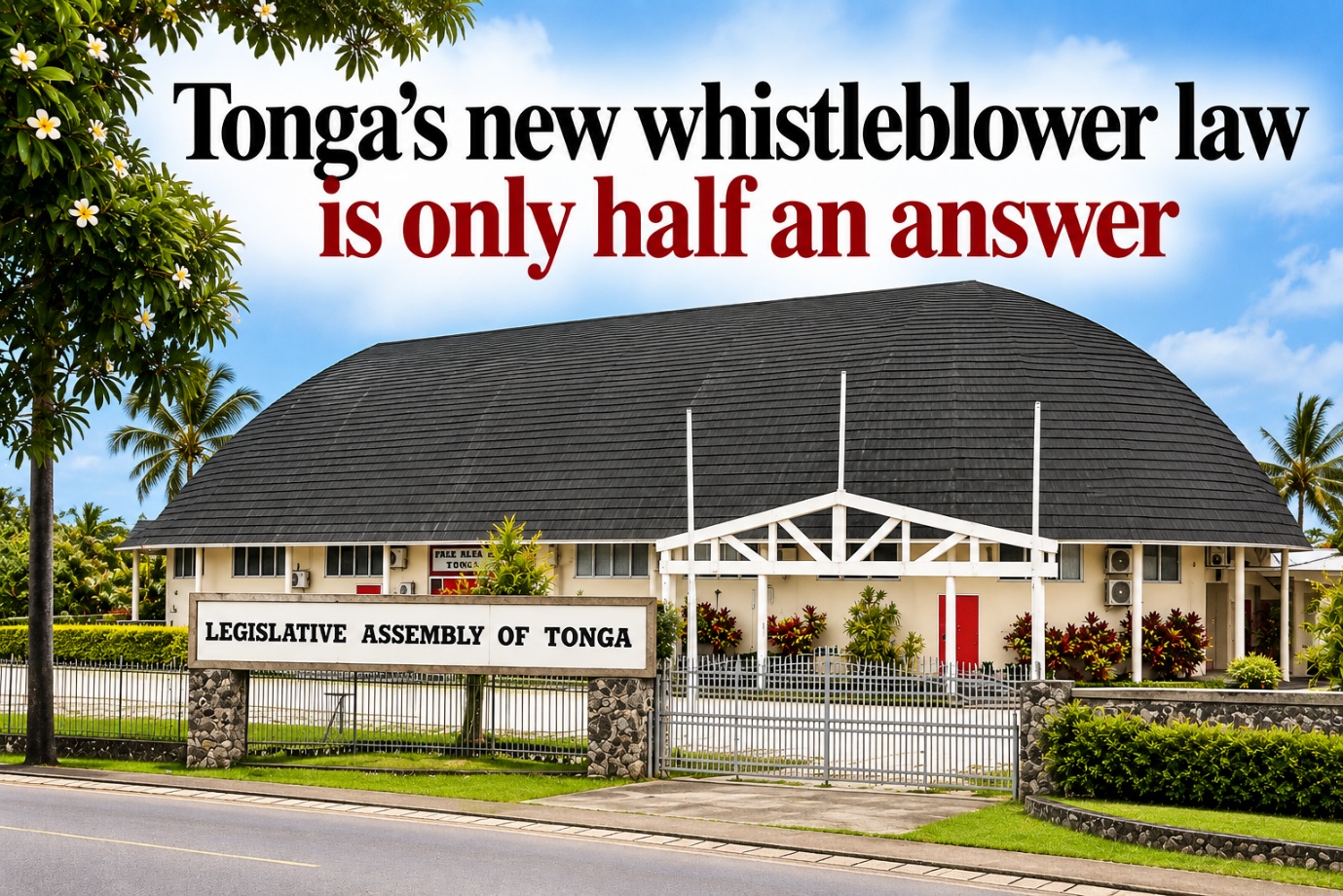
Tonga has a new law to protect whistleblowers. Anyone who reports corruption is now shielded from retaliation. Someone who threatens, sacks, or intimidates them can face jail time or heavy fines.
That is real progress and it deserves credit.
But it is only half the job.
Protecting the person who reports wrongdoing does not guarantee the public ever learns what happened next. Tonga still has no Freedom of Information law. Without one, government keeps full control over what it releases and what it buries.
What happens after the complaint
A whistleblower law and a Freedom of Information law do different jobs.
The whistleblower law lets someone report wrongdoing without fear of losing their job or their safety. That matters.
A Freedom of Information law lets ordinary people ask government direct questions and get direct answers. Where is the contract? Who signed off on the payment? What did the audit find? What did the investigation conclude? What was actually done about it?
These are not unreasonable questions. They are basic questions about public money. Right now, getting them answered depends on a ministry choosing to respond, an official agreeing to hand over a document, an Auditor-General report becoming public, or a source willing to talk. This masthead knows that reality well. None of it is a legal right. All of it can be withdrawn at will.
A public servant can risk everything to report suspected corruption. An investigation might follow. And then the file can simply go quiet. Not necessarily because anyone did anything wrong. There can be good reasons to keep an investigation confidential while it runs. But once it is over, the public still has no legal right to find out what happened.
A Freedom of Information law changes that relationship. Instead of government information belonging to government unless it chooses to release it, the starting position flips: information produced with public money, on public business, belongs to the public, with clear and limited exceptions.
There will always need to be exceptions. National security, personal privacy, active investigations, commercially sensitive material and some Cabinet discussions can reasonably stay protected.
Freedom of Information does not mean throwing open every filing cabinet to anyone who asks. It means government needs a lawful reason to say no, instead of citizens needing a reason for government to say yes.
Accountability cannot depend on government deciding how much government wants to share.
Democracy does not do things by halves
Tonga voted for a more democratic system. That choice comes with an obligation, not just a title.
Democracy is not only the right to vote. It means transparency in how power is used, from Cabinet down to the smallest government account. A country cannot call itself democratic while keeping large parts of how it governs and spends out of public reach.
Half a democracy is not a weaker version of the real thing. It is a system that keeps the parts that suit those in power and leaves out the parts that hold them to account.
Anonymity is hard to keep in Tonga
There is a second problem, and it is specific to us.
Tonga is small. We know each other. Our families know each other. Our churches, workplaces and villages overlap.
If a document known to five people in a ministry suddenly triggers an investigation, working out who spoke up does not take much effort.
A law can promise confidentiality. Reality in a small country is harder to control.
Someone who comes forward is risking their career, their friendships, sometimes their standing in their own community. They need to know that risk will lead somewhere. If the evidence goes in and nothing ever comes out, why would the next person take that same risk?
Protection from retaliation is one part of the deal. Confidence that something will actually happen with what they reported is the other.
This is not a hypothetical problem
TIN has seen this play out directly.
Since Tonga’s political reforms in 2010, one Auditor-General report after another has pointed to the same conclusion. The mismanagement is not a one-off. It is systemic.
A recent example makes the point. The Auditor-General’s special audit of the Tonga Water Board found that cash collected at the main office and the CBD office was not always banked daily or in full. Some days’ takings sat in the safe for weeks. By the time auditors reconciled the books, $785,095 in cash could not be accounted for over the three years to 2023-24.
The Water Board’s Risk and Compliance Manager was the one who decided when cash was paid into the bank, and who signed off payments made straight out of the safe instead of through petty cash. Asked about it, he told auditors this was simply “common practice allowed at the time,” and admitted there were “very low controls in place at the time.”
That is not one account kept badly by one person. It is an attitude. And it is the same attitude TIN keeps running into while reporting on auditors’ findings across different ministries: this is how it has always been done, so no one asks why.
A Freedom of Information law will not change that attitude by itself. But it removes the cover that lets it survive unchallenged. Once the public has a legal right to ask why an account was kept a certain way, “that is how we have always done it” stops being good enough as an answer.