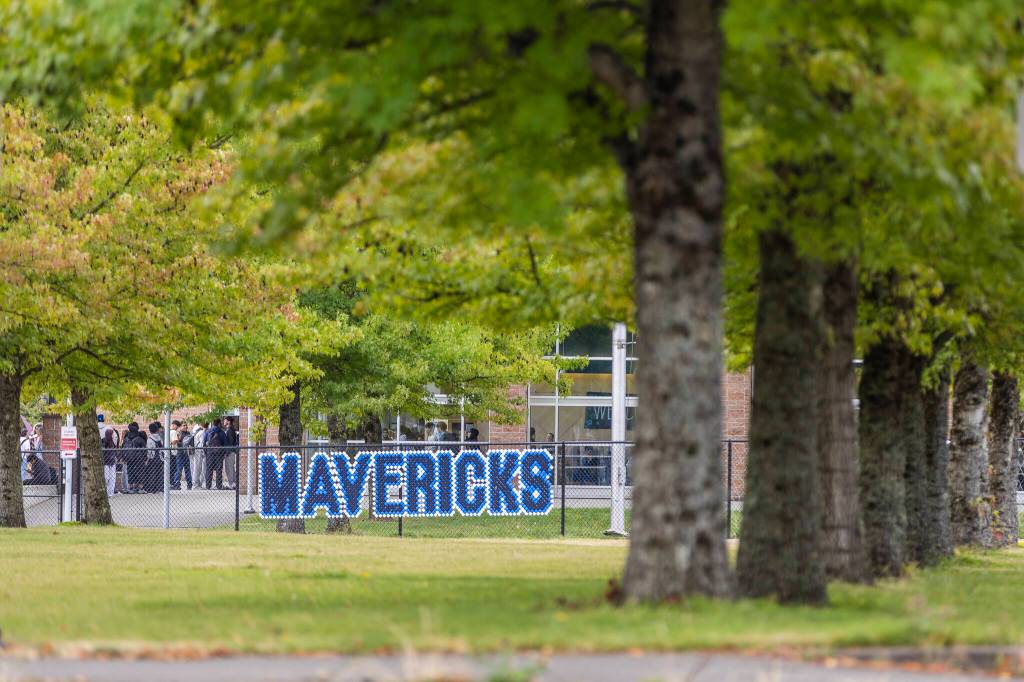
LYNNWOOD — In a city of 40,000, youth gun violence feels like an oversized issue for the residents of Lynnwood.
Shootings in the swelling Seattle suburb have earned national headlines, like the death of Jayda Woods-Johnson, 13, who was killed by a stray bullet fired by a teen as she walked through the Alderwood Mall in 2024. Others remain unsolved, with victims who’ve gone unnamed, like a 14-year-old murdered on New Year’s Eve that same year.
Among those killed are two teens shot while at the park with their girlfriends in 2022. The shootings have included gunfire outside crowded shopping centers and on busy roads during the middle of the day.
Since 2022, 14 shootings have involved 18 teenage victims in Lynnwood, including five fatalities, according to statistics shared by Mayor George Hurst earlier this summer.
“If you look at the raw numbers, we’re not talking about a huge data set,” Lynnwood Police Chief Cole Langdon told The Daily Herald during an interview in July. “We’re not talking about tens or dozens of people being killed in the Lynnwood area, but what I can tell you is every one of those cases are hugely impactful.”
Teen gun violence has not only taken lives — it’s shattered a sense of community safety.
“It makes everybody, including myself, start to reevaluate or reassess, ‘Where do I let my kids go to hang out? Do I let them go to the mall? Do I let them go to a park?’” Langdon said. “I know the numbers are in the favor of that when my kids leave the house … they’re going to be safe, you know, 99 times out of a 100, if not more than that. But that perception starts to creep in.”
As the school year begins, some parents and community groups are urging the Edmonds School District, which includes Lynnwood, to consider reinstating its school resource officer program. Some groups say that eliminating the program in 2020 has contributed to the youth violence issue. Others say the COVID-19 pandemic, the rise of social media or gaps in local mental health care are to blame.
“The concern of the families is huge,” said Lynnwood parent Marie MacCoy in an April interview. “We don’t feel comfortable with our kids going to the park, and that’s a really sad thing. I’m talking to parents, not just in my neighborhood, but a mile away, 3 miles away, and they’re all feeling the same, and they don’t know what to do about it.”
Statistics show crime is falling, but the mood doesn’t match the math.
In 2025, the Lynnwood Police Department reported zero murders after having four in the previous calendar year in a comparison of data from the Washington Association of Sheriffs and Police Chiefs annual crime report.
Juvenile arrests dropped by nearly a third, from 355 in 2024 to 244 in 2025, the data said. Police reported more than 870 fewer criminal offenses in the past year and a 7.5% increase in the number of cases officers were able to resolve.
Langdon didn’t take credit for the downturn, saying it matches what other agencies across Washington are seeing. Instead, He said police are trying to determine if this is the new norm or if crime is simply going unreported.
“The problem with crime data is it is always historical,” Langdon said. “It takes a while for the data to come together and start to collate with policy decisions.”
As answers remain elusive, stakeholders across Snohomish County are questioning practices in the justice system, schools and community service in hopes of putting an end to young people being shot.
‘There’s no real concern’
Snohomish County Deputy Prosecuting Attorney Cheryl Johnson spent seven years working in the department’s Juvenile Unit processing cases at the Denney Youth Justice Center. She remembers being shocked by the idea of a teen running around with a gun when she got her first case of a juvenile arrested for unlawful possession of a firearm a decade ago.
“Now, it is more of a novelty for them to not be having a gun, when you’re talking about people who are being booked into Denney,” Johnson said in an interview alongside Snohomish County Prosecuting Attorney Jason Cummings.
The challenge, according to the prosecutors, is the lack of consequences.
Juvenile court handles cases involving minors arrested for unlawful possession of a firearm. Under Washington state law, a minor with a gun is deemed a Category C offense, a mid-tier charge that means a teen arrested with a gun likely isn’t committed to a youth correctional facility until after a fifth juvenile conviction.
Until then, any sentence remains a local sanction and doesn’t have any real teeth, the prosecutors said.
“We’re frustrated in the potential outcomes for having to prosecute an individual that many times before they face serious consequences,” Cummings told The Daily Herald.
Chief Langdon said police identified two 19-year-old suspects in a shooting of a 17-year-old outside a Lynnwood Starbucks in June because his officers had previously arrested the two in possession of guns multiple times.
“Kids are smart and they’re measuring, and when they realize that there’s no consequence, they’re like, ‘What’s the downside of carrying one?’” Langdon said. “’It gives me status, it’s kind of cool, it’s kind of exciting. I might need to protect myself from a rival gang member.’ I mean, you just start to look at, there’s very few downsides. There’s no real concern about what’s going to happen to them.”
In general, there are legal barriers to prosecuting teenagers. Warrants can only be served on juveniles if they pose “a serious threat to public safety,” according to a 2021 state Supreme Court ruling. Cummings said that’s an extremely hard burden to meet.
Instead of protecting kids, the prosecutors said the rule gives teens an easy way out of avoiding accountability.
“So what happens if you just never come to court again?” Johnson said. “The court now can’t issue a warrant. We can keep having people invite you nicely to come back to court, but why would you do that when there might be consequences for your choices?”
Instead, the local juvenile court has a regular failure to appear calendar that is steadily growing.
Each time a teen opts not to attend their court appearance, their name is added to the docket, Johnson said. The teen remains on the list of no-shows and their case remains in a legal holding pattern.
If the court can’t determine a teen is a serious threat to the community, the teen doesn’t have to engage with the youth probation process, the prosecutors said.
“You want the kid to take some responsibility for the offenses,” Johnson said. “You want to have justice for the community and a victim to the crime, but you also have that equally important goal of juvenile rehabilitation. If we can’t get the kids into the courthouse, if we can’t get them into probation services, then we’re not meeting that (goal) either.”
The prosecutors said in their experience, it isn’t often a case of absentee parenting as some people may assume. Many parents who try to help their kids through the court system are rebuffed by rules on arresting teens and limitations on services.
“There are a surprising number of families that will come to Denney and say, ‘My kid is out of control, I need help,’” Johnson said. “They are coming to these court hearings that their kids are not coming to, asking the judge for the warrant, and the judge says ‘There’s nothing I can do.’”
A 2019 state law prohibits juvenile detention for status offense — an offense that’s based on age, such as truancy. The law also barred juvenile detention for at-risk youth petitions, which are usually submitted by parents whose children are exhibiting concerning behaviors like violating curfew or using drugs and alcohol.
State Rep. Lauren Davis, D-Shoreline, has been vocal about her regret for supporting the bill. Davis’ district also includes Lynnwood.
“For some young people, they need to know that there’s a possibility they might have to go to this place if they don’t comply, and that there’s got to be some structure and accountability for young people, especially young people who are really suffering,” Davis said.
Original plans called for a statewide network of residential crisis centers to support juvenile offenders, but that hasn’t materialized.
“It’s a much more appropriate placement for a youth who’s committed no crime but is obviously struggling,” Davis said. “But we didn’t build those, and so there are only two in the state.”
She now wants tougher laws that prioritize mental health care for youth offenders.
Earlier this year, Davis introduced a bill that would dismiss a charge for a juvenile in possession of a firearm if they agreed to participate in an early intervention program within two weeks. The program would include multisystemic therapy, a mentorship program and other services as needed identified by juvenile probation, such as a mental health or substance use disorder evaluation.
Other state lawmakers are focused on limiting access to guns for children.
State Rep. Strom Peterson, D-Edmonds, has sponsored a bill that would require gun owners who want to store their firearms in a car to keep them in locked storage that’s bolted to the floor of the car. The bill hasn’t made it out of committee for the past two years.
“Especially in shootings and robberies, the access to that gun is where a lot of that is coming from,” Peterson said.
The prosecutor’s office said they would like to see a reevaluation of the state’s juvenile sentencing matrix to reconsider the severity of an offense for a juvenile in possession of a firearm. Right now, state law has unlawful firearm possession as a Class B felony offense for adults, but a Class C offense for juveniles.
“The science out there talks about the juvenile brain and that juveniles are going to make impulsive, rash decisions,” Cummings said. “I would submit to you, doesn’t that make a juvenile possessing a firearm far more dangerous than a 30-year-old unlawfully possessing a firearm, because of the propensity for those rash actions, the propensity for poor decision making, for just pulling a gun out and shooting? Yet, the law doesn’t take that into account.”
Johnson also suggested an automatic mental health review be mandatory for a child found with a gun. Right now, that only occurs if the teen has a gun on a school campus, she said.
Cummings believes there is a disconnect between what his office sees every day and what is being presented to legislators by lobbyists and advocacy groups.
“I see bills that are being proposed that say, ‘Oh no, we are being too tough on juveniles,’ but then I see the consequences of cases we have,” Cummings said, mentioning a violent gang-related stabbing where two teens carved a letter in a 14-year-old’s chest at an Everett park in 2024. “That is not a juvenile crime. That is a heinous, horrible crime.”
He said advocates often want to keep juveniles out of state detention, but for the serious offenders, Cummings believes there isn’t a better option.
“These are kids that are requiring way more services for an intensive type of treatment, if we really want to reach them and you need those services,” Cummings said. “We don’t have those locally.”
‘One big step towards the solution’
Some activists believe the answer begins in the schools.
Earlier this year, a Lynnwood nonprofit, with support from key local voices, began a push to return school resource officers, or SROs, to the Edmonds School District, which includes nine middle and high schools in south Snohomish County.
“There’s been too many killings and shootings in Lynnwood since the SRO program ended,” Lynnwood Mayor George Hurst said in an August interview.
The district’s school board unanimously ended the district-wide program in 2020 amid a review of policies following the murder of George Floyd and nationwide outcry over police brutality.
In early July, students, community members and parents of multiple teen victims voiced support for restoring the program during school board and Lynnwood City Council meetings.
“If having officers in schools or places where kids gather can prevent one family from going through what my family has gone through, then I believe it’s worth considering,” said Tabatha Johnson, the mother of teen gun violence victim Jayda Woods-Johnson, during a July 7 school board meeting.
When Lynnwood police participated in the SRO program, Langdon said it allowed his officers to intervene sooner, providing resources in an everyday environment, instead of when they are responding to a call for service.
“It helps close the loop on a kind of more holistic approach to protecting and working with the kids that live in our community, that make up a couple thousand kids who are going to our schools here,” Langdon said.
The county prosecutor’s office is in favor of the program, too.
“Anecdotally, those schools with SROs have fewer referrals to our office for juvenile offenses because they are dealing with it on campus,” Cummings said.
Many other school districts in Snohomish County, including Everett, Marysville and Mukilteo, still have SROs. In May, the Northshore school board chose to end its last SRO contract at Bothell High School in favor of a consistent school safety model across the district. Following the board’s decision, hundreds of students held a walkout in protest.
In districts with SROs, issues get handled at the school administrative level, whereas in schools without the position, Cummings said similar trouble results in calls to police for the teen to be arrested and have charges referred to his office.
Members of the juvenile unit in the prosecutor’s office meet monthly with SROs across the county to discuss emerging issues, the severity of offenses and whose behavior may be escalating.
“It’s really helpful in terms of us triaging where our resources go,” Johnson said.
After ending the SRO program, the Edmonds School District started a liaison officer program, which appoints officers as points of contact for high schools instead of stationing them on campus. The arrangement keeps officers engaged with the schools, but largely keeps them out of any enforcement role unless asked, Langdon said.
In a July statement to The Herald, Edmonds School Board President Nancy Katims said the district has “strong partnerships” with local law enforcement agencies.
The district also has counselors, psychologists and family resource advocates who provide support to students as preventative measures, according to the district website.
A Lynnwood-based nonprofit, the Association for Collective Community Engagement on Safety and Security, or the ACCESS Project, is leading the push for SROs in the Edmonds School District. Founder Wally Webster started the nonprofit in 2024 after six teens died from gun violence in the two years prior. The organization connects youth with mental health challenges with resources, such as counseling or other community services. The nonprofit also leads peer mediation programs in the Edmonds School District.
Webster presented city and district leaders with data from the Lynnwood Police Department that shows lower service call and arrest rates at three Lynnwood schools before the SRO program was eliminated. An online petition to bring SROs back to the district has since garnered more than 700 signatures.
Some district and city leaders have questioned whether the SRO program is at the root of the change.
“I guess the question is — what evidence tells us that a sworn law enforcement officer is the intervention that will produce better outcomes, rather than investing in counselors, therapists, social workers and other restorative justice principles?” asked Lynnwood City Council member Isabel Mata at a July 6 meeting.
Katims said the COVID-19 pandemic may have more to do with the uptick in incidents than the removal of the SRO program.
“The most obvious answer as to why this might have occurred is that the middle schoolers at that time had missed being in a school setting for the year and a half from 5th/6th grades to 7th/8th grades,” Katims said. “In other words, these students did not have the usual opportunities to learn the socialization skills developed in schools during this critical transition time.”
In 2020, the Edmonds School District surveyed students about the SRO program. Katims said that while some students reported feeling safer with a police officer on campus, others said they felt agitated or had difficulty learning.
“It is difficult when the perception of safety is different from student to student,” Katims said. “Please know that our conversations on this topic are ongoing, as we strive to find the optimal balance of actual safety and perceived safety.
Webster pitched a one-year pilot program for the district. Lynnwood parent Marie MacCoy, who has been working with Webster on the SRO push, said there should also be investment in increasing counselors and mental health support.
Langdon said he hasn’t been invited to have any discussion with the school district about putting his officers back in local schools, but he is prepared to adjust internally and move officers around.
The return of SROs would likely start with a pilot program funded by the department, the chief said. If the district found it beneficial, Langdon said long-term funding could come through a cost-sharing agreement between the department and the district, like the pair had before 2020.
He’s ready to budget for it, in hopes of saving in the long-term.
“I hope there’s a reassessment at some point or kind of a coming together and making sure that all the voices are heard,” Langdon said. “We’ve got an opportunity to intervene meaningfully earlier on.”
Peterson, who also serves on the Snohomish County Council, said he’d rather see county funding go toward mental health support in schools.
“There are school resource officers out there that have had great track records and great results, and I think there are also a number of school resource officers that over-police minority kids,” Peterson said. “We’ve seen some pretty horrific stories from around the country.”
The local prosecutors pushed back against any concerns of SRO programs contributing to a school-to-prison pipeline.
“We’re showing and experiencing the exact opposite,” Johnson said. “It’s intervening earlier and keeping (issues) from even being sent to juvenile court.”
Webster isn’t expecting a return to the old ways. He wants a dialogue between staff, students and community members to understand what works and what is falling short if the position returns to schools.
“We’re not saying the SRO program is the solution,” Webster said. “We say it’s one big step towards the solution.”
‘A catalyst for system change’
As school and state policies remain in dispute, some local leaders have turned their attention to what they suspect are the main root causes of youth violence — money, mental health and gang membership.
Hurst has made increasing household income a focal point of his time as mayor. He said solidifying financial stability for families could keep kids out of gangs.
The Lynnwood City Council has looked into policies surrounding raising the minimum wage, combating wage theft and prioritizing local workers for city projects. Along the way, Hurst said the city reprioritized, seemingly moving away from raising wages.
“If the idea of the minimum wage is to increase the household incomes in Lynnwood, there aren’t that many people who live in Lynnwood that are at minimum wage and also work in Lynnwood,” Hurst told the Herald last month. “It was going to have more of an impact on businesses.”
Instead, new laws regarding wage theft and local workforce agreements could have a more direct impact on Lynnwood families, Hurst said. Since 2023, there have been at least five major instances of confirmed or alleged wage theft in Lynnwood, according to research presented to the City Council last month. The city is also planning major capital projects — including redeveloping the Lynnwood Event Center and replacing the city’s wastewater treatment plant — that could create jobs for Lynnwood workers.
Policymakers are also considering what’s going on inside the minds of young people.
Since 2024, the Verdant Health Commission has invested about $3 million into youth mental health efforts in south Snohomish County, said Alison Poulsen, superintendent of the commission. Verdant, also known as Snohomish County Public Hospital District No. 2, puts the proceeds it receives from leasing the Swedish Edmonds building toward community health.
Poulsen said Verdant is in a unique position to support youth mental health locally, as its boundaries are similar to those of the Edmonds School District. Verdant has already invested in local school-based behavioral health, youth outpatient services and culturally relevant mental health services. The district is currently working on an “intentional” investment strategy to fill gaps in mental health services in south Snohomish County, she added.
“We’re trying to figure out where we can be a catalyst for system change,” Poulsen said. “I think there’s both a real big responsibility that we have as south county to figure this out and a real opportunity to be able to demonstrate that (these are) actually some solvable problems here.”
Verdant hosted a community-wide discussion on potential gaps in services and solutions earlier this year and conducted interviews with more than 120 community members, including youth and families and medical and governmental organizations.
The interviews revealed some common themes: a lack of mental health providers, a difficult-to-navigate system, burnout in the workforce and economic challenges from federal Medicaid cuts.
Webster said the ACCESS Project often works with kids who are dependent on substances or have witnessed or experienced violence at home.
“I always say that the gangs are the greatest psychologists and sociologists that you’ll ever meet because they can identify a youth who has a weakness almost immediately and start recruiting,” Webster said. “They don’t just go out and start recruiting anybody, they have to see symptoms that make that youth vulnerable.”
Gang affiliation has been tied to several of the shootings involving teens in Lynnwood, including a drive-by shooting that left two teens dead at Spruce Park in 2022 and, more recently, gunfire outside a Starbucks in June.
As a step toward addressing the local gang violence, Lynnwood is in the early stages of creating a committee made of former gang members who would provide mentorship to middle and high school students, Hurst said.
Prosecutors in Snohomish County said there is evidence of gangs training younger members for the role of gunman during a crime because they know the consequences may be lighter.
“The individuals interested in engaging in kind of, like, widespread violent crime are taking advantage of the loopholes here,” Johnson said.
The prosecutor’s office said it added another juvenile lawyer to make the system move quicker, getting young offenders engaged with probation services before their actions spiral.
“One thing that we see a lot is the juvenile committed the current offense, the thing that they were just arrested for, while another case was pending,” Johnson said. “The court has already been intervening and it hasn’t worked.”
Chief Langdon said there aren’t hundreds of kids in the Lynnwood community involved in gang activity, but there are enough to cause problems. He said the behavior starts to bubble up in teens and when it goes unaddressed, tragedy strikes.
“These problems are surmountable, it’s not insurmountable,” Langdon said. “That’s where I think we got to get rid of the shoulder shrug and go, what can we do at an earlier point to intervene in these situations to make sure that these kids are not graduating to very, very problematic behavior?”
But the chief, like everyone else, doesn’t know for sure what to do, so as the school year returns without new solutions, Lynnwood is turning to those with the most intimate knowledge in hopes of an answer.
The city recently launched its first-ever Youth Council, which will begin meeting regularly later this month to get a better understanding of the issues young people face and what can be done to create a lasting change.
“They live there in the schools, they know what’s going on,” Hurst said. “I’m hoping they can give us some insight and suggestions on what to do.”
Jenna Peterson: 425-339-3486; jenna.peterson@heraldnet.com; X: @jennarpetersonn.
Ian Davis-Leonard: 425-339-3097; ian.davis-leonard@heraldnet.com