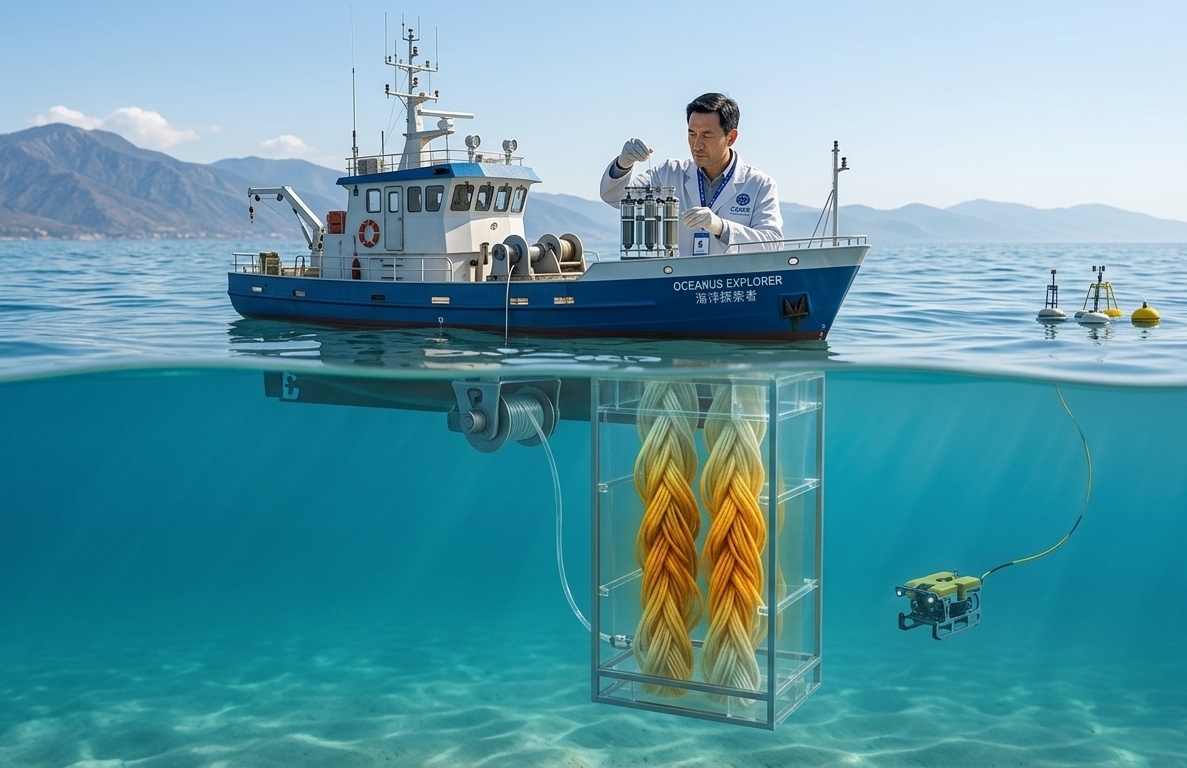
Chinese scientists have developed a new material that allows uranium to be extracted from seawater significantly more efficiently than existing technologies. The development, named PhosCage, is capable of exceeding the efficiency target established by American specialists by more than eight times, according to researchers.
The work of the team from the Chinese Academy of Sciences in Qingdao is reported by South China Morning Post citing publications by the scientists.
The new material is a spongy molecular structure with phosphate groups that act as chemical traps for uranium. During experiments, researchers were able to extract up to 50.4 mg of uranium per gram of adsorbent from natural seawater.
This figure exceeds by more than eight times the benchmark previously set by the U.S. Department of Energy — 6 mg of uranium per gram of material.
Later, scientists adapted the development for potential use in the ocean by converting the material into millimeter-sized spheres. In this form, it was able to capture 22.55 mg of uranium per gram and withstood seven cycles of reuse.
“
“This work opens a new approach to uranium extraction from seawater and lays the foundation for creating adsorbents capable of capturing more uranium and ultimately being used on a large scale,” said the Qingdao Institute of Bioenergy and Bioprocess Technology of the Chinese Academy of Sciences.
The Ocean as a Source of Nuclear Fuel
The development is particularly important for China, which is actively developing nuclear energy but remains dependent on uranium imports.
According to the World Nuclear Association, Chinese deposits produced approximately 1.6 thousand tons of uranium in 2024, while the country’s need for reactor operations was approximately 13 thousand tons.
Meanwhile, the oceans contain significantly more uranium than land deposits. It is estimated that about 4.5 billion tons of this element are found in seawater. For comparison, proven reserves on land are estimated at approximately 7.9 million tons.
However, uranium extraction from the ocean remains a complex technological challenge. One ton of seawater contains only about 3.3 mg of uranium, and other elements, particularly vanadium, interfere with its efficient separation.
American researchers from Oak Ridge and Pacific Northwest National Laboratories also spent many years developing similar technologies. By 2016, their materials reached a level of approximately 6 mg of uranium per gram of adsorbent, but the method proved too expensive compared to traditional mining, and after 2018 the program was largely discontinued.
Industrial Application Still Far Away
The work of the Chinese team was published in the scientific journals Journal of Hazardous Materials and Separation and Purification Technology. Researchers note that PhosCage is capable of selectively capturing uranium even in the presence of other metals, including vanadium.
Nevertheless, experts point out that the technology is still at the laboratory stage. Tests were conducted using systems through which seawater was passed, rather than directly in the open ocean, where conditions are significantly more complex.
Additionally, scientists have not yet assessed the economic efficiency of uranium production using the new material. The next stage will be scaling up the technology and reducing the cost of the process.
The race to create an efficient method for extracting uranium from the ocean continues amid growing demand for nuclear fuel. According to the U.S. Energy Information Administration, uranium concentrate production in the country reached 2.1 million pounds (approximately 950 kg) of U₃O₈ in 2025 — the highest level since 2017. Meanwhile, American nuclear power plants purchased approximately 46.9 million pounds of U₃O₈-equivalent in the same year. The main suppliers were Canada (32%), Kazakhstan (28%), and Australia (15%), while the share of American material was approximately 7%.
New technologies for extracting uranium from seawater could potentially change the global nuclear fuel market, but until an industrial extraction method emerges, ocean reserves remain more of a strategic resource for the future than a real energy source today.