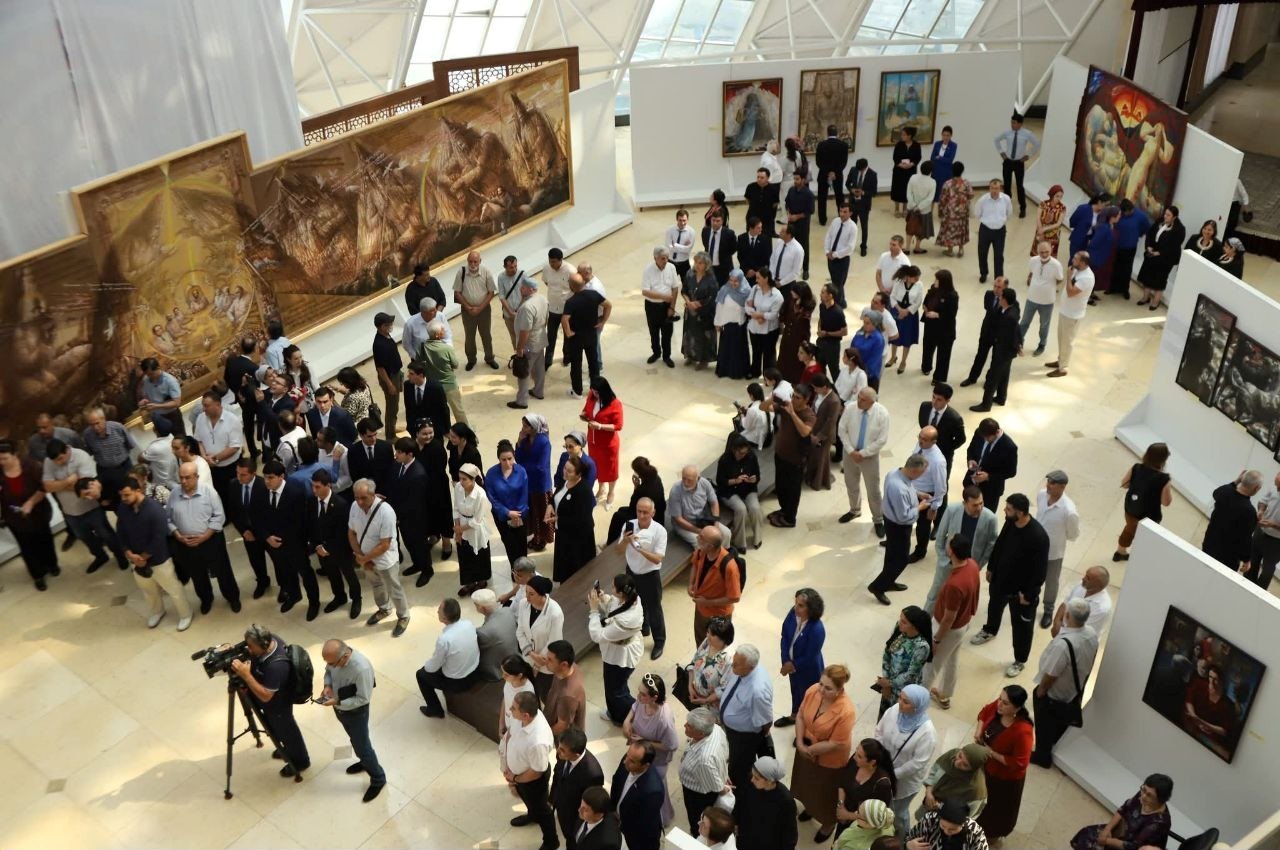
On September 2, a solemn presentation of the exhibition “Modarnoma” (“Ode to Mother”) by Sabzaali Sharif (Sabzali Sharifov), People’s Artist of the Republic, took place at the National Museum of Tajikistan.
The exposition is dedicated to two dates at once — the 35th anniversary of Tajikistan’s state independence and the 80th birthday of the master himself, which he celebrated in May of this year.
The exhibition features more than 30 unique works by the outstanding painter and laureate of the State Prize named after Abuabdullo Rudaki — both from the museum’s golden collection and from the author’s personal collection.
Official figures, colleagues in the field, and admirers of his work came to congratulate the jubilee artist. Among the honored guests were Minister of Culture Matlubajon Sattoriyon, Advisor to the Department of the Assistant to the President of RT on Social Development and Public Relations Muhiddin Panjshanbezoда, Director of the Agency for the Protection of Historical and Cultural Heritage Sherali Khodzazoda, Chairman of the Union of Artists Nargis Hamidova, Chairman of the Union of Writers Nizom Kosim, People’s Poetess of Tajikistan Gulrukshor Safieva, as well as renowned figures in the arts — Malika Kalontarova, Tamara Kataeva, Larisa Dodkhudoeva, Asliddin Nizomi, Manzura Uljabaeva, Rector of the State Institute of Fine Arts and Design of Tajikistan Sirojiddin Dzhurakhonzoda, relatives and close friends of the master.
Each of the speakers emphasized the invaluable contribution of Sabzaali Sharifov to the development of national fine and monumental-decorative art, as well as his special attitude toward the image of mother, which occupies a central place in his work.
The Image of Mother and the Philosophy of Color
Sevara Ganibaeva, a lecturer in art history at the Institute of Fine Arts and Design of Tajikistan and art historian, told a correspondent of “Asia-Plus” about key symbols and helped reveal the philosophical meanings hidden in the artist’s canvases.
“
“Sabzaali Sharif is a master who managed to reflect the history of the Tajik people, its traditions, experiences, and trials of the civil war period through the image of mother. The image of mother is sacred to him. It was his mother who recognized his talent in him, sent him to study, and opened the door to art. This theme is revealed most vividly and tenderly in the painting ‘Angel’ (‘Farishta’), presented in the exhibition,” noted Sevara Ganibaeva.
According to the art historian, the dynamics of the master’s creative growth can be traced through his jubilee projects:
- “Black and White” for the artist’s 50th birthday — an exhibition that reflected the difficult years of civil war, hardship, and the drama of the era.
- Jubilee for the 75th birthday — a large-scale conference at GIIID, where not only paintings were demonstrated, but also graphics, a portrait series, and design concepts.
- The current “Modarnoma” exhibition for the artist’s 80th birthday — a deep retrospective that for the first time presented to the public even sketches of famous monumental works.
Sabzaali Sharif often creates portraits of close friends, conveying not only external resemblance but also the inner essence of a person. For example, in the portrait of art historian Lutfia, the artist revealed her professional path and character through subtle symbolism, notes the art historian.
A separate page in the master’s biography is monumental painting and mosaic.
The artist’s works adorn Kulob and Dushanbe. The famous mosaic stela behind the Rudaki monument in the capital appeared in 2012–2013. When artists from Russia refused this extremely complex project, Sabzaali Sharifov, together with his students, brought it to life in just 27 days — literally using the remnants of smalt that had been preserved by other masters.
The painted triptych “From Generation to Generation” is boldly called by art historians one of the masterpieces of contemporary Tajik art. It intertwines world and national history: images of great poets, historical figures, a self-portrait of the artist himself, and key symbols — an ancient plane tree and a rainbow.
“
“In the master’s works, one can clearly see the transition from the Soviet era to the period of independence,” emphasizes Sevara Ganibaeva. “As the artist himself said: ‘In the Soviet period, we were in the trenches of socialist realism. We could not write on free themes, but we managed to depict the history of the people through symbolism, not Soviet ideology.’ Starting from 2015, the color palette of his canvases became significantly brighter and lighter, a free, sweeping painting style appeared without academic rigidity. Our task as viewers is to learn to read these symbols.”
Sabzaali Murodzoда Sharif (Sabzali Sharifov) was born on May 9, 1946, in Farkhor District of Khatlon Region in the family of a craftsman. In 1967, he graduated from the Republican Art School named after M. Olimov in Dushanbe, and in 1972 — from the Tashkent Theater and Art Institute named after A. N. Ostrovsky with a specialty in “artist of monumental art.”
“AP” Dossier
From 1972–1979, he taught at the Republican Art School named after M. Olimov. He devoted more than 55 years to creative service. Member of the Union of Artists of Tajikistan, honorary member of the Academy of Architecture and Construction of RT.
The master’s works were exhibited at international exhibitions in Moscow, Budapest, Nicosia, Kabul, Warsaw, and Berlin.