In Tajikistan, the number of those who openly and consistently defend the rights of others can be counted on one’s fingers. In conditions where hundreds of public organizations have been eliminated and self-censorship in society is intensifying, the activities of this small number of activists acquire even greater significance for society.
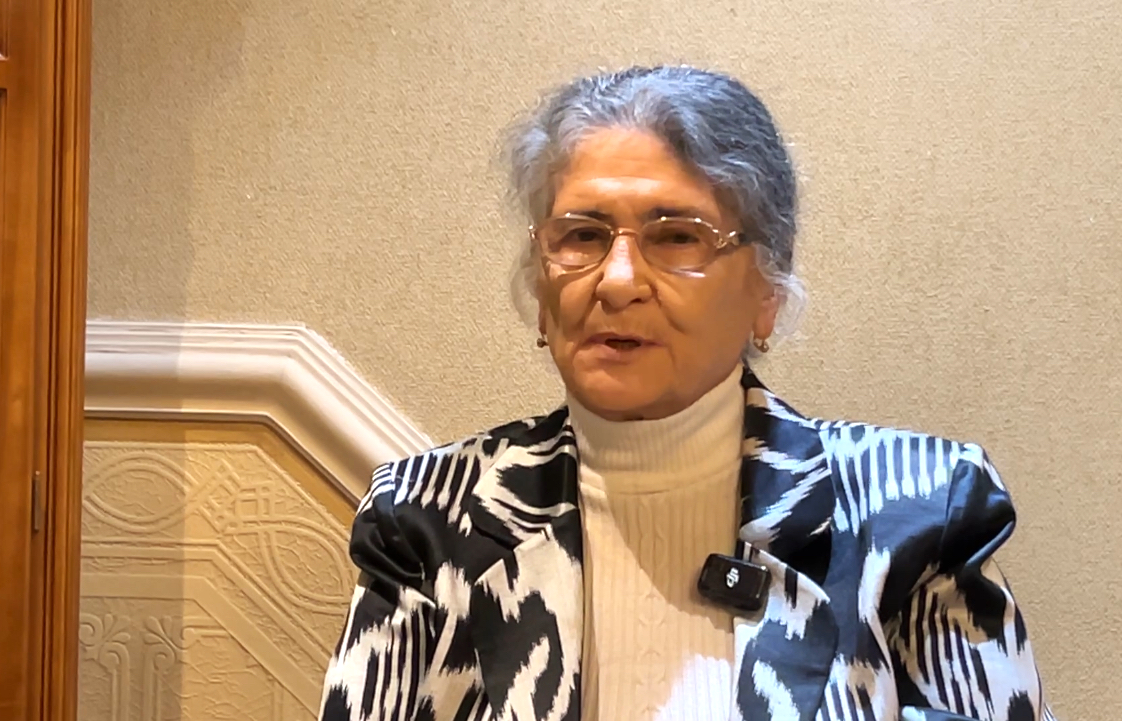
Who is a human rights defender, why does society need them, and how much is the role of these people felt today? We discussed this topic with Oynikhal Bobonazerova — a renowned lawyer, human rights defender, civil society activist, and the only Tajik woman to receive the US International Award “Courageous Woman.”
Who is a human rights defender?
— Let’s start our conversation with the very concept. Can you clearly explain who a human rights defender is?
— These are people who, in addition to their own problems, perceive the pain of each person and the pain of society as their own.
Anyone can be a human rights defender. For example, Andrei Sakharov was a physicist. There are many personalities who were chemists, physicists, or mathematicians, but were primarily engaged in human rights issues. This is completely unrelated to one’s profession.
— However, in society, when people say “human rights defender,” they primarily imagine lawyers and attorneys. How accurate is such a perception?
— This opinion is incorrect. In Central Asia, those who engaged in human rights protection were mostly lawyers and attorneys, and such a perception became firmly entrenched in public consciousness. But I repeat once more: one can cite thousands of examples of people who were neither lawyers nor attorneys.
Attorneys, of course, also defend human rights, but to a certain extent they have fear: when they say something, how will the authorities take it? Because the authorities can revoke their license and prohibit their activities. Therefore, I think that profession should not play any role here.
— That is, you mean to say that not all attorneys are human rights defenders?
— Of course. For example, when people are detained and don’t have the means to hire an attorney, the state itself appoints a defender for them. It’s clear that such attorneys in many cases are forced to take many circumstances into account.
Furthermore, there are cases in which attorneys must sign an obligation regarding non-disclosure of state secrets and have no right to speak about them. Those who specifically engage in human rights protection are not as afraid of such things.
There is also another aspect: attorneys must undergo certification, that is, the Ministry of Justice periodically certifies them. Therefore, to a certain extent, self-censorship arises for them, and that is precisely why not all attorneys can be human rights defenders.
“The power of journalists is even greater than the power of nuclear weapons”
— Can journalists be human rights defenders?
— Of course. One of the most important institutions of any society is precisely journalists. They can help even more than human rights defenders themselves, because they have a pen, they work in newspapers, on radio and television, and when they raise any problem, it becomes known to the entire society.
“
I don’t remember who exactly said that the power of journalists is even greater than the power of nuclear weapons. If society is truly liberal and democratic. Even in theocratic societies and countries with strict regimes, we see groups of journalists who raise serious issues, although this is very dangerous for them.
— That is, journalists also bear the burden of protecting human rights?
— Yes, that’s true. When they publish any material and concern arises in society, society supports them, and the authorities are forced to verify these facts and figures. For example, journalists have repeatedly written about the fact that in Tajikistan, physical and psychological pressure is applied to persons in places of detention.
The authorities paid attention to this to a certain extent, and several people who worked in various positions and were involved in such actions were dismissed, and some were even brought to court. That is, journalists occupy an extremely important place in society.
— A similar situation occurred with beatings during military service…
“
— That’s also true. It is precisely due to the influence of journalists that torture in military units has now been significantly reduced, and control has become more serious. Furthermore, they constantly write about how several people were detained in such-and-such a place, several were forcibly sent to service, and even several sick people were drafted into the army. And after the publication of such news and articles, some of them were even released from military service.
— But there is also a contradiction: when human rights are violated, society itself is afraid that this problem will receive publicity in the media. How can this obstacle be overcome and is it possible to protect violated rights without publicity?
— Indeed, fear and anxiety still exist in our society. People don’t even dare to like a critical post on social media. For society to adapt to this process and realize that openness serves not only the interests of one person but also the interests of the state itself, time is needed.
When journalists write about any shortcoming, this first and foremost benefits the state. Because the state can learn about problems through these articles without additional expenditure of time and resources and without special searching, and can eliminate them.
“
In free and democratic countries, journalists’ publications are taken very seriously, and the importance of their word and what they write is placed first. Even the leaders of democratic governments are very afraid of journalists. Therefore, in such transparent societies, journalists are considered the main and influential force, and this is a very positive phenomenon.
“The More Organizations, the Greater the Benefit for the State”
— Another similar question: in recent years, more than 2,000 public organizations have been closed in Tajikistan, including those engaged in human rights protection. Does this cause harm to human rights protection?
— Undoubtedly. First, most of these organizations are not funded from the state budget, and the state does not provide them with projects; they independently attract grants or funding from international organizations and other structures.
Second, their financial activities are transparent: once or twice a year they submit reports to the Ministry of Justice, and the state always has the opportunity to verify the order and directions of spending these funds.
“
Therefore, in my view, the more such public organizations there are, the more beneficial this is for both society and the state itself. The state should support their activities. If it cannot help, then at least it should not hinder their activities.
— What specifically can public organizations do to protect human rights?
— First and foremost, such organizations engage in protecting the rights of needy and low-income segments of society. By attracting their own lawyers, they can represent and defend the interests of citizens who have faced violations of their rights in court proceedings.
In particular, their assistance is quite noticeable in matters of alimony. Given the large number of our labor migrants in Russia, organizations maintain contact with societies, find persons evading alimony payments. Then they appeal to the appropriate authorities so that when these people apply for a new passport or any other document, they are not issued documents until the alimony debt is paid off.
Furthermore, such organizations conclude cooperation agreements with experienced structures and implement projects in the social and agricultural spheres: create small farms, grow agricultural products, and distribute the harvest among schools and low-income families.
Thus, public organizations can provide society with direct and effective assistance and support in various legal, social, and economic directions.
Can human rights defenders influence state policy?
— Can the activities of human rights defenders influence the policy of the state?
— This question first and foremost depends on the political system of the state. If the state’s strategy is oriented toward the individual, it places human rights and freedoms first, and then the interests of the state. However, in Central Asian countries, in many cases, priority is given first to the interests of the state, and only then to the interests of the individual.
“
In societies where the individual has high value, changes and reforms most often begin “from below,” that is, from society itself. People support the appeals and initiatives of human rights defenders, and the state is forced to change its attitude or policy. In any case, all of this is related to the structure of state governance and the level of democracy.
— Were there cases in Tajikistan when the activities of human rights defenders influenced state policy?
— Yes, for example, in matters of combating torture and conditions of detention in prisons. Previously, when there were many complaints about physical and psychological pressure and the use of electric shock against detainees, the authorities categorically denied this and called it a lie.
“
However, in recent years, state policy in this direction has changed to a certain extent: now every case of torture is investigated, and some responsible persons involved in such actions have been held accountable.
On the other hand, previously, representatives of civil society were not allowed into prisons at all. I myself approached Izzatulo Sharifov, who at that time headed the Penitentiary Administration, and asked him to allow visits to places of detention. He asked which institution I wanted to visit. I said: “To the prison with the strictest regime.” He allowed it. In the first hours, I met with Makhadruzzi Iskandarov and several other people.
Then I went to the Kurgan-Tyube prison (now Bokhtar), where there was an extremely strict regime and where no representative of non-governmental organizations had been allowed before that time. I was allowed to enter, and I met with several people, including the brother of Gaffar Mirzoyev and prisoners who had once escaped from prison, and familiarized myself with their situation.
I was given unlimited permission to visit the women’s colony in Nurek. I often brought books and necessary items there. Once, one of the imprisoned women quietly told me: “All the things you bring are taken from us after you leave.”
I said goodbye to them, left, and half an hour later unexpectedly returned. And I saw that indeed everything I had brought was taken from the women. When I raised this issue with the prison director and complained, several responsible employees were dismissed.
That is, it is certainly possible to influence processes and correct the situation.
“Many resorted to self-censorship”
— What is the current situation? Have human rights defenders retained the same role and influence they had even 10 years ago?
— I think not to the same extent. Many organizations were eliminated, and most activists and representatives of society resorted to self-censorship. The detention and arrest of journalists and civil society activists during this period also negatively affected public sentiment and the activities of human rights defenders.
— What needs to be done to change this situation and improve the activities of human rights defenders?
— This process requires time. Today, the situation with human rights has become complicated not only in Tajikistan or Central Asia, but throughout the world.
If previously America and its judicial system were cited as an example, today, unfortunately, many cases of human rights violations are observed there as well.
“
Therefore, many totalitarian countries are taking advantage of this global situation and allowing themselves to act at their own discretion. Until the developed nations of the world restore their former positions and authority in this sphere, it will be extremely difficult to change the situation.
— Can every ordinary citizen also be a human rights defender?
— Of course. This question is in no way related to a person’s status or position. I remember my friend Valeria Novodvorskaya, who was one of the true and consistent defenders of human rights in Russia and the world, once said words that I will never forget — “If you want to be a human rights defender, you should not have a family and children, because the state will definitely take revenge on you through them.”
I asked: “Is that why you never married?” She answered: “Yes, that’s exactly why!”
At the same time, Novodvorskaya came from a very respected and wealthy family and could have lived like royalty.
I spoke with her twice, but her words always ring in my ears.
When an ordinary citizen or even a lawyer or journalist wants to engage in this activity, first and foremost they think about the future of their family, parents, and children. Whether we like it or not, awareness of this influences a person’s decision-making.
— That is, to become a human rights defender, one must be prepared to sacrifice oneself and, if necessary, something else?
— Yes. And not everyone is capable of enduring such sacrifice.