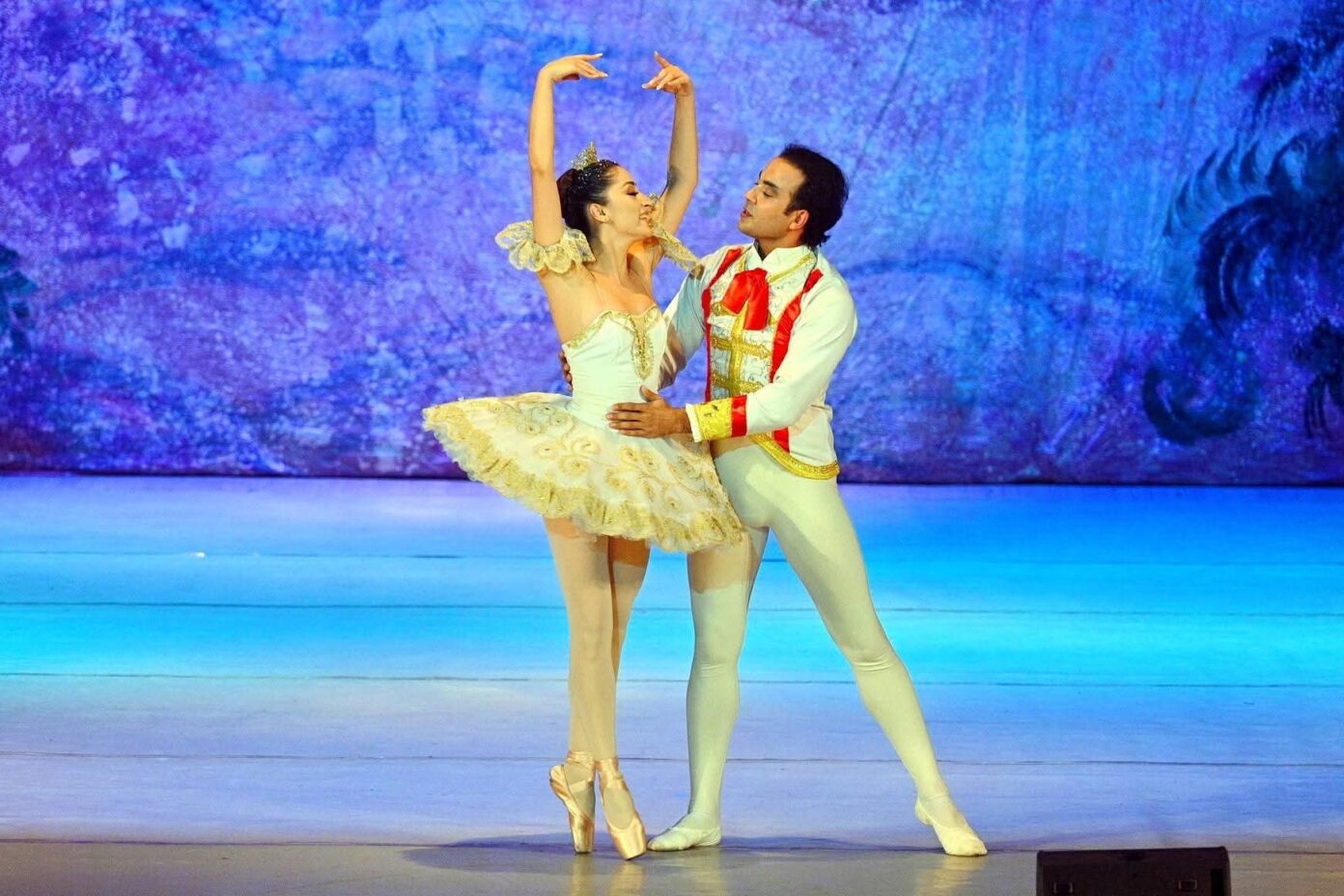
Ballet or dance for men in traditional societies, such as Tajikistan, has always faced certain challenges. Although during the Soviet era many men pursued this profession, achieved success, and left their mark on the history of the country’s theater, industry specialists warn: if more attention is not paid to this direction, Tajik ballet could be left without male artists.
When Akbara Khodzhamberdieva’s mother brought him from a small village in Khatlon Province to study at the Maliki Sobiroeva Choreography College, he didn’t even know what ballet was.
“
“I agreed with my parents’ decision only to study in Dushanbe. But over time I fell in love with ballet and was ready to overcome all difficulties. For example, when people around me found out that I was studying at a choreography college, they mocked me. That’s why my family thought that sooner or later I would quit ballet. But that didn’t happen,” he says.
Akbar Khodzhamberdieva has been working as an artist at the Sadriddin Aini State Academic Opera and Ballet Theater for eight years now. According to him, to understand this direction of art and enter it, one needs a special worldview and understanding.
His colleague Muhammad Azimzoda also works at the theater and teaches the art of ballet to boys at the Choreography College. According to him, society’s attitude toward ballet has barely changed, and this negatively affects the theater’s work.
“
“There are many performances that we cannot show to audiences due to a shortage of men. For example, ‘La Bayadère,’ ‘Swan Lake,’ and ‘Spartacus,’ where the main roles are performed by men. Sometimes we have to cut the performance. It also happens that one man performs the roles of two or three characters: after his role, he goes backstage, changes clothes, and returns to the stage in a different role,” says Azimzoda.
According to him, sometimes students lose motivation due to ridicule from those around them and begin to think about leaving ballet.
“Last year I noticed that one of my very talented students stopped studying with the same enthusiasm. After class, I asked him about the reason. It turned out that a neighbor mockingly asked him: ‘Are you going to become a ballerina?’
I supported him and explained that he shouldn’t give up his favorite activity because of what people around him say. The next day I saw that he was studying with interest again. I understand my students’ pain well because I myself heard mockery more than once at the beginning of my journey,” says Azimzoda.
According to him, such cases are especially painful because ballet requires enormous effort. To master the nuances of this art, he himself spent at least eight years away from his family, studying at the Perm Choreography School in Russia.
“
“Ballet requires great and constant work. For a performance to go on stage, an artist must rehearse daily for two months,” he emphasizes.
Akbar Khodzhamberdieva notes that in other countries, the attitude toward ballet and its artists is completely different. There, men are not ridiculed for choosing a profession that is traditionally considered feminine. On the contrary, people are surprised why he chose such a difficult profession.
“In our country, it’s not just ballet—there are many professions that are traditionally considered masculine or feminine. That’s why parents don’t allow their children to pursue what they really like,” says Khodzhamberdieva.
According to Muhammad Azimzoda, in order for Tajik ballet not to depend on foreign artists and not to be left without male dancers, it is necessary to create worthy conditions for them and attract teenagers from remote cities and districts of the country to this art.
…Currently, the Sadriddin Aini Opera and Ballet Theater employs 13 male artists, three of whom are invited from Japan and Egypt.
At the same time, Tajik ballet has repeatedly proven that it is capable of creating real stars among men.
Examples include renowned artists Gaffar Valamatзoda, Muzaffar Burkhonov, Alexander Bakhman, Kurbon Kholov, Farrukh Ruzimatov, and Valery Aliboev, who dedicated their lives to ballet and achieved significant success.