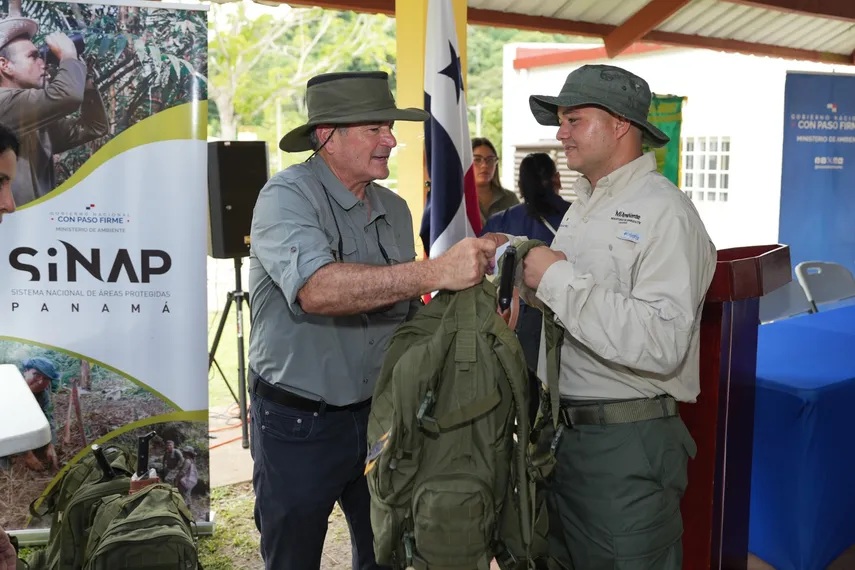
Panama’s Ministry of the Environment (MiAmbiente) graduated a new generation of park rangers. Six women and 30 men became the new guardians of the country’s protected areas, demonstrating a strong commitment to service and a love for nature, in the sixteenth graduating class of park rangers. The new park rangers will be assigned to ecologically important protected areas within the provinces of Coclé, Colón, Chiriquí, Herrera, Los Santos, and Panamá Oeste.
In these territories, they will be the first line of defense for our ecosystems, ensuring their conservation, sustainable management, and compliance with our environmental laws. The National Government is promoting institutional strengthening through the training of highly qualified personnel. This strategy aims to ensure the efficient management of protected areas, reaffirming the State’s commitment to the comprehensive training of new talent dedicated to the monitoring and conservation of our natural heritage.
Institutional Collaboration.
The training of this new generation of park rangers was made possible thanks to the inter-institutional collaboration between MiAmbiente, the National Institute of Professional Training and Human Development (Inadeh) and the Environmental, Rural and Tourist Police Service, whose knowledge and experience contributed to the development of a comprehensive and excellent quality training program. The new park rangers were trained in ecosystem and biodiversity conservation, protected area management, and monitoring and enforcement of environmental regulations.
They also have knowledge of patrolling techniques in diverse environments, first aid, wilderness survival, and expert use of navigation tools such as GPS and compasses. The graduation ceremony was an opportune moment to acknowledge the support provided by experts in protected area management from the University of Colorado, in the United States, in the training process of the new park rangers, chiefs and coordinators of protected areas in our country.
Continuing Education.
In addition, through the National System of Protected Areas (SINAP), the Ministry of Environment (MiAmbiente) is implementing a continuous training strategy aimed at strengthening the technical and operational capabilities of its personnel. Within this framework, during 2026 more than 40 park rangers received specialized training in critical areas. This training included courses in boat handling and boarding techniques in conjunction with the National Air and Naval Service (SENAN); environmental protection with the National Border Service (Senafront); protected area management through the Center for Protected Area Management (CPAM) at Colorado State University; and specialized diving funded by the Coiba Fund.
Under the current administration, the number of park rangers increased from 140 to more than 530, with over 350 new agents graduating in fifteen classes, thus expanding the capacity to monitor and respond to threats such as deforestation, illegal hunting and fishing, pollution and other environmental offenses. Panama currently has 124 protected areas, covering approximately 33% of its land area and 54% of its territorial waters. We have 19 national parks, including Darién, Coiba, Soberanía, Chagres, and Volcán Barú. These areas protect high-value ecosystems and, according to their characteristics and regulations, allow for activities such as scientific research, environmental education, recreation, and sustainable tourism.
Audio transcript
Your browser does not support the audio element.
00:00
/
03:52