Exactly five years ago, on August 12th, a group of ten Tajik rescuers from the Emergency Situations Committee set out to search for the body of pilot Sergey Tyutin, who died in a helicopter crash near the Fedchenko Glacier in early August 2021. The search and rescue operation lasted five days, during which the rescuers had to overcome a dangerous route.
The team was led by Shabon Yaftaliev, an experienced rescuer with 20 years of experience.
Usually rescuers don’t like to give interviews, considering such operations part of their work. Shabon Yaftaliev turned out to be a very modest and unusually easy-to-talk-to person. Nevertheless, he agreed to tell about how the operation proceeded, what was most difficult along the way, and what he himself feared most.
Hostage to Altitude
After the Mi-8 helicopter crashed in the Abdukaghor Gorge near the Fedchenko Glacier, the body of pilot Sergey Tyutin remained at an altitude of 5,300 meters for more than 10 days.
A group of 10 rescuers from the Khorog team was formed for the evacuation, selected from the rapid response team of the Emergency Situations and Civil Defense Administration in GBAO.
The entire complexity of the operation came down to the altitude: there was no pilot with clearance to fly above 5,000 meters. There are only a handful of such pilots in the country, and one of them was Sergey himself.
Then the Emergency Situations Administration decided to use an alternative, but not entirely safe option: fly to an altitude of 4,050 meters and continue climbing on foot.
The group was led by Shabon Yaftaliev, an experienced rescuer with 20 years of experience. Once, in 2012, he had already participated in an operation to evacuate a mountaineer from an altitude of 5,300 meters. Back then, Sergey Tyutin picked them up in his own helicopter.
Dangerous Crossing
So, on August 12th, a border service helicopter delivered the rescuers to the base camp located at an altitude of 4,050 meters. It was an old mountaineering site from which many expeditions had started.
“
“We spent one day on preparatory activities: the guys needed acclimatization and adaptation,” Shabon recalls. “We also had to scout and examine the terrain and compare it with photographs. In preparing for the operation, I first consulted with Volodya Khabibulin, who has been in mountain tourism for 30 years and knows these places firsthand. We moved along the entire route according to his recommendations and photographs.”
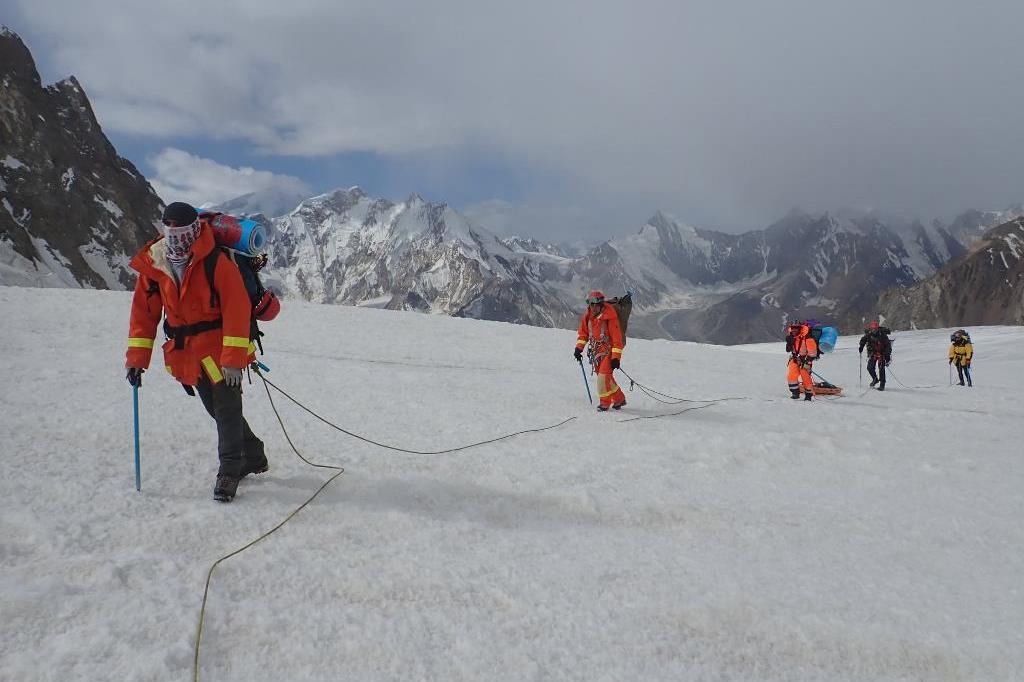
The next morning, the group began climbing to the next base camp. Ahead of them lay the 12-kilometer Abdukaghor Glacier.
The path was difficult and dangerous. The rescuers overcame rocky ice peaks; steep, difficult slopes; enormous accumulations of ice blocks and glacier crevasses. To ensure safety while moving, they traveled in roped teams.
One of the most serious obstacles on the way turned out to be deep glacier crevasses. Some were so long and wide that it was impossible to go around them. Turning back was no longer an option: each of the rescuers understood the importance of this rescue operation. After all, up there lay someone who had risked his own life many times to save others.
“Usually, if the crevasse is not so wide, the bravest and lightest rescuer jumps across it with insurance, secures an ice axe with a rope to some support, and then organizes a rope traverse,” Shabon explains. “But here the crevasse was almost 4 meters wide and 20 meters deep—just a huge abyss. So there was only one very risky option left: throw an ice axe with a rope to the opposite side and try to hook it securely on the crevasse or a rock. We managed to do it on the third try.”
Normally in such cases, rescuers are supposed to have a light titanium collapsible ladder. In this case, they were taking a huge risk, since relying on the rope being securely hooked was dangerous. But the crossing was completed successfully.
Shabon recalls an incident from his practice when, using the same method and moving along a rope, he managed to reach a gas tanker that had fallen into the Zeravshan River and extract people from the cab.
After reaching the flat part of the glacier at an altitude of 4,700 meters, a decision was made to set up camp and settle in for the night. They needed to acclimatize, and fatigue was taking its toll.
There were 400 meters left to the Abdukaghor Pass.
Father’s Example and His Blessing
Over his twenty-year career, Shabon could tell many stories of times when his life hung by a thread from death. One such incident occurred in 2017. Then he had to dive to a depth of 9 meters to pull people out of a car.
“
“Back then, at depth, I was being swept away by a strong current, and as a result, I caught my safety rope on a rock,” the man recalls. “While trying to free myself, I began to understand that I was running out of oxygen. Without thinking twice, I cut the rope and managed to swim to the surface. After resting a bit, I dove again and completed the operation.”
Shabon has his own ritual: before each such operation, he calls his father. The man is convinced that his father’s prayers protect him, since his father once showed him an example of courage and bravery.
“
“Once my father saved a girl who had fallen into the Panj River. He was even awarded a medal ‘For Saving the Drowning,’” Shabon says. “I was very proud of my father. So when, after the army, I was offered to try myself as a rescuer, I gladly agreed.”
The Return Journey
At the pass, the rescuers were awaited by another “surprise”: the weather suddenly deteriorated, which is typical at high altitudes.
“
“Suddenly the wind picked up, and we were surrounded by a snowstorm. It became difficult to navigate,” Shabon recalls. “You walk and can’t see anything around you. At that moment, I became a bit scared. But I wasn’t afraid for myself, but for the team. I had already been through this before; I was more worried about the guys. From my experience, I know that disorientation is one of the main dangers of getting lost in sudden fog in the mountains. In such cases, only navigation systems can save you.”
Finally, in the distance, the overturned helicopter appeared. The snow haze still had not lifted. The body of Sergey Tyutin, covered with a jacket, lay 10-15 meters from the fuselage. “This sight made me feel uneasy,” Shabon recalls. “My imagination painted a tragic film of the event: the helicopter falling, fear and panic, evacuation of the wounded.”
After loading the pilot’s body into special sleds (akya), the rescuers set off on the return journey, which took a full 3 days. The return trip turned out to be much more difficult because of the load.
“Particularly difficult was the path along the end of the glacier tongue, which was covered with a continuous moraine cover. Mountaineers know what that is. A kind of mixture of giant blocks, boulders, clay, gravel. Because of the uneven surface, the sleds couldn’t be pulled on the ground; we had to carry them by hand,” Shabon says. “The same was true during the last six hours of descent to the camp. The ground was already free of ice, rocky, so we took turns carrying the load one after another.”
The rescue operation was successfully completed. On August 19th, Sergey Tyutin was buried in Dushanbe at the Russian cemetery.
Could the Tragedy Have Been Avoided?
The Mi-8 helicopter piloted by experienced pilot Sergey Tyutin was engaged to provide assistance to a group of Russian tourists from Moscow State University, one of whom fell off a snow cornice while making a dangerous traverse of the ridge from the main peak of Saint-Exupéry at an altitude of 6,026 meters.
This route is considered the sixth, highest category of difficulty in the Central Pamir.
The body of the fallen tourist was never found, just as pilot Sergey Tyutin did not survive.
Could these two tragedies have been avoided and the deaths of people prevented? “Asia-Plus” asked this question to Vladimir Khabibulin, a qualified specialist in mountain tourism with 30 years of experience on Pamir expeditions of the fifth and sixth categories of difficulty.
“
“I see several reasons that led to tragic consequences. First, the Russian tourists did not immediately report that their companion had fallen off a cliff. The SOS signal was only given two days later. Because of this, assistance was planned hastily,” he says. “Second, the tourists were not registered with the Emergency Situations Committee, and this despite the fact that they were undertaking a dangerous route. This important procedure is somehow being ignored today. With us it’s voluntary, although absolutely free. But this needs to be done for the safety of the tourists themselves.
And third, the tour operator himself, who was responsible for receiving the tourists, also did not inform the Emergency Situations Committee about the route and control points of the group’s movement.”
When people go on difficult routes at altitudes of 6,000+, it is important to follow the rules outlined below, Vladimir explains.
Unfortunately, the group of tourists led by Denis Osin did not use these rules.
1. Tourists must have permit documents from their route and qualification commissions, which must indicate that their experience and current mountain conditions allow them to undertake such routes;
2. Tourists must leave a detailed map of the route and report the situation to the Emergency Situations Committee duty officer every day;
3. In case of an emergency, immediately report to the Emergency Situations Committee so they have time to prepare and think everything through.
“If you remember, from July 18-28, the city experienced unprecedented heat: in the mountains, intensive snow melting began, and extreme avalanche danger arose on snowy slopes,” Vladimir continues. “If the Russian tourists had been in daily contact with the Emergency Situations Committee, they would have received an unfavorable forecast and would not have climbed the avalanche-prone ridge. This is what another group of Moscow State University tourists did, who canceled their ascent of Revolution Peak around the same time after receiving the sad message from Osin’s group.”
From the Editorial Board
We very much hope that in light of tourism development in Tajikistan, such cases will serve as a lesson for a more serious approach to the equipment, training, and status of rescuers in general.
Furthermore, in order not to expose rescuers and pilots to unjustified risk, it is important to tighten requirements for tour operators, who, as it turned out, currently do not interact with the Emergency Situations Committee at the planning stages of their activities.